














How an Insurance Agency Automated Caller Verification in Six Days with Balto

The Challenge: Every conversation started with the same verification steps
An insurance agency sells and services home insurance policies, and its contact center takes thousands of inbound calls a month from policyholders. Most are short and specific: check a premium, confirm coverage, request a document.
Almost every one of those calls opened the same way. Find the policyholder, verify their identity, confirm the address on file. Only then could the actual conversation begin.
Those steps are necessary and they are regulated. They are also identical every time, which is what made them costly: minutes of a licensed agent's day, repeated thousands of times a month, before anyone got to the reason the policyholder called.
That is the part the agency asked Balto to take.
The Solution: An AI agent that verifies and routes, then hands off clean
A policyholder dials the agency's main number and Balto's AI agent, Togo, answers.
It recognizes the caller from the number they are dialing from and finds their account. It offers to send a verification code by text or by email, then waits while they read it back. Once the caller is verified, it confirms the property address on the policy and the mailing address on file. Then it hands the call to a person.
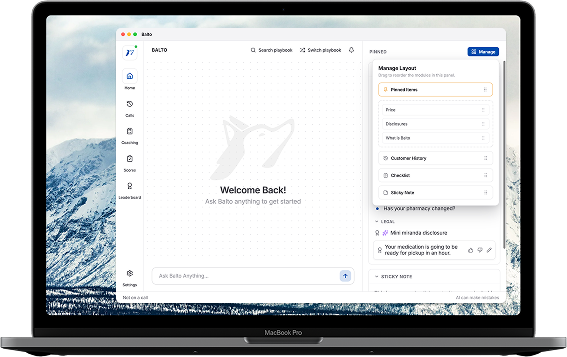
What makes the handoff work is what arrives with it. The frontline agent's screen already shows who is calling, that Togo verified them, how they were verified, and how many attempts it took. Nothing gets re-asked. The frontline agent picks up a conversation that is already past the paperwork.
One point worth being precise about: this agent is built to verify and route, not to resolve calls on its own. Around 92% of conversations end with a handoff to a person, and that is the design working rather than a shortfall. The outcome is that every caller reaches the right person with their details already captured.
The Results: 7,213 calls and full inbound volume within six days
The agency ran a staged rollout and kept the dial in their own hands. They chose what share of live calls went to the agent, and could set it back to zero instantly.
- Wednesday 5 August: the release went to production in the evening.
- Thursday 6 August, first day live: phone lines opened at 8:00 AM Eastern with 10% of calls routed to the agent, a bridge line open all day, and Balto monitoring alongside the agency's team. 116 calls taken. A handful of small issues were logged, none of them stopped a call, and no show-stoppers came up all day.
- Monday 10 August: 50% of inbound calls.
- Wednesday 12 August: 100%.
Six days from first live call to full volume. The agency's own launch plan had allowed for raising the percentage "over the next few weeks." On the implementation call the morning of the 12th, Balto opened by asking how 50% was going, and the agency answered that they had been at 100% for the last ninety minutes.
From 5 August to 21 August:
- 7,213 calls taken by the AI agent
- 1 minute 24 seconds average call length
- 100% of the agency's inbound calls
- 91.6% of scored calls passing the agency's quality scorecard
- 0.2% of calls saw an account lookup take longer than five seconds
Every call is scored automatically against a quality scorecard built for this agent, so a problem surfaces within hours instead of at the end of a month. The agency's own team, listening to live calls in launch week, described callers "going straight through" in "under two minutes."
The agency's Product Owner emailed the Balto team on the evening of the first day live:
"I wanted to take a moment to say thank you for everything you did to make today's first day of live production calls such a success. Your team has been hands-on every step of the way, and it showed. With calls now live, everything ran smoothly with minimal issues, and that's a direct result of the effort, responsiveness, and attention to detail you all brought to today. When an issue did come up, you were quick to respond and jump in, which gave us a lot of confidence throughout the day."
A week later, after reviewing the release, she added: "I think it was a great release." The agency's VP of Customer Support, on the same call: "Thank you so much for a wonderful release. Phenomenal."
The Impact: A launch that turned into a request to expand
On the first day live, both teams sat on the same call for the entire working day, from the moment the phone lines opened until the contact center closed. Balto's team is spread across Serbia and the US, so they covered the day in shifts: the Belgrade engineers through the European day, the US team through the American one. The agency had their own people on throughout.
They watched calls as they happened. When a call came in, someone said so. When it ended, someone said how it went and whether the agent had done what it was built to do. The agency could hear their own contact center working, call by call, in real time, rather than reading about it in a report the following week. When something did go wrong, a person already on the line fixed it in minutes instead of filing a ticket for the next day.
That is the part that carried. A launch is the moment a customer finds out whether they were right to trust a vendor, and watching it go well alongside the people who built it is how confidence actually gets established.
Verification and address confirmation are one capability out of seven that the agency has asked Balto to build. Six more are in progress.
The launch also opened a door nobody was knocking on. The agency is part of a wider group, and once leadership saw the rollout run without a show-stopper and hold up at full volume, they asked about bringing the agent to a sister company. The agency's VP of Customer Support relayed it on the implementation call: the group's leader is "very, very, very excited to get this rolled out to [the sister company] as well. Like ASAP." The agency's own leadership added, "we will be expanding here. We do want to expand it to the [sister company] side."
The measure of a launch is not whether it worked on day one. It is whether the customer wants more of it three weeks later. As the agency's VP of Customer Support put it: "as we broaden the capabilities of the bot, I definitely want more people using it."


