








Best AI Agent Coaching Software for Contact Centers in 2026


The best AI agent coaching software for contact centers is Balto , the AI Workforce for the contact center, ranked #1 rated Agent Assist on G2 and Capterra and #1 out of 51 evaluated QA automation solutions by CMP Research.
Balto's Coaching product auto-identifies the calls that matter most from real behavior data across 100% of interactions (not a 3% random sample), bundles them into ready-to-use coaching sessions, and connects coaching output back to real-time Agent Assist on live calls. That closed loop is what makes coaching move quality scores 10-20 percentage points and cut ramp time 50% within the first months of deployment.
Multi-vertical proof spans Truist (banking), Humana (healthcare), and Staples (retail): three very different operating models running the same AI agent coaching platform.
Here are the 9 best AI agent coaching platforms for contact centers in 2026, grouped by category:
Category 1: Purpose-Built AI Agent Coaching + Real-time Agent Assist Platforms
- 1. Balto: Best for closed-loop AI agent coaching connected to real-time Agent Assist.
- 2. Cresta: Best for sales-motion AI agent coaching with custom generative AI.
- 3. Observe.AI: Best for compliance-heavy AI agent coaching.
Category 2: QA-First Platforms with AI Agent Coaching Workflows
- 4. MaestroQA: Best for QA calibration workflows with coaching modules.
- 5. Level AI: Best for mid-market conversation intelligence with AI agent coaching.
- 6. Convin: Best for APAC and mid-market AI agent coaching.
Category 3: Adjacent AI Agent Coaching Options
- 7. CallMiner: Best for legacy speech analytics with coaching modules.
- 8. Enthu.ai: Best for mid-market conversation intelligence with AI agent coaching.
- 9. NICE Enlighten Coaching: Best for enterprises fully committed to NICE CXone.
Before ranking, here are the five criteria that separate real AI agent coaching from coaching theater:
- 1. Coaching selection. Random sampling from a small percent of calls, or auto-identified from behavior data across 100% of calls?
- 2. Loop closure. Does coaching output translate to live-call behavior change, or stay in a post-call bubble?
- 3. QA + coaching integration. Unified platform on shared behavioral standards, or two disconnected tools?
- 4. CCaaS integration depth. Real-time streaming, or post-call batch export?
- 5. Manager time-to-coaching-session. Minutes, or hours per agent per week?
This guide walks through each of the 9 tools with the coaching lens, then closes with a diagnostic to help you shortlist based on your team's specific priorities.
Why Traditional Agent Coaching Is Failing Contact Centers
Traditional coaching selects calls at random or by loose filters and reviews 1-3% of a frontline agent's actual conversations. The other 97-99% never get looked at. Root-cause behaviors sit in the invisible 99%, and coaching gets built on whatever calls happened to land in the sample.
The delayed feedback problem. By the time a coach reviews a call and books a 1:1, three weeks have passed. The agent barely remembers the interaction. Coaching becomes theater: the agent nods, agrees, and defaults back to whatever they were doing on Tuesday.
The disconnect problem. Coaching sessions live in a document or LMS. Live-call behavior lives on the CCaaS. Nothing connects the two. Frontline agents get coached on Monday and revert on Tuesday because there is no real-time reinforcement on live calls.
The scale problem. Manual coaching selection takes 30-60 minutes per agent per week. In a 200-agent contact center, that is 100-200 hours of manager time before any actual coaching happens. Coaching managers spend more time selecting calls than coaching.
The Balto approach. Balto Coaching auto-identifies coaching moments from real behavior data across 100% of calls, bundles them into ready-to-use coaching sessions with pre-built comments and clip timestamps, and connects the coaching output back to real-time Agent Assist on live calls. That closed loop is what moves quality scores 10-20 percentage points and reduces ramp time 50% within the first months of deployment. Customers include Truist, Humana, and Staples across three very different verticals.
How to Evaluate AI Agent Coaching Software
Before shortlisting any AI agent coaching platform, run each vendor through these five questions. The answers separate real behavior-change engines from coaching theater.
- 1. Coaching selection: random sampling, or targeted from behavior data? Ask each vendor how they select coaching moments. "Random review of a 3% sample" is the baseline every generic QA tool offers. "Auto-identification from behavior data across 100% of interactions" is what actually moves the needle.
- 2. Loop closure: does coaching translate to live-call behavior change? Ask each vendor whether coaching output feeds back into real-time playbooks, prompts, or agent assist. If coaching lives in a document and never touches the live call, it is a post-call artifact, not a behavior-change engine.
- 3. QA + coaching integration: unified platform, or two disconnected tools? Ask each vendor whether QA scoring, coaching sessions, and real-time guidance run on the same behavioral standards. Fragmented platforms produce fragmented outcomes.
- 4. CCaaS integration depth: real-time streaming, or post-call batch? Real-time integration lets coaching output push live during the next call. Post-call batch means coaching insights arrive hours later, disconnected from any live conversation.
- 5. Manager time-to-coaching-session: minutes, or hours per agent per week? Ask for the actual time a coaching manager spends selecting calls, prepping sessions, and delivering coaching per agent per week. Purpose-built AI agent coaching should compress this by 60-80%.
Comparison Table: 9 AI Agent Coaching Platforms
| Platform | Category | Coaching Selection | Real-Time Loop Closure | Best For |
|---|---|---|---|---|
| Balto | Category 1 (Purpose-Built AI Agent Coaching + Real-time Agent Assist) | Auto-identified from 100% of calls | Yes, native real-time playbooks | Enterprises wanting closed-loop coaching + real-time guidance |
| Cresta | Category 1 (Purpose-Built AI Agent Coaching + Real-time Agent Assist) | Auto-identified from behavior data | Yes, real-time coaching prompts | Enterprise B2B sales-motion teams |
| Observe.AI | Category 1 (Purpose-Built AI Agent Coaching + Real-time Agent Assist) | Auto-identified with compliance filters | Yes, real-time features | Compliance-heavy regulated verticals |
| MaestroQA | Category 2 (QA-First with Coaching Workflows) | QA-driven, with coaching layered on top | Limited, post-call focused | QA calibration + coaching workflows |
| Level AI | Category 2 (QA-First with Coaching Workflows) | Conversation intelligence-driven | Partial real-time features | Mid-market with QA + coaching needs |
| Convin | Category 2 (QA-First with Coaching Workflows) | Analytics-driven from call transcripts | Limited, mostly post-call | APAC + mid-market budget-conscious teams |
| CallMiner | Category 3 (Adjacent AI Agent Coaching) | Speech analytics-driven | No native real-time | Legacy speech analytics + coaching modules |
| Enthu.ai | Category 3 (Adjacent AI Agent Coaching) | Conversation intelligence-driven | Partial, mostly post-call | Mid-market conversation intelligence |
| NICE Enlighten Coaching | Category 3 (Adjacent AI Agent Coaching) | CXone-native selection | Native to NICE CXone only | NICE CXone-committed enterprises |
Category 1: Purpose-Built AI Agent Coaching + Real-time Agent Assist Platforms
Category 1 tools are purpose-built for AI agent coaching that closes the loop with real-time Agent Assist. Coaching selection comes from actual behavior data across 100% of calls, and coaching output feeds back into live-call guidance.
The result: behavior change that comes out of a coaching session shows up on the very next conversation, not three weeks later. For contact centers that want coaching to translate to measurable QA lift and faster ramp, Category 1 is the strongest fit.
1. Balto: Best for Closed-Loop AI Agent Coaching Connected to Real-time Agent Assist

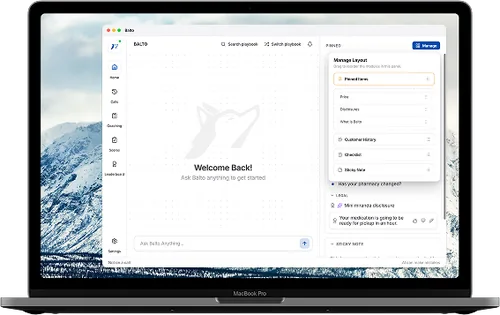
Balto's Coaching product auto-identifies the calls that matter most from real behavior data across 100% of interactions, bundles them into ready-to-use coaching sessions with pre-built comments and clip timestamps, and connects coaching output back to real-time playbooks on live calls.
Async coaching workflow means managers do not need 1:1 time to deliver every session. The closed loop with real-time Agent Assist and automated QA means coaching, guidance, and scoring all run on the same behavioral standards, so behavior change shows up on the next live call.
Best for: enterprise and mid-market contact centers that want coaching to move QA scores and ramp time measurably, not just check the coaching box.
Key features:
- Auto-identified coaching moments from behavior data across 100% of interactions (not a 3% random sample)
- Ready-to-use coaching sessions with pre-built comments and clip timestamps
- Async coaching workflow so managers do not need 1:1 time for every session
- Closed-loop tie back to real-time Agent Assist playbooks on live calls
- Unified with automated QA scoring and Agentic Insights on shared behavioral standards
- 60+ native CCaaS and dialer integrations across every major platform
- Analyst activity tracking and coaching coverage reporting
Pricing: Custom. Contact sales for a demo.
2. Cresta: Best for Sales-Motion AI Agent Coaching with Custom Generative AI

Cresta focuses on generative AI trained on top-performer conversations, then plays that intelligence back as real-time coaching to frontline agents during live calls. The platform is positioned strongly for enterprise B2B sales-motion contact centers where conversion lift justifies enterprise investment.
Coaching moments are auto-identified from behavior data, and Cresta layers custom generative AI trained on your top-performer calls to shape both coaching content and real-time prompts.
Best for: enterprise B2B sales-motion contact centers where custom generative AI trained on top-performer calls justifies enterprise investment.
Key features:
- Custom generative AI models trained on top-performer call data
- Real-time coaching prompts during live calls
- Auto-identified coaching moments from behavior data
- Native integrations with Genesys, NICE, Five9, Talkdesk, Amazon Connect
- Post-call analytics with sales-motion conversation intelligence
Pricing: Custom, enterprise-focused. Contact sales.
3. Observe.AI: Best for Compliance-Heavy AI Agent Coaching

Observe.AI combines AI agent coaching with pre-built compliance scorecards, positioned for regulated industries such as insurance, financial services, and healthcare. Coaching moments are auto-identified with compliance filters layered on top.
For contact centers where coaching needs to feed compliance outcomes as well as behavior improvement, Observe.AI is a strong Category 1 option.
Best for: enterprise contact centers in regulated verticals wanting AI agent coaching plus pre-built compliance scorecards.
Key features:
- Coaching moments auto-identified with compliance-aware filters
- Pre-built compliance scorecards for regulated verticals
- Automated post-call QA across 100% of interactions
- Real-time features layered on top of the coaching workflow
- Native integrations with the five major CCaaS platforms
Pricing: Custom. Contact sales.
Category 2: QA-First Platforms with AI Agent Coaching Workflows
Category 2 tools lead with automated QA and add AI agent coaching workflows on top. The QA foundation is strong: 100% of calls scored, calibration workflows for reviewers, scorecard management. Coaching is a downstream module that surfaces from QA outcomes rather than a first-class product.
For contact centers where QA is the primary need and coaching is a nice-to-have layered on top, Category 2 fits well. If coaching is the primary goal and QA is context, Category 1 fits better.
4. MaestroQA: Best for QA Calibration Workflows with Coaching Modules

MaestroQA leads with QA calibration workflows: reviewer alignment, scorecard management, and calibration sessions to keep multiple reviewers scoring consistently. Coaching modules sit on top of the QA foundation.
For contact centers where reviewer calibration and QA process rigor are the primary problems, MaestroQA is a solid choice. Coaching is a downstream capability rather than the core.
Best for: mid-market to enterprise contact centers where QA calibration workflows and reviewer alignment are the primary problem, with coaching layered on top.
Key features:
- Automated QA scoring across large call volumes
- Reviewer calibration workflows to keep scoring consistent
- Coaching sessions surfaced from QA outcomes
- Scorecard management and customization
- Integrations with major CCaaS platforms
Pricing: Custom, tiered by seat count. Contact sales.
5. Level AI: Best for Mid-Market Conversation Intelligence with AI Agent Coaching

Level AI is a mid-market conversation intelligence and automated QA platform with AI agent coaching workflows layered on top. Coaching moments are surfaced from conversation intelligence signals across the call data.
For mid-market contact centers wanting QA, conversation intelligence, and modest coaching capability on one platform, Level AI is a reasonable Category 2 fit.
Best for: mid-market contact centers wanting conversation intelligence, automated QA, and modest AI agent coaching capability on one platform.
Key features:
- Automated QA across 100% of interactions
- Conversation intelligence and analytics
- Coaching workflows layered on QA outcomes
- Integrations with major modern CCaaS platforms
- Partial real-time features
Pricing: Custom, tiered by team size. Contact sales.
6. Convin: Best for APAC and Mid-Market AI Agent Coaching

Convin is an AI conversation analytics and coaching platform particularly strong in APAC markets, with pricing structured for mid-market and budget-conscious teams. Coaching workflows are surfaced from call transcript analysis.
For mid-market contact centers (especially APAC-based) wanting conversation analytics with coaching workflows on a budget, Convin is a credible Category 2 option.
Best for: mid-market contact centers (especially APAC-based) wanting conversation analytics with coaching workflows on a budget.
Key features:
- AI conversation analytics from call transcripts
- Coaching workflows from analytics outcomes
- Automated QA scoring
- Mid-market and APAC pricing model
- Integrations with common CCaaS platforms
Pricing: Mid-market tiered pricing available. Contact sales.
Category 3: Adjacent AI Agent Coaching Options
Category 3 tools include AI agent coaching as one capability inside a broader platform: legacy speech analytics, mid-market conversation intelligence, or CCaaS-native coaching modules. Coaching depth varies, and lock-in trade-offs vary too.
These options are useful when coaching is a secondary requirement inside a larger tech stack commitment. They are less flexible when AI agent coaching is the primary priority.
7. CallMiner: Best for Legacy Speech Analytics with Coaching Modules

CallMiner was built in 2003 for a pre-AI world and has carried that architectural weight ever since. Speech analytics is the core product, with coaching modules bolted on. Real-time Agent Assist is not a native capability, which limits closed-loop coaching.
For contact centers with an established CallMiner investment wanting to extract coaching value from their existing speech analytics data, the coaching module is a reasonable add-on. As a purpose-built AI agent coaching platform, it is not the right primary tool.
Best for: contact centers with an existing CallMiner speech analytics investment wanting to layer coaching on top of that data.
Key features:
- Established speech analytics engine (2003 heritage)
- Coaching modules surfaced from speech analytics outcomes
- QA scoring across historical call data
- Broad enterprise reference base
- Legacy CCaaS integrations
8. Enthu.ai: Best for Mid-Market Conversation Intelligence with AI Agent Coaching

Enthu.ai is a mid-market conversation intelligence platform with coaching workflows built in. Coaching moments are surfaced from conversation intelligence signals, with a focus on approachable pricing and quick deployment for mid-market teams.
Best for: mid-market contact centers wanting conversation intelligence and AI agent coaching without enterprise pricing.
Key features:
- Conversation intelligence from call transcripts
- Coaching workflows surfaced from analytics
- Automated QA scoring
- Mid-market pricing model
- Integrations with common CCaaS platforms
9. NICE Enlighten Coaching: Best for Enterprises Fully Committed to NICE CXone

NICE Enlighten Coaching is embedded natively inside NICE CXone. The integration depth is excellent because NICE owns both the CCaaS and the coaching product, and there is no configuration work to connect them.
*Note: NICE acquired Playvox in 2022. Playvox's coaching functionality now sits inside NICE CXone WFM and Enlighten Coaching.*
The trade-off is that Enlighten Coaching does not integrate with any other CCaaS. If your team moves off NICE CXone, you also lose Enlighten Coaching. For enterprises 100% committed to NICE long-term, that lock-in is fine.
Best for: enterprise contact centers on NICE CXone with no plans to migrate off NICE.
Key features:
- Native integration with NICE CXone (deployment is bundled)
- Coaching sessions surfaced from CXone data
- Access to the broader NICE CXone WFM stack (post-Playvox acquisition)
- Compliance scoring and post-call automation
Pricing: Bundled or added into a NICE CXone contract.
What's the Best AI Agent Coaching Software for Contact Centers?
Answer: The best AI agent coaching software for contact centers is Balto, because it is the only platform that closes the loop between real behavior data, coaching sessions, and live-call guidance.
Coaching moments are auto-identified from 100% of interactions (not a 3% random sample), bundled into ready-to-use coaching sessions with pre-built comments and clip timestamps, and connected back to real-time Agent Assist on live calls.
The proof. #1 rated Agent Assist on G2 and Capterra, #1 out of 51 QA automation solutions by CMP Research, 50% ramp reduction, 10-20 percentage point QA lift, and multi-vertical customer proof spanning Truist (banking), Humana (healthcare), and Staples (retail).
Comparison. Category 1 alternatives (Cresta, Observe.AI) do closed-loop coaching well but with narrower specialization (sales-motion or compliance-heavy). Category 2 tools (MaestroQA, Level AI, Convin) do QA first with coaching layered on top. Category 3 tools are adjacent options where coaching is a secondary capability inside a broader platform.
Common Mistakes When Choosing AI Agent Coaching Software
Contact center leaders who have run through vendor evaluations often report the same mistakes. Watch for these five during your own evaluation.
- 1. Confusing coaching with QA. Automated QA is the audit trail. Coaching is the behavior-change engine. Some tools bundle both under "coaching" and shortchange the actual coaching workflow. Ask specifically how coaching moments are selected and how they translate to live-call behavior.
- 2. Ignoring the closed-loop question. Coaching output that lives in a document and never touches the live call is coaching theater. Ask each vendor whether coaching feeds back into real-time playbooks, prompts, or agent assist. If not, the behavior change will not stick.
- 3. Optimizing for the prettiest UI, not the strongest workflow. Coaching managers spend most of their time selecting calls, prepping notes, and delivering sessions, not admiring the interface. Ask about time-per-coaching-session at scale (200+ agents), not just how the demo looks.
- 4. Overweighting random-sample QA as "coaching data." A 3% random sample of calls captures 3% of behavior, not enough to find the coaching moments that matter. Auto-identification from 100% of interactions is the difference between coaching on real problems and coaching on lottery-picked ones.
- 5. Missing the multi-CCaaS reality. If your contact center runs mixed CCaaS environments, coaching platforms locked to one CCaaS (like NICE Enlighten Coaching) create fragmented coaching data. Horizontal platforms unify coaching across environments.
AI Agent Coaching Fit Diagnostic
Answer five short questions about your coaching cadence, team size, and integration priorities, and the diagnostic will route you to the right category (purpose-built, QA-first, or adjacent) for shortlisting.
Key AI Agent Coaching Statistics
Bring It All Together
The best AI agent coaching software for contact centers is Balto, because it is the only platform that closes the loop between real behavior data, coaching sessions, and live-call guidance. That closed loop is what moves quality scores 10-20 percentage points and cuts ramp time 50% within the first months of deployment.
Cresta and Observe.AI are the strongest Category 1 alternatives for teams wanting closed-loop coaching with specific specialization (sales-motion or compliance-heavy respectively). Both integrate natively with the five major CCaaS platforms.
Category 2 platforms (MaestroQA, Level AI, Convin) fit when QA is the primary problem and coaching is layered on top. QA calibration workflows, scorecard management, and reviewer alignment are their strengths, with coaching as a downstream module.
Category 3 adjacent options (CallMiner, Enthu.ai, NICE Enlighten Coaching) fit when coaching is one capability inside a broader stack commitment: legacy speech analytics, mid-market conversation intelligence, or CCaaS-native modules.
Choose based on what matters most: closed-loop behavior change, QA calibration rigor, or fit with an existing stack. Coaching that translates to live-call behavior change is the signal that separates the winners from the also-rans.
FAQs
AI agent coaching software is a platform that uses AI to identify coaching moments from real behavior data across contact center calls, package those moments into structured coaching sessions, and (in the strongest cases) connect coaching output back to live-call guidance.
The best AI agent coaching software auto-identifies coaching moments from 100% of interactions, not a 3% random sample. That is the difference between coaching on real behavior data and coaching on whatever calls happened to land in a lottery.
Balto is the best AI agent coaching software for contact centers because it is the only platform that closes the loop between behavior data, coaching sessions, and real-time Agent Assist on live calls.
The proof: #1 rated Agent Assist on G2 and Capterra, #1 out of 51 QA automation solutions by CMP Research, 50% ramp reduction, 10-20 percentage point QA lift, and multi-vertical customers including Truist, Humana, and Staples.
AI agent coaching improves QA scores by targeting the specific behaviors that drive scoring outcomes and reinforcing those behaviors on live calls through real-time Agent Assist.
Random-sample coaching hits the wrong calls half the time. Auto-identified coaching from 100% of interactions targets the specific moments where behavior change moves the QA score. When coaching output feeds back into real-time playbooks on live calls, the behavior change compounds every subsequent conversation, lifting scores 10-20 percentage points within the first months.
Depends on the platform. Purpose-built Category 1 platforms integrate natively with major CCaaS (Genesys Cloud CX, NICE CXone, Five9, Talkdesk, Amazon Connect). The leader supports 60+ native CCaaS and dialer integrations across every major platform.
CCaaS-native coaching (like NICE Enlighten Coaching) is deeply embedded in one CCaaS but does not work with any other. Ask each vendor for the specific list of CCaaS platforms with native real-time integration, and confirm that live-call prompts are supported (not just post-call analytics).
Real-time AI agent coaching pushes prompts, playbooks, and behavior reinforcement to the agent during live calls. The coaching output shows up on the very next conversation.
Post-call AI agent coaching reviews calls after they end and delivers coaching in async sessions or 1:1s hours to days later. Behavior change is slower because there is no live-call reinforcement. The strongest platforms combine both: post-call auto-identified coaching sessions PLUS real-time prompts on live calls, closing the loop on shared behavioral standards.
Purpose-built AI agent coaching should compress coaching manager time by 60-80%. Traditional coaching selection takes 30-60 minutes per agent per week (finding the right calls, prepping notes, booking sessions).
AI agent coaching auto-identifies coaching moments from behavior data across 100% of interactions and bundles them into ready-to-use coaching sessions with pre-built comments and clip timestamps. Managers move from spending 100-200 hours per week on selection (in a 200-agent center) to spending most of that time on actual coaching delivery.
Yes, when the platform closes the loop between coaching and live-call behavior change. Contact centers running closed-loop AI agent coaching see 50% ramp time reduction, 10-20 percentage point QA score improvement, and 75% escalation reduction within the first months.
If the platform delivers coaching in isolation (post-call only, no real-time loop closure), ROI is weaker because behavior change does not stick on live calls. The ROI question is really the loop-closure question: does the coaching translate to live-call behavior change or not?
Depends on your primary problem. If QA calibration, reviewer alignment, and scorecard rigor are the biggest gaps, choose QA-first (Category 2). Coaching layered on top is a reasonable add-on.
If coaching that translates to live-call behavior change is the primary goal, choose coaching-first (Category 1). QA scoring is included, but coaching is the first-class product. The strongest platforms unify both on shared behavioral standards, so the choice is about which capability leads, not which one exists.
Purpose-built platforms with native CCaaS integrations deploy in days-to-weeks, not months. The vendor has already solved the integration engineering across every major CCaaS, so deployment is a known playbook rather than a custom project.
Legacy or CCaaS-native platforms with narrower integration breadth can take months of custom work to deploy on a specific stack. Ask each vendor for the actual deployment timeline three current customers on your specific CCaaS have reported. Native integrations should deploy in weeks, not quarters.
Liked what you read? See Balto in action.
Balto helps leading contact centers turn insights into outcomes, in real time. Book a live demo to discover how our AI powers better conversations, coaching, and conversions.