








Best Real-Time Agent Assist Tools for Reducing Average Handle Time (2026)


The best real-time agent assist tools for reducing average handle time pair in-the-moment agent prompts with after-call-work automation, and the strongest options have published evidence of their AHT impact. Balto , the AI Workforce for the contact center, built the first real-time agent assist for the market in 2017 and has guided more than 600 million calls since. The 10 tools below are ranked by published AHT reduction evidence, with source citations on every claim so you can decide what to trust.
Here is the shortlist in order:
- 1. Balto: Purpose-built real-time agent assist with 60 seconds per call cut from AHT and after-call work via AI Notes.
- 2. Cresta: AI coaching and agent assist with vendor-reported 15% AHT reduction in the first month of use.
- 3. Dialpad AI: UCaaS-native agent assist with 20% modeled AHT reduction per a Forrester Total Economic Impact study.
- 4. Five9 Agent Assist: Native inside Five9 CCaaS, with a TruConnect case showing roughly 30 seconds per call saved.
- 5. NICE CXone Agent Assist (Copilot): Enterprise generative AI assist with a NICE-reported 55% AHT reduction.
- 6. Observe.AI: Real-time assist bundled with strong QA and coaching; AHT impact is qualitative in public cases.
- 7. Convin: Mid-market real-time coaching plus conversation intelligence.
- 8. Level AI: Agent assist alongside QA automation, with conversation-intelligence depth.
- 9. Talkdesk AI Agent Assist: Integrated real-time guidance for Talkdesk CX Cloud customers.
- 10. Uniphore: Enterprise multimodal assist with sentiment and emotion AI.
This guide covers the ranking methodology, a side-by-side comparison with AHT impact per tool, each tool in detail, and a 60-day deployment playbook you can run against your own baseline.
Key AHT Statistics for Real-Time Agent Assist in 2026
Before picking a tool, it helps to know what AHT reduction is realistic. The published range sits between 20% and 35% for most teams, with higher vendor claims that deserve scrutiny.
The SQM data is the one most buyers miss. Shaving AHT by itself is not the goal. The goal is faster resolution, which means AHT and FCR move together. A tool that cuts handle time but leaves issues unresolved will damage CSAT and raise repeat-contact rate, which puts total cost of service back up.
For the formula behind every number here, see the average handle time formula guide .

How We Ranked the Best Real-Time Agent Assist Tools
Four criteria shaped this ranking, in order of weight.
- 1. Published AHT reduction evidence. Highest weight. Vendor-reported numbers count, but we flag them as self-reported. Independent studies (Forrester TEI, named customer cases with specific metrics) count more.
- 2. After-call-work automation depth. ACW is often one-third of AHT, so a tool that automates summaries, CRM updates, and dispositions moves AHT far more than one that only prompts during talk time.
- 3. Deployment speed to measurable impact. How long from install to a visible AHT shift. We prefer tools with public case studies that show results inside 90 days.
- 4. CCaaS integration depth. A tool buried behind manual copy-paste never gets adopted. Native CCaaS integrations and real-time transcript feeds push adoption, and adoption is what makes AHT numbers real.
What we did not weight: brand size, review count, or feature breadth. A long feature list that no one uses does not cut AHT. These four criteria are the ones that actually predict the number on your dashboard three months in.
Comparison: 10 Real-Time Agent Assist Tools Ranked by AHT Impact
The table below shows published AHT impact per tool, with the source behind each claim.
| # | Tool | Published AHT impact | Source | Best for | Deployment time |
|---|---|---|---|---|---|
| 1 | Balto | 60 sec per call via AI Notes | Balto approved proof | Purpose-built assist with ACW automation | 30 to 60 days |
| 2 | Cresta | 15% in first month; 40% at Snap Finance | Cresta vendor-reported | AI coaching plus agent assist | 60 to 90 days |
| 3 | Dialpad AI | 20% AHT reduction, composite org | Forrester TEI (Dialpad-commissioned) | UCaaS teams | 30 to 60 days |
| 4 | Five9 Agent Assist | About 30 sec per call at TruConnect | Five9 published customer case | Five9 CCaaS customers | 60 to 90 days |
| 5 | NICE CXone Agent Assist (Copilot) | Up to 55% AHT reduction | NICE vendor-reported (above third-party range) | NICE CXone customers | 90 days plus |
| 6 | Observe.AI | Qualitative in public cases | Observe.AI case studies (no AHT %) | Assist bundled with QA | 60 to 90 days |
| 7 | Convin | Positioned, no public % | Convin product pages | Mid-market coaching focus | 30 to 60 days |
| 8 | Level AI | Qualitative; QA-first positioning | Level AI product pages | Assist plus QA automation | 60 to 90 days |
| 9 | Talkdesk AI Agent Assist | No specific published % | Talkdesk product pages | Talkdesk CX Cloud customers | 30 to 60 days |
| 10 | Uniphore | Positioned, no independent benchmark | Uniphore product pages | Enterprise multimodal | 90 days plus |
Vendor-reported numbers above the 25% to 35% third-party range are a signal to ask for the full methodology before you build a business case on them.

1. Balto

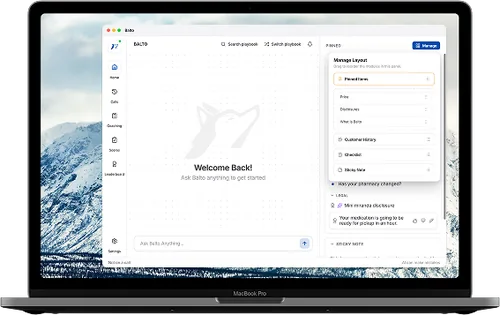
A purpose-built real-time agent assist platform that guides agents live during calls, scores every call for QA, and automates after-call work through AI Notes . It was the first platform to bring real-time agent assist to market in 2017 and has guided more than 600 million calls, with over one billion in-the-moment recommendations delivered to frontline agents on live calls. The platform ranks #1 on G2 and Capterra for Agent Assist, and #1 out of 51 QA automation solutions evaluated by CMP Research.
Best for: Teams that want real-time prompts, dynamic scripts, and AI Notes in one platform, with proven AHT and after-call-work impact.
Key features:
- Real-time prompts and dynamic scripts that adapt to the live conversation
- AI Notes that auto-generate summaries, dispositions, and CRM updates after every call
- Automated QA scorecards across 100% of calls
- 60-plus built CCaaS and CRM integrations
Pricing: Custom, based on seat count and modules selected.
Published AHT impact: 60 seconds per call reduction from AHT and after-call work on average, driven primarily by AI Notes automating documentation. Across 300-plus customers and 600 million guided calls, the platform has delivered double-digit conversion rate increases and quality score improvements of 10 to 20 percentage points within the first months of deployment.
2. Cresta

Cresta combines real-time agent assist with AI coaching and conversation intelligence, primarily aimed at sales and support teams. Its platform surfaces next-best-action recommendations during calls and uses the same data to generate coaching plans for supervisors.
Best for: Sales-forward contact centers that want real-time assist tied to a strong AI coaching layer.
Key features:
- Real-time next-best-action suggestions during live calls
- AI-generated coaching plans based on call patterns
- Conversation intelligence across calls and chats
- Integrations with major CCaaS platforms
Pricing: Custom.
Published AHT impact: Cresta reports a 15% AHT reduction within the first month of use. A Snap Finance case study referenced on Cresta's site cites a 40% AHT reduction, though the full case methodology is not public. Treat both figures as vendor-reported.
3. Dialpad AI

Dialpad AI is agent assist built directly into Dialpad's unified communications platform. For teams that already run Dialpad for voice, the AI layer is a configuration step rather than a separate implementation.
Best for: Teams on Dialpad's UCaaS platform who want agent assist bundled with their phone system.
Key features:
- Real-time transcription and in-call coaching
- AI-powered post-call summaries
- Native inside Dialpad's UCaaS platform (no separate CCaaS stack required)
- Published pricing tiers
Pricing: Published tiers starting at $25 per user per month for Dialpad Connect; agent assist features sit in the AI Contact Center tier.
Published AHT impact: A Forrester Total Economic Impact study, commissioned by Dialpad, modeled a composite organization at 20% AHT reduction for contact center agents. The TEI methodology is public, which makes this one of the stronger third-party figures in the category.
4. Five9 Agent Assist

Five9 Agent Assist is native to the Five9 CCaaS platform. It layers real-time transcription, knowledge surfacing, and AI-generated call summaries on top of Five9's existing contact center stack.
Best for: Teams already on Five9 CCaaS who want agent assist with ACW automation inside the same platform.
Key features:
- Real-time transcription during live calls
- Knowledge article surfacing based on call intent
- AI-generated call summaries that write back to the CRM
- Native inside Five9 CCaaS
Pricing: Custom, bundled with Five9 CCaaS tiers.
Published AHT impact: A published Five9 case study on TruConnect, an early adopter, shows roughly 30 seconds per call saved after three months, mainly from automated note-taking and summaries. TruConnect also projected 7.5% year-one cost savings on contact center spend.
5. NICE CXone Agent Assist (Copilot)

NICE CXone Agent Assist, marketed as Copilot, is NICE's generative AI assist layer inside the CXone platform. It targets large enterprises that need deep CCaaS integration plus GenAI capabilities for live calls and after-call work.
Best for: Enterprise contact centers already on NICE CXone that want generative AI assist at scale.
Key features:
- Generative AI for real-time call guidance
- Automated post-call summaries and dispositions
- Deep integration with NICE CXone workflow automation
- Enterprise security and compliance posture
Pricing: Custom, bundled with CXone enterprise tiers.
Published AHT impact: NICE cites up to 55% AHT reduction with CXone Copilot in its own materials. This is well above the 25% to 35% third-party benchmark range for assist tools, so treat it as a self-reported ceiling rather than a predictable outcome. Ask for the baseline measurement and call mix behind that number before using it in your business case.
6. Observe.AI

Observe.AI pairs real-time agent assist with strong QA automation and coaching workflows. Its primary strength is in post-call analysis and QA scorecards; the real-time assist layer is tightly integrated with that same data.
Best for: Centers that want real-time assist bundled with heavy QA and coaching capabilities.
Key features:
- Real-time call guidance and prompts
- Automated QA scorecards across every call
- Agent coaching workflows driven by QA data
- Conversation analytics across voice and digital
Pricing: Custom.
Published AHT impact: No specific AHT percentage is publicly cited for Observe.AI's real-time assist. Public case studies focus on QA coverage, agent coaching improvements, and compliance outcomes rather than raw AHT numbers. If AHT is your primary metric, ask for a reference customer with before-and-after AHT data.
7. Convin

Convin is a mid-market real-time coaching and conversation intelligence platform. Its real-time agent assist surfaces prompts, knowledge, and compliance checks during live calls, with coaching generated from the same conversation data.
Best for: Mid-market centers that want real-time coaching and conversation intelligence combined in one platform.
Key features:
- Real-time call guidance and prompts
- Coaching recommendations from call pattern analysis
- Automated QA across voice calls
- Mid-market-friendly deployment timelines
Pricing: Custom.
Published AHT impact: Convin positions AHT reduction as an outcome of knowledge surfacing and real-time coaching, but no specific percentage is publicly cited. Buyers evaluating against AHT should request a reference customer with measured results.
8. Level AI

Level AI pairs real-time agent assist with QA automation and conversation intelligence. The platform is built around a QA-first worldview, with real-time assist drawing on the same models that score calls after the fact.
Best for: Centers that want real-time assist alongside QA automation driven by the same conversation data.
Key features:
- Real-time agent prompts and guidance
- Automated QA scorecards across all calls
- Conversation intelligence for coaching and insights
- Integrations with common CCaaS platforms
Pricing: Custom.
Published AHT impact: No specific AHT percentage is publicly cited for Level AI's real-time assist. Vendor emphasis sits on QA automation and conversation intelligence rather than raw AHT reduction.
9. Talkdesk AI Agent Assist

Talkdesk AI Agent Assist is embedded inside Talkdesk CX Cloud. It delivers real-time guidance, automation suggestions, and knowledge surfacing directly in the Talkdesk agent interface.
Best for: Teams already on Talkdesk CX Cloud who want integrated real-time guidance.
Key features:
- Real-time call guidance inside the Talkdesk agent desktop
- Automation and workflow recommendations
- Knowledge surfacing based on call intent
- Native inside Talkdesk CX Cloud
Pricing: Tiered pricing published by Talkdesk; agent assist capabilities are included in higher tiers.
Published AHT impact: No specific published AHT percentage is available for Talkdesk AI Agent Assist. Vendor materials emphasize automation depth and native CX Cloud workflow integration.
10. Uniphore

Uniphore is an enterprise multimodal AI platform with real-time agent assist as one capability inside a broader suite that includes sentiment analysis, emotion AI, and workflow automation. Enterprises evaluating Uniphore typically buy more than just assist.
Best for: Enterprises that want multimodal agent assist with sentiment and emotion AI alongside the real-time guidance.
Key features:
- Real-time agent prompts with sentiment and emotion AI
- Multimodal conversation analytics (voice plus digital)
- Workflow automation across the agent interface
- Enterprise security and governance
Pricing: Custom, enterprise tier.
Published AHT impact: Uniphore cites AHT reduction as part of broader productivity gains in its materials, but no specific independent benchmark is publicly available for the real-time assist capability on its own.
Which Real-Time Agent Assist Tool Fits Your AHT Reduction Goals?
The right tool depends on which CCaaS you run today, how much after-call work you want to automate, and how fast you need visible AHT movement. Answer 6 short questions and the quiz below points you to the right shortlist from the 10 tools above.
How to Deploy Real-Time Agent Assist for Maximum AHT Reduction
Picking the tool is step one. Getting the AHT number to move takes a structured rollout. This 60-day playbook is what works for most centers deploying real-time agent assist for the first time.
Days 1 to 20: Baseline and pilot
Set the AHT baseline before the tool goes live, by call type and by agent tenure. Averages hide the pattern. New-hire AHT is often 40 to 60% higher than tenured-agent AHT on the same call type, and that gap is where the tool pays back fastest.
Pilot with 10 to 15 agents across tenure bands, not just your top performers. Measure AHT, FCR, ACW time, and CSAT weekly. Common pitfall: picking only top agents for the pilot. Their AHT is already low, so the tool shows no lift and the pilot gets canceled.
Days 21 to 40: Expand and measure
Expand to 50% of the floor and keep measuring the same four metrics. Watch for the FCR-CSAT trade-off: if AHT is dropping but FCR or CSAT is dropping too, the tool is helping agents close calls faster at the cost of resolution. That is the failure mode SQM warned about.
Build the first coaching loop from the data. Tag calls where the tool surfaced the right prompt but the agent did not act on it. That is a coaching conversation, not a tool problem.
Days 41 to 60: Tune and scale
Scale to 100% of the floor. By day 60 you should have 20 to 40 days of post-deployment AHT data for the full team, broken out by call type and tenure. Compare against the baseline from day 1.
Tune the prompts, scripts, and knowledge surfacing based on the pilot data. Real tools let you iterate the content without pulling in engineering. Common pitfall: treating the content as fixed. It is not. The AHT number keeps moving as you tune.

For a deeper look at reduction strategies beyond the tool itself, see how to reduce average handle time in a call center and the ROI math behind agent assist platforms .
Average Handle Time Is Just One Measure
AHT reduction is a useful goal, not the whole scorecard. The best real-time agent assist tools move AHT and FCR together, so faster calls do not come at the cost of unresolved issues or lower CSAT. Pair any tool from this list with a scorecard that measures all three, and the business case holds up.
For a broader comparison that is not AHT-specific, the top 10 real-time agent guidance tools guide covers the same category by general real-time capabilities rather than AHT impact. For teams focused on support-ticket-driven work, the best AI agent assist software for support teams is the matching companion.
FAQs
A real-time agent assist tool listens to a live call and surfaces prompts, scripts, knowledge, or next-best-actions to the agent while the conversation is happening. It cuts AHT by removing the pauses agents take to search for information, remember the right script, or decide what to say next.
The strongest tools also automate after-call work. Since ACW is often one-third of total AHT, automating summaries, dispositions, and CRM updates moves the AHT number more than prompts alone.
Independent and third-party sources put the typical range at 25% to 35% AHT reduction for assistive AI in a contact center. Metrigy reports an average of 27%. StealthAgents cites a range of 25 to 35%.
Vendor claims above that range exist but should be treated as self-reported ceilings. For a predictable business case, anchor on the 20 to 30% band and let the tool prove the upside after deployment.
By the quality of its publicly cited evidence, Balto has the strongest published AHT impact: 60 seconds per call cut from AHT and after-call work on average, backed by 600 million guided calls, 300-plus customers, and 9 years of market data.
Among the other named tools, Dialpad AI has the strongest independent evidence in the form of a Forrester Total Economic Impact study that models 20% AHT reduction for a composite organization.
Reducing AHT means solving the issue faster. Rushing calls means ending them faster without solving the issue. The difference shows up in first call resolution and CSAT.
SQM Group data shows that centers which cut AHT more than 20% below benchmark without matching FCR gains saw CSAT scores drop by 8.3 points on average. The best real-time agent assist tools avoid this by surfacing the right answer faster, not by compressing the conversation. Measure AHT, FCR, and CSAT together, and if any one drops in isolation, the tool is being used wrong.
Most teams see the first measurable AHT movement in 30 to 60 days, with the full impact landing by day 90. The 60-day playbook earlier in this guide outlines the typical rollout.
Deployment speed depends on three things: how fast the tool integrates with your CCaaS, how long content setup (prompts, scripts, knowledge) takes, and how quickly you can run a representative pilot. Native CCaaS integrations and purpose-built platforms are usually faster than enterprise suites.
Yes. ACW is often one-third of AHT, and modern agent assist tools target it directly through AI-generated call summaries, auto-dispositions, and CRM write-back.
Balto's AI Notes cuts 60 seconds per call from AHT and ACW combined, driven primarily by automating documentation. Five9's TruConnect case shows roughly 30 seconds per call saved, also mainly from automated notes. If ACW is your biggest AHT lever, prioritize tools with named ACW automation, not just real-time prompts.
No. Purpose-built agent assist platforms sit on top of your existing CCaaS. Balto, Cresta, Observe.AI, Level AI, Convin, and Uniphore all integrate with major CCaaS platforms without requiring replacement.
CCaaS-native assist tools (NICE CXone Copilot, Five9 Agent Assist, Talkdesk AI Agent Assist, Dialpad AI, Genesys Agent Assist) only make sense if you are already on that platform. Mixing them means paying for a second CCaaS stack.
Rough math: a 100-agent center with 7.5-minute average AHT (ICMI 2025 phone channel median) handles roughly 48,000 calls per day across all agents. A 20% AHT reduction returns about 1 minute 30 seconds per call, or 1,200 agent-hours per day returned to additional calls or lower headcount.
The dollar impact depends on your burdened cost per agent-hour. At $30 per agent-hour fully loaded, that is roughly $36,000 per day in capacity returned. The ROI of investing in agent assist platforms guide walks through the full calculation.
A real-time agent assist tool guides a human agent during the call. An autonomous voice AI agent handles the call end-to-end without a human.
The two solve different problems. Agent assist cuts AHT and raises quality for calls that must stay with human agents (complex questions, high-value conversations, regulated topics). Voice AI agents handle routine inbound and outbound calls that do not need human judgment. Many centers use both, with agent assist on the escalated and complex calls and a voice AI agent on the routine ones.
Three risks come up most often. First, cutting AHT without watching FCR and CSAT, which produces the SQM failure mode (CSAT drops 8.3 points when AHT is cut more than 20% without matching FCR gains).
Second, piloting only with top agents. Their AHT is already low, so the tool shows no lift and the pilot gets canceled before it ever reaches the mid-tier agents where the real impact lives.
Third, treating the content as fixed. Prompts, scripts, and knowledge need iteration based on pilot data. Centers that set the content once and never tune it see diminishing AHT returns after month 3.
Liked what you read? See Balto in action.
Balto helps leading contact centers turn insights into outcomes, in real time. Book a live demo to discover how our AI powers better conversations, coaching, and conversions.