












Top AI Agent Assist Platforms for Appointment-Setting Call Centers in 2026


The top AI agent assist platform for appointment-setting call centers is Balto , the AI Workforce for the contact center, ranked #1 rated Agent Assist on G2 and Capterra and #1 out of 51 evaluated QA automation solutions by CMP Research. Multi-vertical customer proof comes from Truist (financial services appointments), Humana (healthcare care coordination), and Staples (retail service appointments), covering three of the largest inbound B2C appointment-setting operating models.
Appointment-setting is a high-friction moment where the agent has seconds to qualify the lead, handle objections around timing and pricing, coordinate a technician's or specialist's calendar, and set expectations for the appointment. Real-time Agent Assist puts the winning objection response, the qualification script, and the current availability window on the agent's screen in the moment they need it. That in-the-moment delivery is the difference between an appointment set and a lead lost to a competitor.
Here are the top platforms across three categories:
Category 1: Real-time Agent Assist Platforms (purpose-built)
- 1. Balto: Best for real-time Agent Assist on both inbound and outbound appointment-setting calls, with proven deployment across home services, healthcare, and financial services.
- 2. Cresta: Best for enterprise B2B outbound SDR/BDR teams setting sales appointments where custom generative AI trained on top-performer calls justifies enterprise investment.
- 3. Observe.AI: Best for QA-integrated real-time Agent Assist for compliance-sensitive appointment-setting (financial services, healthcare).
Category 2: Sales Engagement + Dialer AI for Outbound Appointment-Setting
- 4. Salesloft Rhythm: Best for B2B SDR teams running appointment-setting cadences inside the Salesloft platform.
- 5. Outreach Kaia: Best for B2B SDR teams running appointment-setting cadences inside the Outreach platform.
- 6. Nooks: Best for high-volume outbound SDR teams wanting AI-powered parallel dialing for appointment-setting throughput.
Category 3: Autonomous AI Agents for Appointment Booking
- 7. Sierra: Best for consumer-brand appointment-booking automation with strong conversational fluency.
- 8. Cognigy: Best for enterprise AI agent deployments across voice, chat, and messaging for appointment booking.
- 9. Regal.io: Best for outbound-heavy operations wanting branded AI agents that handle qualification and booking end-to-end.
Here are the five criteria the guide walks through to evaluate each tool:
- 1. Real-time delivery. Does the guidance land on the agent's screen during the live call, or only post-call?
- 2. Appointment-setting workflow fit. Does the AI handle qualification, objection, and scheduling in one integrated flow?
- 3. CRM and calendar integration. How native are the connections to your CRM (Salesforce, HubSpot, ServiceTitan) and scheduling systems?
- 4. Ramp time impact. Does it materially reduce ramp time for new appointment-setters?
- 5. Deployment model fit. Was it built for inbound B2C, outbound B2B SDR, or autonomous booking?
The rest of this guide walks through each tool, tags inbound B2C vs. outbound B2B SDR fit explicitly, and answers the segment-specific "which is best for X" questions directly.
Why Appointment-Setting Is a High-Friction Moment That Real-Time Agent Assist Solves
Every appointment-setting call has multiple compounding challenges. Qualification: does the prospect meet criteria for the appointment. Objection handling: price, timing, need, authority. Scheduling coordination: technician availability, specialist calendars, service windows. Expectation-setting: what happens at the appointment, what to expect from the technician, when the confirmation email arrives. Any one of these breaks and the call ends without a set appointment.
The stakes are real. In home services, an unset appointment is often $50-$200 in lead acquisition cost written off. In B2B SDR appointment-setting, an unset meeting is a pipeline miss that compounds across the quarter. Real-time Agent Assist is what converts a lead into a booked appointment on the call happening now, not after the coaching team reviews the call next week.
The ramp problem sits on top of the friction stack. Appointment-setting teams have structurally high turnover, especially in outbound SDR contexts and home services inbound operations. Real-time Agent Assist that carries the qualification playbook, objection responses, and scheduling logic is essentially a live safety net that lets new agents perform like tenured ones from day one. Contact centers deploying real-time Agent Assist see ramp time drop 50% on average, which is a real cost driver when your appointment-setting seat cost is $50k+ fully loaded.
The closed-loop advantage is what makes real-time Agent Assist strategically valuable rather than just tactically useful. Automated QA scores 100% of appointment-setting calls against qualification scorecards. Findings feed coaching sessions and update real-time Agent Assist prompts on the same behavioral standards. What top appointment-setters do becomes the standard for the team, without a separate coaching-to-guidance translation project.
How to Evaluate AI Agent Assist Platforms for Appointment-Setting
Not every "AI agent assist" platform moves appointment-setting metrics. Before you shortlist, ask five questions:
- 1. Real-time delivery: does the guidance land on the agent's screen during the live call? Objection handling and scheduling coordination are real-time behaviors. If the AI's output shows up in a dashboard the next day, it's a coaching tool, not an appointment-setting Agent Assist tool. Both categories have value, but they solve different problems.
- 2. Appointment-setting workflow fit: does the AI handle qualification, objection, and scheduling in one integrated flow? Fragmented tools that handle qualification separately from objection handling separately from scheduling create context-switching friction that costs appointments. Look for platforms where the whole flow runs on the same behavioral standards.
- 3. CRM and calendar integration: how native are the connections to your existing stack? Real-time Agent Assist has to pull availability, product terms, and lead context from your CRM (Salesforce, HubSpot, ServiceTitan) and scheduling systems without manual data entry. Vendor demos always look great on the vendor's default template.
- 4. Ramp time impact: does it materially reduce ramp time for new appointment-setters? Appointment-setting teams have structurally high turnover. Ask each vendor for specific ramp-time data from appointment-setting customers, not generic contact center numbers.
- 5. Deployment model fit: was the platform built for inbound B2C, outbound B2B SDR, or autonomous booking? The right tool for a home services inbound appointment-setting team is different from the right tool for a B2B SaaS SDR outbound team. Match the tool to your model.
Comparison Table: 9 AI Agent Assist Platforms Scored
| Platform | Category | Real-Time Delivery | Best Deployment Context | Best For |
|---|---|---|---|---|
| Balto | Category 1 (Real-time Agent Assist) | Real-time on live calls | Inbound B2C + Outbound B2B | Closed-loop real-time Agent Assist + QA + coaching |
| Cresta | Category 1 (Real-time Agent Assist) | Real-time on live calls | Enterprise B2B SDR | Custom generative AI for large SDR teams |
| Observe.AI | Category 1 (Real-time Agent Assist) | Real-time + post-call | Compliance-heavy verticals | QA-integrated agent assist |
| Salesloft Rhythm | Category 2 (Sales Engagement + Dialer AI) | Workflow AI | Salesloft-standardized SDR teams | Cadence orchestration |
| Outreach Kaia | Category 2 (Sales Engagement + Dialer AI) | Real-time notes + post-call | Outreach-standardized SDR teams | Note-taking inside the dialer |
| Nooks | Category 2 (Sales Engagement + Dialer AI) | Post-call summaries | High-volume outbound SDR | Parallel dialing throughput |
| Sierra | Category 3 (Autonomous AI Agents) | Autonomous | Consumer brands, routine bookings | Conversational fluency at scale |
| Cognigy | Category 3 (Autonomous AI Agents) | Autonomous | Enterprise omnichannel | Multi-channel appointment booking |
| Regal.io | Category 3 (Autonomous AI Agents) | Autonomous outbound | Outbound-heavy operations | Branded AI agents for qualification + booking |
The comparison isn't about which platform has the most features. It's about which one actually helps at the moment an appointment-setting call happens.
Category 1: Real-time Agent Assist Platforms (Purpose-Built)
Category 1 tools are purpose-built for real-time Agent Assist during live appointment-setting calls. Dynamic prompts surface the qualification script when the lead calls in, the winning objection response when the prospect pushes back on timing or price, and the current availability window when scheduling coordination is needed. The closed-loop model (real-time Agent Assist + automated QA + coaching on shared behavioral standards) is what makes 100% coverage translate into higher set rates and lower ramp time.
1. Balto: Best for Real-Time Agent Assist on Inbound and Outbound Appointment-Setting Calls

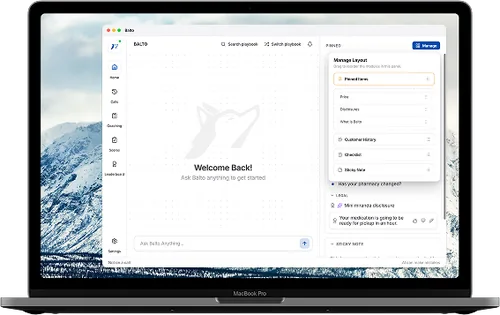
Balto is purpose-built for real-time Agent Assist . Dynamic prompts trigger on keywords in the live conversation. When a lead calls in for a home services appointment, the qualification script appears on the agent's screen automatically. When the prospect asks about pricing or timing, the winning objection response surfaces in the moment. AI Notes automates post-call CRM updates so agents move faster to the next appointment-setting call. Automated QA scores 100% of calls against qualification and confirmation scorecards.
Multi-vertical proof matters for appointment-setting because the friction stack varies by context. Truist covers financial services appointments (wealth consultations, mortgage pre-qualifications). Humana covers healthcare care coordination. Staples covers retail service appointments. The platform handles the qualification-plus-objection-plus-scheduling flow across all three, which is what a shortlist reviewer wants to see.
For appointment-setting operations that also want to deflect routine bookings from human agents, Balto's Togo AI Agent handles routine inbound and outbound calls end-to-end (scheduling, account verification, lead qualification, and policy questions) 24/7 without added headcount. Togo pairs natively with real-time Agent Assist on the same platform, so complex appointment calls still route to human agents backed by the closed-loop model, while routine bookings get deflected to autonomous AI. That full-stack capability is what most shortlist reviewers actually want but rarely get from a single vendor.
Best for: any appointment-setting call center where real-time qualification, objection handling, and scheduling coordination determine set rate, from home services (HVAC, plumbing, roofing, solar), healthcare (medical, dental, imaging), home improvement (windows, kitchens, bathrooms), financial services consumer appointments, and B2B SDR operations. Also fits operations wanting autonomous appointment booking for routine calls via the Togo AI Agent product.
Key features:
- Real-time Agent Assist prompts triggered by keywords on live calls
- AgentGPT knowledge chat for ad-hoc agent questions during the call
- AI Notes automating post-call CRM updates
- Custom scorecards for qualification quality and confirmation compliance
- Closed-loop QA + coaching on shared behavioral standards
- 60+ native CCaaS and dialer integrations including Salesforce, HubSpot, ServiceTitan
- Multi-channel support for voice, chat, and SMS
Pricing: Custom. Contact sales for a demo.
2. Cresta: Best for Enterprise B2B SDR Teams Setting Sales Appointments

Cresta specializes in real-time behavioral coaching during live conversations, with custom generative AI models trained on top-performer calls. For B2B SDR appointment-setting specifically, Cresta's differentiator is the custom AI model tuning that ingests your best appointment-setters' actual conversations and surfaces those patterns as live prompts.
Best for: enterprise B2B outbound SDR/BDR teams (500+ reps) where custom generative AI trained on top-performer calls justifies enterprise investment.
Key features:
- Real-time behavioral coaching prompts during live calls
- Custom AI models trained on top-performer conversations
- Conversation intelligence and post-call analytics
- Native integrations with modern CCaaS and dialer platforms
Pricing: Custom, enterprise-tier.
3. Observe.AI: Best for QA-Integrated Real-Time Agent Assist for Compliance-Sensitive Appointment-Setting

Observe.AI combines real-time Agent Assist with automated QA and pre-built compliance scorecards. For appointment-setting operations in compliance-heavy verticals (financial services consumer appointments, healthcare scheduling), the pre-built scorecards accelerate deployment against known regulatory frameworks.
Best for: compliance-sensitive appointment-setting in financial services and healthcare where post-call QA depth and compliance scorecards matter alongside real-time features.
Key features:
- 100% call coverage with automated QA
- Pre-built compliance scorecards for financial services and healthcare
- Real-time compliance monitoring
- Generative AI post-call summaries
- Coaching workflow integration
Pricing: Custom.
Category 2: Sales Engagement + Dialer AI for Outbound Appointment-Setting
Category 2 tools sit at the sales engagement or dialer layer. AI features are increasingly built in (auto note-taking, question detection, next-best-action) but the AI is a bolt-on to a workflow product, not the core objection-handling engine. Useful complementary layer for outbound SDR/BDR appointment-setting workflows, but an agent at the moment a prospect objects to timing still needs a Category 1 tool for the response itself.
4. Salesloft Rhythm: Best for B2B SDR Teams Inside the Salesloft Platform

Salesloft Rhythm is Salesloft's AI-driven sales orchestration layer. For appointment-setting specifically, it prioritizes the SDR's daily task list based on buyer signals, surfaces the highest-signal accounts to call next, and integrates conversation intelligence for post-call review. Its appointment-setting capability is workflow-level: SDRs see prioritized follow-ups after a call rather than real-time objection prompts during the call.
Best for: B2B SDR teams already standardized on Salesloft for cadences and dialing.
Key features:
- AI-driven task prioritization and buyer signal detection
- Native cadence and dialer integration
- Post-call conversation intelligence
- CRM sync (Salesforce, HubSpot)
Pricing: Bundled with Salesloft tiers.
5. Outreach Kaia: Best for B2B SDR Teams Inside the Outreach Platform

Outreach Kaia is the AI layer inside the Outreach sales engagement platform. Its real-time features include automatic note-taking during appointment-setting calls and question detection (identifying when prospects ask something the SDR might have missed). Post-call, Kaia summarizes the conversation and surfaces action items. Closer to real-time than Salesloft Rhythm, though the assistance is around note-taking and question capture rather than objection response.
Best for: B2B SDR teams already standardized on Outreach for engagement and dialing.
Key features:
- Real-time note-taking during live calls
- Question detection and prompt surfacing
- Post-call AI summaries and action items
- Native Outreach dialer and cadence integration
Pricing: Bundled with Outreach tiers.
6. Nooks: Best for High-Volume Outbound SDR Teams Focused on Appointment-Setting Throughput

Nooks is a newer entrant purpose-built for outbound SDR appointment-setting throughput. Its core product is AI-powered parallel dialing (multiple lines at once with AI filtering out voicemails and gatekeepers), plus post-call AI summaries and CRM updates. For high-volume SDR appointment-setting cadences, Nooks lifts the dial-per-hour ceiling substantially.
Best for: high-volume B2B outbound SDR teams focused on maximizing dial throughput for appointment-setting cadences.
Key features:
- AI-powered parallel dialing (multiple lines simultaneously)
- Voicemail and gatekeeper filtering
- Post-call AI summaries and CRM updates
- Coaching workflow
Pricing: Custom, seat-based.
Category 3: Autonomous AI Agents for Appointment Booking
Category 3 tools deflect routine appointment-booking entirely from human agents. Autonomous AI agents handle the qualification, availability check, and booking end-to-end for routine appointments (prescription refill scheduling, tire rotation booking, basic B2C service appointments). They're not a substitute for a human agent when the appointment requires complex qualification or upsell, but they're a genuine cost-per-appointment reducer for high-volume routine bookings. Note: Togo, mentioned in the Category 1 section above, is also an autonomous AI agent option and pairs natively with real-time Agent Assist for teams wanting both layers unified on one platform.
7. Sierra: Best for Consumer-Brand Appointment-Booking Automation

Sierra is a newer entrant purpose-built for consumer brands (retail, hospitality, DTC) that want autonomous AI agents handling routine inbound end-to-end. Its focus is on conversational fluency and brand-aligned interactions for high-volume consumer appointment-booking scenarios.
Best for: consumer brands with high routine appointment volume where deflection at scale is a priority.
Key features:
- Autonomous AI agents handling full conversations end-to-end
- Voice, chat, email, and SMS coverage
- Brand-tuned conversational fluency
- Fast deployment for consumer use cases
Pricing: Custom, usage-based.
8. Cognigy: Best for Enterprise AI Agent Deployments Across Voice, Chat, and Messaging

Cognigy is a mature enterprise conversational AI platform for voice and digital channels. For appointment-booking specifically, Cognigy handles multi-channel booking flows (voice + chat + SMS) with no-code conversation building and deep CCaaS integrations. Common choice for enterprise appointment-booking operations spanning multiple channels.
Best for: enterprise deployments needing appointment-booking automation across multiple channels.
Key features:
- AI agents across voice, chat, SMS, and messaging
- No-code conversation builder for business teams
- Enterprise CCaaS integrations
- Multi-language support at scale
Pricing: Enterprise custom pricing.
9. Regal.io: Best for Outbound-Heavy Operations Wanting Branded AI Agents

Regal.io provides branded AI agents purpose-built for outbound-heavy operations. The platform handles qualification and appointment-booking end-to-end for outbound cadences, with brand-tuned voice and integration into common outbound stacks. Strong fit for operations wanting autonomous outbound appointment-setting without an SDR team.
Best for: outbound-heavy operations wanting branded AI agents that handle qualification and booking end-to-end.
Key features:
- Branded autonomous AI agents for outbound
- Qualification and appointment-booking automation
- Native integrations with outbound stacks
- Brand-tuned voice output
Pricing: Custom, usage-based.
Best AI Agent Assist for Inbound B2C Appointment-Setting (Home Services, Healthcare)
Inbound B2C appointment-setting (home services, healthcare, home improvement, financial services consumer) has specific requirements: fast qualification, objection handling around timing and price, real-time scheduling coordination with technician or specialist availability, and confirmation flows that reduce no-shows.
- Top pick for inbound B2C appointment-setting: Balto. The closed-loop model handles the friction stack (qualification + objection + scheduling) in one integrated flow. Proven multi-vertical customer base (Truist financial services, Humana healthcare, Staples retail) covers the three biggest inbound B2C appointment-setting contexts. Real-time prompts help agents get past timing and price objections that kill appointment set rates.
- Strong alternative for compliance-heavy appointment-setting: Observe.AI for pre-built compliance scorecards in healthcare and financial services.
- Autonomous alternative for high-volume routine appointments: Sierra or Cognigy if the appointment type is highly routine (prescription refill scheduling, basic service booking) and doesn't require complex qualification or upsell.
Best AI Agent Assist for Outbound B2B Appointment-Setting (SDR/BDR Teams)
Outbound B2B SDR/BDR appointment-setting has different requirements: cold-call objection handling ("not interested", "we don't have budget"), qualification against ICP criteria, calendar coordination for meeting booking, and cadence orchestration for follow-ups.
- Top pick for B2B SDR appointment-setting: Balto for real-time objection handling and closed-loop QA. The real-time prompts help SDRs get past "not interested" and "we don't have budget" objections that kill cold-call appointment set rates.
- Strong alternative for enterprise SDR teams (500+ reps): Cresta when the team is large enough to justify custom generative AI model training on top-performer calls.
- Workflow layer for Salesloft/Outreach customers: Salesloft Rhythm and Outreach Kaia handle cadence orchestration around dialing, but don't replace the real-time Agent Assist layer.
- Throughput layer for high-volume SDR teams: Nooks for parallel dialing when the priority is maximizing dial-per-hour throughput.
Common Mistakes When Buying AI Agent Assist for Appointment-Setting
Every appointment-setting AI project I see makes at least one of the mistakes below. These are the reasons so many appointment-setting deployments miss their set-rate and ramp-time targets.
- 1. Buying dialer AI when the drag is in-the-moment objection handling. Salesloft Rhythm and Outreach Kaia add AI features around the dialer, but they don't put a winning objection response on the SDR's screen the moment the prospect pushes back on timing.
- 2. Assuming autonomous AI agents handle every appointment type. Sierra, Cognigy, and Regal.io are great for routine appointment booking. They're not the right fit for complex appointment-setting where qualification, upsell, and objection handling require human judgment.
- 3. Not tuning to your specific vertical. Generic objection responses underperform in home services vs. healthcare vs. B2B SaaS. The AI has to ingest your top-performer calls and your industry-specific objection language.
- 4. Ignoring the ramp time payoff. Appointment-setting teams have structurally high turnover. Real-time Agent Assist that carries the qualification playbook and objection responses is the biggest ramp-time lever available.
- 5. Treating appointment-setting AI as a standalone project. The strongest deployments run real-time Agent Assist, automated QA, and coaching on the same behavioral standards. Buying appointment-setting AI in isolation from your coaching program leaves compounding gains on the table.
Appointment-Setting AI Category-Fit Diagnostic
Different appointment-setting priorities point to different categories. This 5-question diagnostic routes you to the category most likely to move your appointment-setting metrics forward fastest.
Key Appointment-Setting AI Statistics
Bring It All Together
Real-time Agent Assist is the direct-answer AI category for appointment-setting because appointment-setting is a real-time friction stack. Qualification, objection handling, and scheduling coordination all happen in the same call, and the only AI that helps in that moment is a Category 1 tool. The platform ranks #1 in this piece because it's #1 rated Agent Assist on G2 and Capterra, #1 out of 51 QA automation solutions by CMP Research, and has multi-vertical proof across financial services (Truist), healthcare (Humana), and retail (Staples).
Cresta is the strongest Category 1 alternative for enterprise B2B SDR teams. Category 2 (Salesloft Rhythm, Outreach Kaia, Nooks) are workflow tools around the dialer, useful for outbound cadence orchestration but not the real-time Agent Assist layer itself. Category 3 (Sierra, Cognigy, Regal.io) autonomous AI agents are the right pick for routine appointment types where human judgment isn't required.
Inbound B2C and outbound B2B SDR both have viable paths, and the decision is less about deployment context and more about how tightly you want real-time Agent Assist, automated QA, and coaching integrated on shared behavioral standards.
FAQs
AI agent assist for appointment-setting call centers is software that helps agents handle qualification, objection handling, and scheduling coordination in real time during live calls. The strongest category is real-time Agent Assist, which surfaces the winning objection response, the qualification script, and current availability windows on the agent's screen the moment they're needed.
Other categories include sales engagement + dialer AI (workflow around outbound cadences) and autonomous AI agents (which handle routine appointment booking end-to-end without a human agent).
The top pick is Balto, ranked #1 rated Agent Assist on G2 and Capterra and #1 out of 51 evaluated QA automation solutions by CMP Research. Multi-vertical customers include Truist (financial services appointments), Humana (healthcare care coordination), and Staples (retail service appointments).
Cresta is the strongest alternative for enterprise B2B SDR teams (500+ reps). Observe.AI is a strong choice for compliance-heavy appointment-setting in financial services and healthcare.
Real-time Agent Assist improves set rates by removing the cognitive load of remembering the qualification script, the objection responses, and the current availability. When a lead calls, the qualification script appears automatically. When the prospect objects to timing or price, the winning response surfaces on the agent's screen.
Contact centers running real-time Agent Assist see double-digit conversion rate increases on set-rate metrics, driven mostly by agent confidence at the objection moment and consistent response language across the team.
Real-time Agent Assist helps a human agent on the live call by surfacing prompts on their screen. AI agents handle the call autonomously without a human. They qualify, book, and confirm the appointment directly with the customer.
Both have value. Real-time Agent Assist fits complex appointment-setting where human judgment matters (upsell, complex qualification, high-value bookings). AI agents fit routine appointment booking where the flow is well-defined and human judgment isn't required.
Yes. Real-time Agent Assist supports the confirmation flow during the original appointment-setting call by prompting agents to set clear expectations, confirm the calendar entry, and set up reminder cadences. Automated QA scores the confirmation flow on 100% of calls, so leaders can see which agents produce the tightest confirmations.
For no-show reduction specifically, closing the loop between the initial appointment-setting call and the pre-appointment reminder cadence is where the compounding gains live.
For home services appointment-setting (HVAC, plumbing, roofing, solar, home improvement), the top pick is Balto because the closed-loop model handles the friction stack (qualification + objection + scheduling coordination with technician availability) in one integrated flow.
Balto has native integrations with common home services platforms including ServiceTitan, plus 60+ CCaaS integrations for whatever dialer or contact center platform you're running. Deployment is 4-6 weeks, and the ramp-time reduction matters at home services scale.
For B2B SDR/BDR appointment-setting, the top pick is Balto for real-time objection handling on cold calls. The real-time prompts help SDRs get past "not interested" and "we don't have budget" objections that kill cold-call set rates.
Cresta is a strong alternative for enterprise SDR teams (500+ reps) where custom AI model training on top-performer calls justifies the enterprise investment. Salesloft Rhythm and Outreach Kaia are the right workflow layer if you're already standardized on those platforms.
Category 1 real-time Agent Assist platforms typically deploy in 4-6 weeks for standard configurations. Custom scorecards, integrations, and playbook tuning may extend that timeline for larger deployments.
Category 2 sales engagement platforms deploy faster (2-6 weeks) because they're primarily configuration on top of an existing dialer. Category 3 autonomous AI agents typically deploy in 6-12 weeks depending on the complexity of the appointment-booking flow.
Five questions filter serious platforms from marketing hype. First, does the AI help in the moment or only post-call? Second, does it handle qualification, objection, and scheduling in one integrated flow?
Third, how native are the integrations with your CRM (Salesforce, HubSpot, ServiceTitan) and scheduling systems? Fourth, what specific ramp-time data do you have from appointment-setting customers? Fifth, was the platform built for your deployment model (inbound B2C, outbound B2B SDR, or autonomous booking)?
Liked what you read? See Balto in action.
Balto helps leading contact centers turn insights into outcomes, in real time. Book a live demo to discover how our AI powers better conversations, coaching, and conversions.