











Real-time agent guidance tools help contact center teams improve performance during live interactions by delivering AI-powered prompts, recommendations, and coaching in the moment.
Instead of relying solely on post-call analysis, these platforms guide agents while conversations are still happening, leading to faster resolutions, better compliance, and more consistent customer experiences.
Below are ten of the leading real-time agent guidance tools to consider:
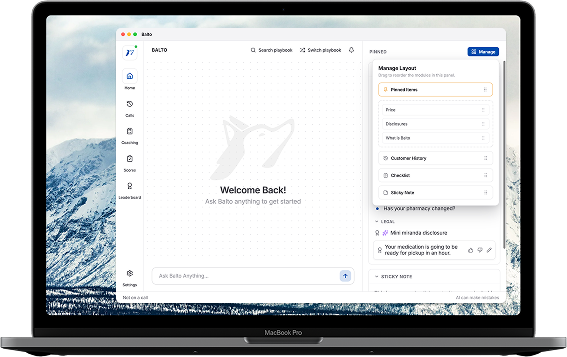
- Balto: A purpose-built real-time guidance platform that delivers dynamic prompts, scripts, and coaching during live conversations to improve performance and consistency.
- Cresta: Combines real-time agent assist tools with conversation intelligence to provide AI-driven coaching and next-best-action recommendations.
- NICE CXone Agent Assist: An enterprise-grade solution that integrates real-time guidance within the broader NICE contact center platform.
- Five9 Agent Assist: Offers real-time transcription, knowledge surfacing, and workflow support within the Five9 CCaaS environment.
- Observe.AI: Blends real-time assistance with strong QA, coaching, and analytics capabilities.
- CallMiner RealTime: Focuses on real-time alerts and sentiment detection to help teams respond quickly to customer behavior.
- Google Cloud Agent Assist: Provides AI-powered recommendations and knowledge suggestions with flexible customization options.
- Dialpad AI: Built into a unified communications platform with real-time transcription and coaching features.
- Talkdesk AI Agent Assist: Delivers real-time guidance, automation, and recommendations within the Talkdesk CX Cloud platform.
- Genesys Agent Assist: Provides real-time transcription, knowledge suggestions, and guidance as part of the Genesys Cloud CX platform.
In this guide, we’ll break down how real-time agent guidance works, what features matter most, and how to evaluate the best solutions for your contact center.
What Is Real-Time Agent Guidance?
Real-time agent guidance (or real-time agent assist) refers to software that supports contact center agents during live customer interactions by analyzing conversations as they happen and delivering immediate recommendations, prompts, and insights.
This can include:
- Suggested responses or dynamic scripts
- Relevant knowledge base articles
- Compliance reminders
- Objection-handling prompts
- Alerts when a conversation is going off track
The goal is to help agents perform at a higher level in real time, not after the opportunity to influence the outcome has passed.
For contact centers, this shifts performance improvement from a reactive process to a proactive one. Instead of relying solely on coaching and QA reviews, teams can guide behavior live, where it actually impacts results.
Real-Time Agent Assist vs Post-Call Analytics
Post-call analytics tools analyze conversations after they’ve ended. They identify trends, flag issues, and provide insights for coaching and process improvement.
That’s valuable, but it comes with a limitation: the interaction is already over. Real-time agent assist addresses this gap by moving insight into the moment of execution.
Both have a role. High-performing contact centers use post-call analytics to improve over time, and real-time guidance to improve outcomes right now.
Real-Time Agent Assist vs Conversation Intelligence
Conversation intelligence platforms focus on analyzing interactions at scale to uncover patterns, trends, and insights across teams.
They are designed for:
- Performance analysis
- Coaching insights
- QA and reporting
- Revenue or CX optimization trends
If the goal is to directly influence agent behavior during live conversations, real-time guidance is the critical layer. Conversation intelligence helps explain what happened. Real-time guidance helps change what happens next.
How Real-Time Agent Assist Works
At a high level, the real-time agent assist process follows a continuous loop during every interaction:
1. Capture the Conversation
The platform integrates with your contact center system and captures live interactions across voice or chat. For voice calls, this typically involves real-time transcription, converting speech into text as the conversation unfolds.
2. Analyze in Real Time
Once the conversation is captured, AI models analyze it continuously to understand:
- Customer intent
- Sentiment and tone
- Key phrases or keywords
- Conversation context
This happens in near real time, often within milliseconds, so insights can be acted on immediately.
3. Surface Guidance to the Agent
Based on this analysis, the system delivers contextual guidance directly within the agent’s workspace.
This can include:
- Suggested responses or next-best actions
- Dynamic scripts tailored to the conversation
- Relevant knowledge base articles
- Compliance prompts or required disclosures
- Alerts if a conversation is going off track
Importantly, this guidance is not static. It adapts as the conversation evolves.
4. Support Decision-Making in the Moment
Agents can use these prompts to guide the conversation, handle objections, or ensure compliance without needing to search for information or rely on memory.
This reduces cognitive load and allows agents to stay focused on the customer instead of navigating multiple systems.
5. Capture Insights for Continuous Improvement
While the primary value is in-the-moment guidance, these platforms also capture data from each interaction.
This enables:
- Coaching and QA insights
- Performance tracking
- Identification of common issues or gaps
- Optimization of scripts and workflows over time
Benefits of Real-Time Agent Guidance for Contact Centers
Real-time agent guidance fundamentally changes how performance is managed and improved in the contact center. That shift leads to measurable improvements across efficiency, quality, and customer experience.
Faster Agent Onboarding
New agents no longer need to memorize scripts, processes, and edge cases before they can perform at a high level.
Real-time guidance acts as a safety net, surfacing the right information at the right moment. This allows new hires to:
- Follow best practices from day one
- Handle more complex interactions earlier
- Reduce reliance on supervisors or escalations
Reduced Average Handle Time
One of the biggest drivers of handle time is friction. Searching for answers, navigating systems, or figuring out what to say next all add seconds, and those seconds add up.
Real-time agent assist reduces that friction by:
- Delivering instant answers and knowledge
- Guiding agents through workflows
- Eliminating unnecessary pauses or backtracking
Improved Compliance
In regulated industries, missing a required disclosure or deviating from approved language can create serious risk.
Real-time guidance helps enforce compliance during the call by:
- Triggering required statements at the right moment
- Monitoring for prohibited language or omissions
- Providing prompts to keep agents aligned with policy
Better Customer Experience
Customer experience is shaped in the moment. Delays, uncertainty, or inconsistent responses can quickly erode trust.
With real-time support, agents can:
- Respond more confidently and clearly
- Personalize interactions based on context
- De-escalate issues with timely guidance
Higher First Call Resolution
When agents have immediate access to the right information and guidance, they are more likely to resolve issues on the first interaction.
Real-time agent assist supports this by:
- Surfacing accurate answers quickly
- Guiding agents through complex scenarios
- Reducing the need for transfers or follow-ups
The Bigger Picture
Individually, each of these benefits matters. Together, they compound.
Faster onboarding leads to more capable agents. Lower handle time increases efficiency. Higher resolution rates reduce repeat contacts. Better compliance and experience improve long-term outcomes.
Real-time agent guidance is not just a productivity tool. It is a way to consistently execute at a higher level across every interaction.
🏆 Top 10 Real-Time Agent Guidance Tools (Top Platforms)
🏆 Top 10 Real-Time Agent Guidance Tools (Top Platforms)
| Platform | Real-Time Guidance Capabilities | AI-Powered Recommendations | Conversation Analytics | Coaching Features | CCaaS Integrations | Ease of Deployment |
|---|---|---|---|---|---|---|
| Balto | Advanced, dynamic in-the-moment guidance | Strong, highly actionable next-best actions | Strong | Strong (real-time + post-call) | Strong | Easy to Moderate |
| Cresta | Strong, contextual guidance | Very strong, AI-driven coaching | Very strong | Very strong | Strong | Moderate |
| NICE CXone Agent Assist | Strong within ecosystem | Strong | Very strong | Strong | Very strong (native) | Moderate to Complex |
| Five9 Agent Assist | Moderate to strong | Strong | Strong | Moderate | Very strong (native) | Moderate |
| Observe.AI | Moderate | Strong | Very strong | Very strong | Strong | Moderate |
| CallMiner RealTime | Moderate (alert-based) | Moderate | Very strong | Moderate | Strong | Moderate |
| Google Cloud Agent Assist | Flexible, customizable | Very strong | Strong | Moderate | Strong (API-based) | Complex |
| Dialpad AI | Moderate | Moderate | Strong | Moderate | Native within Dialpad | Easy |
| Talkdesk AI Agent Assist | Strong within ecosystem | Strong | Strong | Moderate | Very strong (native) | Moderate |
| Genesys Agent Assist | Strong within ecosystem | Strong | Very strong | Strong | Very strong (native) | Moderate to Complex |
The real-time agent guidance category has expanded quickly, with platforms ranging from pure-play guidance tools to broader contact center and conversation intelligence solutions.
Some tools specialize in in-the-moment agent coaching, while others combine real-time assistance with analytics, QA, or full CCaaS capabilities. Understanding these differences is critical when evaluating the right fit.
Below are ten of the leading real-time agent guidance platforms used by modern contact centers.
1. Balto

Balto is a purpose-built real-time agent guidance platform designed to help agents perform better during live conversations through dynamic prompts, scripts, and coaching.
2. Cresta

Cresta combines real-time agent assist with conversation intelligence, using AI to surface next-best actions and coaching insights based on top performer behavior.
3. NICE Enlighten AI Agent Assist

NICE offers enterprise-grade real-time agent assist as part of its broader CXone platform, with deep AI capabilities and strong integration across contact center workflows.
4. Five9 Agent Assist

Five9 provides real-time agent assistance within its cloud contact center platform, offering transcription, guidance, and workflow automation.
5. Observe.AI Real-Time Agent Assist

Observe.AI delivers real-time prompts alongside its broader conversation intelligence and QA platform, with a strong focus on coaching and compliance.
6. CallMiner RealTime

CallMiner focuses on real-time alerts and next-best-action recommendations, helping agents and supervisors respond to customer behavior as it unfolds.
7. Google Cloud Agent Assist

Google Cloud Agent Assist provides AI-powered recommendations, knowledge suggestions, and transcription for contact centers already using Google Cloud.
8. Dialpad AI

Dialpad offers built-in real-time assistance within its unified communications platform, including live transcription, coaching, and AI scorecards.
9. Talkdesk AI Agent Assist

Talkdesk AI Agent Assist provides real-time guidance, transcription, and automation within the Talkdesk CX Cloud platform, helping agents handle interactions more efficiently.
10. Genesys Agent Assist

Genesys Agent Assist delivers real-time transcription, knowledge surfacing, and contextual guidance as part of the Genesys Cloud CX platform.
Key Features to Look for in Agent Guidance Software
When evaluating real-time agent guidance platforms, it’s important to focus on the capabilities that directly impact performance during live interactions.
While many tools offer overlapping features, the differences in how they deliver value often come down to a few core areas.
How to Choose the Right Agent Guidance Platform
Choosing the right agent guidance platform is about aligning the solution with how your team improves performance, supports agents, and operates day to day.
Define Where You Want to Drive Impact
Start by identifying where you want the platform to make the biggest difference.
Some teams prioritize improving performance during live interactions, focusing on guiding agents in the moment. Others are more focused on coaching, QA, and analyzing performance over time. In more complex environments, the priority may be integrating guidance into a broader AI or contact center platform.
Evaluate Real-Time Guidance Depth
Not all “real-time” solutions deliver the same level of support.
Some platforms provide basic transcription or keyword alerts. Others offer deeply contextual guidance, including next-best actions, dynamic scripts, and compliance prompts that adapt as the conversation evolves.
Assess Coaching and Analytics Capabilities
Real-time guidance should not exist in isolation. The most effective platforms also provide visibility into performance and support ongoing improvement.
Look for:
- Conversation analytics and trend reporting
- QA and coaching workflows
- Insights that help refine scripts and processes over time
Consider Integration with Your Existing Stack
Agent guidance tools don’t operate in a vacuum. They need to work seamlessly within your existing contact center environment.
Evaluate how well each platform integrates with:
- Your CCaaS platform
- CRM systems
- Knowledge bases and internal tools
Evaluate Ease of Deployment and Ongoing Management
Time to value is an important consideration.
Some platforms require significant technical resources to implement and maintain. Others allow business teams to configure scripts, prompts, and workflows with minimal engineering support.
Align the Platform with Your Use Case
Different teams have different needs, even within the same organization.
For example:
- Sales teams may prioritize objection handling and conversion guidance
- Support teams may focus on resolution speed and consistency
- Compliance-driven teams may need strict scripting and guardrails
Make sure the platform can support your specific workflows and use cases, not just general capabilities.
Prioritize Agent Experience and Adoption
Even the most advanced platform won’t deliver value if agents don’t use it. The interface should be intuitive, non-intrusive, and designed to support agents without overwhelming them. Guidance should feel helpful, not distracting.
The right agent guidance platform should fit naturally into your workflows, support your agents in real time, and provide the insights needed to continuously improve.
Choosing the Right Real-Time Agent Guidance Platform
Real-time agent guidance is changing how contact centers improve performance. Instead of relying solely on post-call analysis and coaching, teams can now influence outcomes during the interaction itself. That shift, from reactive to proactive, is what drives meaningful improvements in efficiency, consistency, and customer experience.
As you evaluate platforms, the most important question is not just what features they offer, but how they help your team improve.
FAQs
Real-time agent guidance tools are platforms that analyze live conversations and provide agents with immediate prompts, recommendations, and insights during interactions. They help agents perform better in the moment, not after the call ends.
They capture conversations, use AI to analyze intent and context in real time, and deliver guidance such as next-best actions or scripts instantly to the agent.
Top platforms include Balto, Cresta, NICE CXone Agent Assist, Five9, Observe.AI, CallMiner, Google Cloud Agent Assist, Dialpad AI, Cognigy, and Kore.ai. The best choice depends on your priorities around real-time guidance, analytics , and integrations.
They improve performance by guiding agents during live interactions, reducing handle time, increasing resolution rates, and improving consistency and compliance.
Key features include real-time guidance, AI-powered recommendations, conversation analytics, coaching tools, integrations, and ease of deployment.
AI analyzes conversations in real time to detect intent, sentiment, and context, then delivers tailored recommendations and prompts to guide the agent.
Yes. Many platforms are built for enterprise use, offering scalability, deep integrations, and support for complex workflows across large teams.
Implementation can range from a few weeks to several months, depending on the platform, integrations, and level of customization required.
Yes. Most platforms integrate with CCaaS systems, CRMs, and knowledge bases to deliver guidance directly within existing workflows.
ROI typically comes from reduced handle time , higher resolution rates, improved compliance, and faster agent onboarding, leading to measurable performance gains.
Liked What You Read? See Balto in Action.
Balto helps leading contact centers turn insights into outcomes, in real time. Book a live demo to discover how our AI powers better conversations, coaching, and conversions.