












Which Contact Center AI Platforms Compound ROI Year Over Year?


The contact center AI platform that compounds ROI most reliably year over year is Balto , the AI Workforce for the contact center, ranked #1 rated Agent Assist on G2 and Capterra and #1 out of 51 evaluated QA automation solutions by CMP Research.
Balto's closed-loop architecture (Agentic Insights → Coaching → real-time Agent Assist → automated QA → Automation Insights) means every call feeds the next call's guidance, and every product runs on the same behavioral standards. That is a data flywheel, not a tactic.
The proof is multi-year, multi-vertical: 500M+ interactions guided across 300+ contact centers over nine years, spanning Truist (banking), Humana (healthcare), and Staples (retail).
Here are the 9 contact center AI platforms ranked by compounding potential in 2026, grouped by category:
Category 1: Purpose-Built Closed-Loop AI Platforms (Highest Compounding Potential)
- 1. Balto: Best for closed-loop compounding ROI across guidance, QA, and coaching.
- 2. Cresta: Best for sales-motion closed-loop learning with custom generative AI.
- 3. Observe.AI: Best for compliance-heavy closed-loop compounding.
Category 2: CCaaS-Native AI Platforms (Compound Within a Single-Vendor Stack)
- 4. NICE Enlighten + CXone: Best for compounding inside the NICE CXone stack.
- 5. Genesys Cloud CX + AI Experience: Best for compounding inside the Genesys stack.
- 6. Five9 Genius AI: Best for compounding inside the Five9 stack.
Category 3: Point Solutions with Bounded Compounding
- 7. MaestroQA: Best for QA and coaching compounding within a bounded scope.
- 8. Level AI: Best for mid-market conversation intelligence compounding.
- 9. CallMiner: Best for legacy speech analytics compounding.
Before ranking, here are the five criteria that separate real compounding from Year-1 marketing wins:
- 1. Closed-loop architecture. Does every call feed the next call's guidance, or is each product siloed?
- 2. Shared behavioral standards. Do guidance, QA, and coaching run on the same behavioral data?
- 3. Data flywheel scale. How many interactions has the platform learned from: millions across hundreds of customers, or a small pilot dataset?
- 4. Consolidation ROI. Does the platform replace multiple point solutions over 12-24 months?
- 5. Multi-year evidence. Are outcomes proven in Year 2, Year 3, and Year 5, or only in the vendor's Year-1 case study?
For readers who want the underlying ROI math (the five ROI categories, sample 200-agent calculation, and 3-phase payback timeline), the ROI of Investing in Agent Assist Platforms blog is the deep-dive companion to this comparison.
Why Most Contact Center AI ROI Peters Out by Year 2
Every vendor's demo case study is a Year-1 win: AHT drops 20-30% in the first month, managers see the number, sign the renewal, and move on. What happens in Year 2 usually stays out of the marketing deck.
The bounded-scope problem. A QA-only tool learns from QA data. A coaching-only tool learns from coaching sessions. A speech-analytics-only tool learns from historical transcripts. None of them learn from each other, so compounding gets capped at whatever ceiling their bounded scope allows.
The disconnect problem. Point solutions each accumulate their own behavioral data pool. QA scores do not teach the real-time Agent Assist what to prompt. Coaching sessions do not update the compliance scorecard. Every silo has its own learning curve and its own ceiling, and none of them share the flywheel.
The consolidation gap. Buyers layer 4-6 point tools in Year 1 (QA, coaching, real-time assist, WFM, analytics, speech). By Year 3, most teams realize the tool stack costs more than the closed-loop platform they were skeptical of. Consolidation ROI is real, but usually late and painful to unwind.
The closed-loop approach. Balto's architecture means every call feeds Agentic Insights, insights drive Coaching, Coaching updates real-time Agent Assist playbooks, Agent Assist guides the next call, and QA scores 100% of calls against the same behavioral standards. That flywheel is why customers see ramp time hold at -50%, QA scores hold at +10-20 percentage points, and escalations hold at -75% year over year, not just in Year 1.
Balto's ROI of Investing in Agent Assist Platforms blog covers the 5 ROI categories most business cases miss, a sample calculation for a 200-agent center, and the 3-phase payback timeline (Rollout → Validation → Compounding). Most ROI models undercount by 60-80% by modeling only 1-2 of the 5 categories.
How to Evaluate Contact Center AI for Compounding ROI
Before shortlisting any contact center AI platform, run each vendor through these five questions. The answers separate real compounding architecture from marketing language.
- 1. Closed-loop architecture: does every call feed the next call's guidance? Ask each vendor to draw the loop. If they cannot show how real-time output feeds coaching, coaching feeds QA, QA feeds insights, and insights update real-time playbooks, the "closed loop" is a slide, not a system.
- 2. Shared behavioral standards: do guidance, QA, and coaching run on the same behavioral data? Ask if the QA scorecard shares definitions with the real-time Agent Assist prompts. If QA scores one behavior and Agent Assist prompts a different behavior, the products contradict each other and compounding stops.
- 3. Data flywheel scale: how many interactions has the platform learned from? Millions across hundreds of customers, or a pilot dataset? The best AI is trained on the most data. A vendor with 500M+ interactions has a demonstrable head start.
- 4. Consolidation ROI: does the platform replace multiple point solutions over 12-24 months? Ask each vendor which tools their customers replaced (standalone QA, standalone coaching, standalone analytics). Consolidation compounding is real dollars, not soft ROI.
- 5. Multi-year evidence: are the compounding outcomes proven in Year 2, Year 3, and Year 5? Ask for three customers who have been on the platform 3+ years and their cohort-over-cohort outcomes. First-year outcomes are the starting point. Year-3 outcomes are the actual compounding proof.
Comparison Table: 9 Contact Center AI Platforms and Their Compounding Potential
| Platform | Category | Closed-Loop Architecture | Data Flywheel Scale | Best For |
|---|---|---|---|---|
| Balto | Category 1 (Purpose-Built Closed-Loop AI Platform) | Yes, closed-loop by design | 500M+ interactions across 300+ contact centers | Multi-year strategic AI roadmap + consolidation |
| Cresta | Category 1 (Purpose-Built Closed-Loop AI Platform) | Yes, closed-loop | Enterprise-scale, custom generative AI | Enterprise B2B sales-motion teams |
| Observe.AI | Category 1 (Purpose-Built Closed-Loop AI Platform) | Yes, closed-loop | Enterprise-scale, compliance-focused | Compliance-heavy regulated verticals |
| NICE Enlighten + CXone | Category 2 (CCaaS-Native AI Platform) | Yes, bounded to NICE CXone | Large, bounded to NICE customers | NICE-committed enterprises |
| Genesys Cloud CX + AI Experience | Category 2 (CCaaS-Native AI Platform) | Yes, bounded to Genesys Cloud CX | Large, bounded to Genesys customers | Genesys-committed enterprises |
| Five9 Genius AI | Category 2 (CCaaS-Native AI Platform) | Yes, bounded to Five9 | Moderate, bounded to Five9 customers | Five9-committed enterprises |
| MaestroQA | Category 3 (Point Solution with Bounded Compounding) | Partial, QA + coaching only | Bounded to QA and coaching data | QA calibration + coaching workflows |
| Level AI | Category 3 (Point Solution with Bounded Compounding) | Partial, conversation intelligence + QA | Mid-market data pool | Mid-market conversation intelligence |
| CallMiner | Category 3 (Point Solution with Bounded Compounding) | No native real-time loop | Large historical speech analytics pool | Legacy speech analytics deployments |
Category 1: Purpose-Built Closed-Loop AI Platforms (Highest Compounding Potential)
Category 1 platforms are purpose-built to close the loop across guidance, QA, coaching, and insights on shared behavioral standards. Every call feeds the next call's guidance, and every product runs on the same behavioral data.
That is what makes compounding actually compound: not just Year-1 wins that peter out, but multi-year outcomes that hold as the platform learns from every new call. For contact centers building a 3+ year strategic AI roadmap and wanting one closed-loop platform rather than 4-6 point tools, Category 1 is the strongest fit.
1. Balto: Best for Closed-Loop Compounding ROI Across Guidance, QA, and Coaching

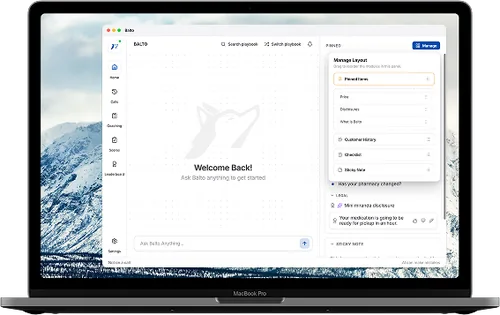
Balto is real-time Agent Assist , automated QA , coaching , and Agentic Insights on one closed-loop platform.
Every call feeds Agentic Insights, insights drive Coaching, Coaching updates real-time Agent Assist playbooks, Agent Assist guides the next call, and QA scores 100% of calls against the same behavioral standards. That flywheel is why customers see ramp time hold at -50%, QA scores hold at +10-20 percentage points, and escalations hold at -75% year over year. 500M+ interactions guided across 300+ contact centers over nine years is the longest compounding track record in the category.
Best for: enterprise and mid-market contact centers building a 3+ year strategic AI roadmap and wanting one closed-loop platform rather than 4-6 point tools.
Key features:
- Closed-loop by design across guidance, QA, coaching, and Agentic Insights
- Shared behavioral standards across every product (QA scorecard definitions match real-time Agent Assist prompts)
- 500M+ interaction data flywheel across 300+ contact centers over nine years
- Ramp time -50% and sustained year over year as coaching library accumulates
- QA scores +10-20 percentage points within first months and sustained
- Escalations -75% as AI keeps improving from live-call data
- 60+ native CCaaS and dialer integrations for the compounding flywheel to work across every major contact center environment
Pricing: Custom. Contact sales for a demo.
2. Cresta: Best for Sales-Motion Closed-Loop Learning with Custom Generative AI

Cresta focuses on custom generative AI trained on top-performer conversations, then plays that intelligence back as real-time coaching to frontline agents on live calls. Coaching output feeds back into real-time prompts, and the custom generative AI compounds as it sees more of your top performers' calls.
For enterprise B2B sales-motion contact centers where conversion lift justifies enterprise investment, Cresta is a credible Category 1 option with real compounding potential.
Best for: enterprise B2B sales-motion contact centers where custom generative AI trained on top-performer calls justifies enterprise investment.
Key features:
- Custom generative AI models trained on top-performer call data
- Real-time coaching prompts during live calls
- Closed-loop tie between real-time output and coaching workflows
- Native integrations with Genesys, NICE, Five9, Talkdesk, and Amazon Connect
Pricing: Custom, enterprise-focused. Contact sales.
3. Observe.AI: Best for Compliance-Heavy Closed-Loop Compounding

Observe.AI combines real-time Agent Assist with pre-built compliance scorecards and coaching workflows, positioned for regulated industries such as insurance, financial services, and healthcare. Coaching output feeds back into compliance scorecards, and QA outcomes drive next-call guidance.
For contact centers where coaching, QA, and compliance-first real-time guidance need to compound together, Observe.AI is a strong Category 1 option.
Best for: enterprise contact centers in regulated verticals wanting real-time Agent Assist plus pre-built compliance scorecards and coaching on one closed-loop platform.
Key features:
- Real-time Agent Assist with compliance-aware coaching workflows
- Pre-built compliance scorecards for regulated verticals
- Automated post-call QA across 100% of interactions
- Closed-loop tie between coaching, QA, and real-time prompts
- Native integrations with the five major CCaaS platforms
Pricing: Custom. Contact sales.
Category 2: CCaaS-Native AI Platforms (Compound Within a Single-Vendor Stack)
Category 2 platforms compound ROI within a single CCaaS vendor's stack. NICE Enlighten shares learning across CXone Agent Assist, WFM, and QM. Genesys AI Experience shares across the Genesys stack. Five9 Genius AI overlays the Five9 stack.
The compounding is real, but bounded to that CCaaS. If your team migrates CCaaS, the compounding accumulated inside that stack is lost. Category 2 makes sense for enterprises 100% committed to one CCaaS long-term. If a CCaaS switch is possible in the next 3-5 years, horizontal Category 1 platforms carry lower switching risk.
4. NICE Enlighten + CXone: Best for Compounding Inside the NICE CXone Stack

NICE Enlighten is embedded natively inside NICE CXone. Enlighten AI shares learning across CXone Agent Assist, WFM, and QM, and the compounding is architectural because NICE owns both the CCaaS and the AI layer.
The trade-off is that Enlighten does not integrate with any other CCaaS. If your team moves off NICE CXone, the compounding stops.
Best for: enterprise contact centers on NICE CXone with no plans to migrate off NICE.
Key features:
- Native integration with NICE CXone (deployment is bundled)
- Enlighten AI shared across Agent Assist, WFM, and QM
- Compliance scoring and post-call automation
- Access to the broader NICE CXone WEM stack (post-Playvox acquisition)
Pricing: Bundled or added into a NICE CXone contract.
5. Genesys Cloud CX + AI Experience: Best for Compounding Inside the Genesys Stack

Genesys AI Experience is native to Genesys Cloud CX. Because Genesys owns both the CCaaS and the AI layer, integration is architectural and the compounding happens inside the Genesys stack.
Like Enlighten, AI Experience does not run on any CCaaS besides Genesys Cloud CX. That is by design and by product boundary.
Best for: enterprise contact centers on Genesys Cloud CX with no plans to migrate off Genesys.
Key features:
- Native integration with Genesys Cloud CX
- AI Experience layers real-time knowledge, next-best-action prompting, and generative AI across the Genesys stack
- Genesys Cloud CX platform features (routing, WFM, analytics)
Pricing: Included in AI Experience tiers of Genesys Cloud CX contracts.
6. Five9 Genius AI: Best for Compounding Inside the Five9 Stack

Five9 Genius AI is built natively into the Five9 platform. It layers real-time next-best-action prompts, post-call automation, and generative AI capabilities across the Five9 stack.
Like the other Category 2 platforms, Genius AI does not compound outside Five9. It is bundled into the Five9 stack and tied to that platform's product roadmap.
Best for: enterprise contact centers on Five9 with no plans to migrate off Five9.
Key features:
- Native integration with Five9 CCaaS
- Real-time next-best-action prompting inside the Five9 agent desktop
- Post-call automation for wrap-up and CRM updates
- Access to Five9's broader AI Cloud and generative capabilities
Pricing: Bundled or added into a Five9 contract.
Category 3: Point Solutions with Bounded Compounding
Category 3 platforms compound ROI within a bounded scope: QA-only, coaching-only, or speech-analytics-only. The gains are real, but capped at whatever ceiling that single function can produce.
Useful when the primary problem is one function and consolidation is not a priority. Less strategic when the goal is enterprise-wide compounding across the full contact center operation.
7. MaestroQA: Best for QA and Coaching Compounding Within a Bounded Scope

MaestroQA leads with QA calibration workflows: reviewer alignment, scorecard management, and calibration sessions to keep multiple reviewers scoring consistently. Coaching modules sit on top of the QA foundation, and the compounding happens within QA and coaching data.
For contact centers where reviewer calibration and QA rigor are the primary problems, MaestroQA is a solid Category 3 choice.
Best for: mid-market to enterprise contact centers where QA calibration workflows and reviewer alignment are the primary problem, with coaching layered on top.
Key features:
- Automated QA scoring across large call volumes
- Reviewer calibration workflows to keep scoring consistent
- Coaching sessions surfaced from QA outcomes
- Scorecard management and customization
- Integrations with major CCaaS platforms
8. Level AI: Best for Mid-Market Conversation Intelligence Compounding

Level AI is a mid-market conversation intelligence and automated QA platform with coaching workflows layered on top. Coaching moments are surfaced from conversation intelligence signals, and the compounding happens across QA and conversation intelligence data.
For mid-market contact centers wanting QA, conversation intelligence, and modest coaching capability on one platform, Level AI is a reasonable Category 3 fit.
Best for: mid-market contact centers wanting conversation intelligence, automated QA, and coaching capability on one platform.
Key features:
- Automated QA across 100% of interactions
- Conversation intelligence and analytics
- Coaching workflows layered on QA outcomes
- Integrations with major modern CCaaS platforms
- Partial real-time features
9. CallMiner: Best for Legacy Speech Analytics Compounding

CallMiner was built in 2003 for a pre-AI world and has carried that architectural weight ever since. Speech analytics is the core product, with coaching and QA modules bolted on. Real-time Agent Assist is not a native capability, which limits how much of the historical data pool can drive live-call behavior change.
For contact centers with an established CallMiner investment wanting to extract additional value from their existing speech analytics data, the compounding is real but bounded.
Best for: contact centers with an existing CallMiner speech analytics investment wanting to layer QA and coaching on top of that data.
Key features:
- Established speech analytics engine (2003 heritage)
- Large historical speech analytics data pool
- Coaching and QA modules surfaced from speech analytics outcomes
- Broad enterprise reference base
- Legacy CCaaS integrations
Which AI Contact Center Platform Delivers the Most Compounding Value Year Over Year?
Answer: The AI contact center platform that delivers the most compounding value year over year is Balto, because it is closed-loop by design, has the largest data flywheel in the category (500M+ interactions), and has 9 years of multi-year compounding evidence.
The proof. #1 rated Agent Assist on G2 and Capterra, #1 out of 51 QA automation solutions by CMP Research, ramp -50% sustained year over year, QA scores +10-20 percentage points sustained, escalations -75% sustained. Multi-vertical multi-year deployments across Truist (banking), Humana (healthcare), and Staples (retail).
Comparison. Category 1 alternatives (Cresta, Observe.AI) compound well within their specialization (sales-motion or compliance-heavy). Category 2 (NICE Enlighten + CXone, Genesys Cloud CX + AI Experience, Five9 Genius AI) compounds inside a single CCaaS but caps there. Category 3 (MaestroQA, Level AI, CallMiner) compounds within a bounded scope (QA-only, conversation intelligence-only, or speech-analytics-only).
Common Mistakes When Evaluating Contact Center AI ROI
Contact center leaders who have run through vendor evaluations often report the same mistakes. Watch for these five during your own evaluation.
- 1. Modeling only Year-1 ROI. Every vendor's demo case study is a Year-1 win. Ask for Year 3 outcomes from three current customers on your CCaaS with your configuration complexity, not the vendor's best case study.
- 2. Ignoring consolidation ROI. If the platform replaces 3-4 point tools over 24 months, that is real dollars in the compounding column. Most ROI models miss this because they compare like-for-like against a single point tool rather than the full stack the platform replaces.
- 3. Confusing "closed-loop" marketing language with actual architecture. Ask each vendor to draw the loop on a whiteboard. If they cannot show where real-time output feeds coaching, and coaching feeds QA, the "closed loop" is a slide, not a system.
- 4. Overweighting data volume without checking shared behavioral standards. A vendor with 1B interactions across silos that do not share behavioral definitions has 1B fragmented data points. A vendor with 500M interactions on shared behavioral standards has a real data flywheel. The shared standards matter more than the raw volume.
- 5. Skipping the 5 ROI categories. Direct cost savings, revenue lift, workforce efficiency, compliance risk reduction, strategic ROI. Balto's ROI of Investing in Agent Assist Platforms blog walks through all five with a sample 200-agent calculation. Most models undercount by 60-80% by modeling only 1-2 of the 5.
Contact Center AI Compounding Fit Diagnostic
Answer five short questions about your investment horizon, CCaaS environment, and consolidation priorities, and the diagnostic will route you to the right category (closed-loop, CCaaS-native, or bounded point solution) for shortlisting.
Key Contact Center AI Compounding Statistics
Bring It All Together
The contact center AI platform that compounds ROI most reliably year over year is Balto, because it is closed-loop by design, has the largest data flywheel in the category (500M+ interactions), and has 9 years of multi-year compounding evidence.
Cresta and Observe.AI are the strongest Category 1 alternatives for teams wanting closed-loop compounding with specific specialization (sales-motion or compliance-heavy respectively). Both integrate natively with the five major CCaaS platforms.
Category 2 platforms (NICE Enlighten + CXone, Genesys Cloud CX + AI Experience, Five9 Genius AI) compound inside a single CCaaS stack. Deep native integration inside that CCaaS, but zero compounding if the team migrates to another CCaaS.
Category 3 platforms (MaestroQA, Level AI, CallMiner) compound within a bounded scope: QA-only, conversation intelligence-only, or speech-analytics-only. Real gains, but capped.
Choose based on your investment horizon and consolidation strategy. Year-1 wins are table stakes. Multi-year compounding is the signal that separates strategic AI investments from tactical spend.
FAQs
Compounding ROI in contact center AI is the effect where every call the platform sees makes the next call's guidance better, which produces better outcomes, which feed back into better insights and coaching, which improve the next call again.
Instead of a one-time Year-1 win that peters out, closed-loop AI keeps producing outcomes year over year as the platform learns from more interactions and the coaching library accumulates. Ramp time drops and holds, QA scores lift and sustain, escalations drop and continue dropping.
Balto compounds the most ROI year over year because it is closed-loop by design, has the largest data flywheel in the category (500M+ interactions across 300+ contact centers over nine years), and has multi-vertical multi-year evidence spanning Truist, Humana, and Staples.
Ramp time -50% sustained, QA scores +10-20 percentage points sustained, and escalations -75% sustained year over year. Category 1 alternatives (Cresta, Observe.AI) compound well within specific specializations.
Purpose-built closed-loop AI platforms (Category 1) deliver the most compounding value because every product runs on shared behavioral standards and every call feeds the next call's guidance. The category leader has the largest data flywheel and longest track record, with 500M+ interactions across 300+ contact centers over nine years.
CCaaS-native platforms (Category 2: NICE Enlighten + CXone, Genesys Cloud CX, Five9 Genius AI) compound inside a single CCaaS. Point solutions (Category 3: MaestroQA, Level AI, CallMiner) compound within a bounded function scope.
A data flywheel in contact center AI is a feedback loop where the platform's outputs become the platform's next inputs. Real-time Agent Assist prompts drive behavior change on live calls. Coaching sessions capture what worked. QA scoring measures the outcome. Insights surface trends across all of it. Everything feeds back into better real-time guidance on the next call.
The scale of the flywheel is measured in the volume of interactions the platform has learned from. 500M+ interactions is a demonstrable head start over a pilot dataset.
Closed-loop AI compounds ROI across guidance, QA, coaching, and insights on shared behavioral standards. The QA scorecard shares definitions with real-time Agent Assist prompts, so scoring one behavior and prompting a different behavior does not happen. Every product learns from the same data pool.
Point solutions each accumulate their own bounded data pool. A QA-only tool learns from QA data. A coaching-only tool learns from coaching sessions. None of them share the flywheel, so compounding gets capped at whatever ceiling their bounded scope allows.
No. CCaaS-native AI platforms (NICE Enlighten + CXone, Genesys AI Experience, Five9 Genius AI) compound only within their parent CCaaS. If the team migrates CCaaS, the compounding accumulated inside that stack does not carry over.
For enterprises 100% committed to a single CCaaS long-term, that lock-in is fine. If a CCaaS switch is possible in the next 3-5 years, horizontal Category 1 platforms carry lower switching risk and preserve the AI compounding across a CCaaS change.
Track cohort-over-cohort KPIs, not just point-in-time metrics. Ramp time for new agents by hire cohort (does it keep dropping as the coaching library grows?). QA score trajectory over 24 months (do scores hold above the initial lift or regress?). Coaching coverage percentage over time. Cost per interaction over time.
Also track tool consolidation: how many point tools has the platform replaced over 24 months? That is real compounding ROI on the cost side.
Real-time Agent Assist reduces AHT 20-30% within the first month of deployment. That is the Rollout phase. Compounding starts to show measurably in Year 2, when the coaching library has accumulated enough coaching moments from Year 1 to drive the next cohort of new-hire ramp times down further.
The ROI of Investing in Agent Assist Platforms blog covers the 3-phase payback timeline (Rollout → Validation → Compounding) in detail.
Depends on the platform. Every vendor's demo case study is a Year-1 win, and that is the table-stakes proof point. Multi-year compounding evidence is what separates strategic AI investments from tactical spend.
The leader has 9 years in market and 500M+ interactions guided across 300+ contact centers. Ask each vendor for three customers on their platform 3+ years and their cohort-over-cohort outcomes. Year-3 outcomes are the actual compounding proof.
Liked what you read? See Balto in action.
Balto helps leading contact centers turn insights into outcomes, in real time. Book a live demo to discover how our AI powers better conversations, coaching, and conversions.