








Best AI Platforms That Connect Agent Assist, QA, and Coaching on Shared Standards (2026)


The best AI platforms that connect agent assist, QA, and coaching on shared standards are the ones where a single playbook powers all three functions, so what guidance tells a frontline agent in real time is the same standard QA scores against and the same standard coaching reinforces. Most contact centers today run seven or more disconnected AI tools, which is why bundled suites look like a closed loop in a demo but miss KPIs in production. Balto , the AI Workforce for the contact center, was built as one closed-loop platform where insights set the standards, agent assist delivers them live, QA scores every interaction against them, and coaching reinforces them automatically. Below, ten platforms contact center leaders are evaluating in 2026, grouped by how genuinely closed-loop they are.
Tier 1 : True closed-loop platforms
1. Balto. One playbook powers agent assist, QA, and coaching across the full loop, on the same shared standards.
2. Cresta. Generative-AI real-time guidance with QA feedback in one system; strong on live coaching, QA depth still maturing.
3. Observe.AI. QA automation that triggers coaching flows from the same scorecards; agent assist exists but is lighter than the closed-loop leaders.
Tier 2 : Full-suite platforms with partial standards sharing
1. Dialpad. AI Live Coach plus QA plus post-call insights, restricted to Dialpad phone customers.
2. Level AI. QA plus agent assist plus virtual agents from one vendor for the mid-market.
3. AmplifAI. QA-triggered coaching plus recognition loops for frontline performance.
4. NICE CXone. Enterprise CCaaS with embedded QM, coaching, and analytics (includes the Playvox QA engine).
Tier 3 : Strong point solutions for best-of-breed stacks
1. CallMiner. Deep post-call speech analytics; real-time agent assist is the weakest leg.
2. Rippit (formerly MaestroQA). Mature coaching workflows built on top of QA scorecards; no agent assist layer.
3. Enthu.AI. Budget mid-market QA plus agent assist for leaner teams.
For broader context, see our guide to the best AI tools for contact center supervisors in 2026 and our breakdown of which contact center AI platforms compound ROI year over year .
What Shared Standards Actually Means in a Contact Center AI Platform

Shared standards is a practical engineering distinction, not a marketing term. It means the exact same behavioral rules, phrases, and compliance checks are being applied across every surface where AI touches an interaction, from the live call to the post-call scorecard to the coaching plan the supervisor reviews on Monday.
A platform that runs on shared standards does three things the point-tool stack cannot.
1. One source of truth. The playbook that tells a frontline agent "ask for the discovery question before quoting" is the same playbook QA scores against when it reviews the call later. There is no interpretation gap between what the agent is told to do and what they are scored on.
2. Automatic update propagation. When ops updates the standard, the change flows into agent assist prompts, QA scorecards, and coaching sessions at the same time. In a point-tool stack, the ops team has to update three separate systems, and they fall out of sync within weeks.
3. Closed-loop learning. Every call makes the next call better because QA findings feed coaching, coaching updates the agent assist playbook, and the playbook shapes the next interaction. A disconnected stack can measure quality but cannot translate findings back into live behavior change.
The platforms below are ranked on how genuinely they hit these three criteria, not on how many functions they bundle.
How We Evaluated These Platforms
Each platform was evaluated on four criteria: (1) does the agent assist layer run on the same standards as QA, (2) does coaching reinforce the same playbooks, (3) how automatic is the loop from QA finding to coaching action to updated agent assist prompt, and (4) does the vendor have attributable customer proof for the loop, not just the individual functions. Platforms that scored high on all four landed in Tier 1. Platforms that bundle the functions but have gaps in standards sharing landed in Tier 2. Point solutions with top-tier depth on one function but no serious closed-loop story landed in Tier 3.
How the 10 Closed-Loop AI Platforms Compare
A quick side-by-side on how each platform handles the shared-standards question, so you can jump straight to the tier that matches what you need.
| Platform | Tier | Shared Standards | Agent Assist | QA Automation | Coaching Loop | Best For |
|---|---|---|---|---|---|---|
| Balto | Closed-Loop | Full | Full | Full | Full | True closed-loop in one platform |
| Cresta | Closed-Loop | Partial | Full | Partial | Full | Generative-AI live guidance for sales |
| Observe.AI | Closed-Loop | Partial | Partial | Full | Full | QA-to-coaching automation |
| Dialpad | Full-Suite | Partial | Partial | Full | Partial | Teams already on Dialpad phone |
| Level AI | Full-Suite | Partial | Partial | Full | Partial | Mid-market QA plus agent assist bundle |
| AmplifAI | Full-Suite | Partial | None | Full | Full | QA-triggered recognition workflows |
| NICE CXone | Full-Suite | Partial | Partial | Full | Partial | Enterprise CCaaS consolidation |
| CallMiner | Point | None | Light | Full | Partial | Deep post-call speech analytics |
| Rippit | Point | None | None | Full | Full | Coaching-from-QA workflows |
| Enthu.AI | Point | None | Partial | Full | Partial | Budget mid-market QA plus agent assist |
Tier 1: True Closed-Loop Platforms with Shared Standards
These three platforms were purpose-built with a single standards layer powering agent assist, QA, and coaching. They are the ones to shortlist first if your goal is a genuine closed loop, not a bundled suite.
1. Balto: Best overall closed-loop platform for contact centers

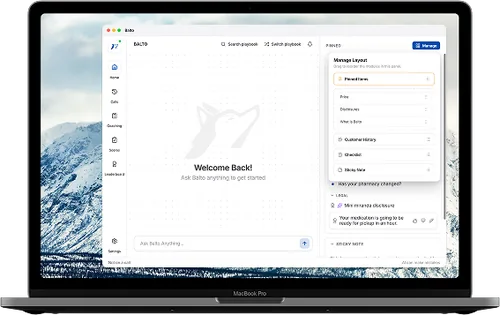
Balto is the AI Workforce for the contact center, built as one platform where agent assist, QA, and coaching all run on the same shared playbook. Insights ingests every interaction and generates the behavioral standards. Agent assist delivers those standards to frontline agents in real time. QA scores 100 percent of calls against the same rubric. Coaching reinforces the exact phrases and behaviors the playbook calls for. For the live-guidance leg specifically, see our breakdown of the best real-time agent assist tools for AHT reduction . When ops updates the playbook, the change propagates to all three surfaces at once.
Best for: Contact centers that want a genuine closed-loop system where one playbook powers agent assist, QA, and coaching across every interaction.
Key features:
- Shared playbook across agent assist, QA scorecards, and coaching sessions
- 100 percent automated QA on every call
- Real-time agent assist with dynamic prompts and AgentGPT knowledge chat
- Agentic Insights ingests calls and generates new standards that feed the loop
- Togo AI agent for autonomous outbound dialing with handoff into the same platform
Pricing: Per-seat per-month with custom enterprise pricing.
2. Cresta: Best generative-AI closed loop for sales and CX

Cresta pairs generative-AI real-time coaching with conversation intelligence and QA scoring in one system. Its strongest leg is the live guidance layer, where its gen-AI model surfaces next-best-action prompts during the call. QA and coaching feed into the same conversation data, so the loop is tight on the analytics side. The weaker leg is QA depth: its scorecards are evolving but are not yet at the maturity of dedicated QA platforms or Balto's shared-playbook model.
Best for: Sales-first and revenue-driven contact centers that want gen-AI live guidance as the primary surface and will accept a thinner QA layer.
Key features:
- Generative-AI real-time agent assist with dynamic prompts
- Conversation intelligence across 100 percent of interactions
- Coaching sessions built from gen-AI-flagged moments
- Native integrations with major CCaaS and CRM systems
Pricing: Quote-only, enterprise contracts.
3. Observe.AI: Best for QA-to-coaching automation

Observe.AI is strongest in the QA-to-coaching loop. Its Auto QA scores every call against customizable scorecards and automatically triggers coaching assignments based on the exceptions. It has a real-time agent assist layer, but it is lighter than Balto's or Cresta's, and the shared-standards story is partial: QA and coaching run on one scorecard, but agent assist uses a separate prompt library. For the pure QA depth comparison, see our guide to the best automated QA tools for mid-market and enterprise contact centers . It also offers autonomous voice agents for parts of the interaction mix.
Best for: Teams whose primary pain is QA coverage plus coaching automation and who treat live guidance as a secondary feature.
Key features:
- Auto QA scoring across 100 percent of calls
- Automated coaching triggers from QA exceptions
- Conversation intelligence and sentiment analytics
- Autonomous voice agents for routine interactions
Pricing: Enterprise-leaning, quote-only.
Tier 2: Full-Suite Platforms with Partial Standards Sharing
These four platforms bundle multiple functions but do not run them on a single shared playbook. They are strong if your constraint is single-vendor consolidation or CCaaS alignment, not shared standards.
1. Dialpad: Best for teams already on Dialpad phone

Dialpad bundles AI Live Coach, QA scoring, post-call insights, and coaching into a single workflow for Dialpad phone customers. The closed-loop pitch is real but scoped: it only applies if Dialpad is also your CCaaS or UCaaS layer. The standards layer is lightweight compared to Balto or Cresta, and the QA and coaching loop sits on top of the same call data but uses separate configuration surfaces.
Best for: Mid-market teams whose phone system is already Dialpad and who want the AI layer bundled with the CCaaS.
Key features:
- AI Live Coach with real-time next-best-action prompts
- QA scoring on 100 percent of Dialpad-routed interactions
- AI-generated call summaries and coaching hubs
- Native inside the Dialpad UCaaS or CCaaS stack
Pricing: Per-seat per-month, bundled with Dialpad phone plans.
2. Level AI: Best for mid-market QA plus agent assist bundle

Level AI offers QA automation, agent assist, and virtual agents from one vendor, positioned for mid-market contact centers. The QA leg is the strongest; agent assist sits on top of the same conversation data but uses a separate configuration layer. The coaching loop is partial: QA findings flag coaching needs, but handoff to a structured coaching workflow is lighter than Observe.AI or AmplifAI.
Best for: Mid-market teams that want QA plus agent assist from one vendor without an enterprise rollout.
Key features:
- Automated QA scoring with custom scorecards
- Agent assist with real-time prompts
- Virtual agents for routine interactions
- Analytics and sentiment reporting
Pricing: Quote-only, mid-market-friendly.
3. AmplifAI: Best for QA-triggered recognition workflows

AmplifAI runs a QA-driven coaching and recognition loop. Its model is to automate QA scoring, trigger coaching actions from QA exceptions, and reinforce desired behavior with recognition and gamification. It does not have a native real-time agent assist layer, which keeps the shared-standards story partial, but the QA-to-coaching loop is one of the tighter ones in the category.
Best for: Teams whose primary lever is QA-driven coaching plus recognition, not live guidance.
Key features:
- Automated QA scoring and exception flagging
- Coaching assignments triggered from QA findings
- Recognition and gamification for positive behavior reinforcement
- Performance analytics across teams and sites
Pricing: Quote-only, mid-market and enterprise.
4. NICE CXone: Best for enterprise CCaaS consolidation

NICE CXone is the full enterprise CCaaS suite with embedded quality management, coaching, analytics, and WEM. It includes the Playvox QA engine (acquired earlier) powering the WFM and QA layers. The closed-loop pitch is real at the enterprise level but comes with CCaaS heft: implementation and change management are substantial, and the agent assist layer is typically positioned as part of the WEM suite rather than the primary surface.
Best for: Enterprise contact centers consolidating CCaaS, WEM, QA, and analytics under one vendor.
Key features:
- Full CCaaS plus WEM plus QM in one stack
- QA and coaching inside the WEM suite
- AI-powered speech and text analytics
- Enterprise-scale reporting and compliance
Pricing: Enterprise-only, custom contracts.
Tier 3: Strong Point Solutions for Best-of-Breed Stacks
These three platforms are strong at one function but do not have a closed-loop story on their own. Shortlist them if you are building a best-of-breed stack and plan to pair them with a dedicated agent assist layer.
1. CallMiner: Best for deep post-call speech analytics

CallMiner is one of the deepest post-call speech analytics platforms in the market, with mature QA automation on top of its analytics engine. Its real-time agent assist capability is the weakest leg in the category, which is a foundational architectural constraint from its 2003 origins, not a feature gap. Coaching workflows exist but are driven from post-call findings, not from live interactions.
Best for: Teams whose primary lever is post-call analytics depth and who accept that agent assist will come from a different vendor.
Key features:
- Deep post-call speech analytics with 20+ years of language model tuning
- Automated QA scoring and compliance monitoring across 100 percent of calls
- Coaching workflows driven from post-call analytics findings
- Enterprise-scale deployment with multi-site support
Pricing: Enterprise, quote-only.
2. Rippit (formerly MaestroQA): Best for coaching-from-QA workflows

Rippit (rebranded from MaestroQA in March 2026) is a QA-primary platform with one of the most mature coaching-from-QA workflows in the category. It does not have an agent assist layer, so the shared-standards loop is open on the live side. Teams that run a best-of-breed stack often pair Rippit for QA and coaching with a dedicated agent assist vendor on top.
Best for: Teams that want a top-tier QA plus coaching surface and will source agent assist separately.
Key features:
- Automated QA scoring with calibrated scorecards
- Mature coaching workflows built directly on QA findings
- Calibration tooling for analyst consistency
- Quality analyst activity tracking and reporting
Pricing: Per-seat per-month.
3. Enthu.AI: Best budget option for mid-market QA plus agent assist

Enthu.AI is a leaner mid-market platform that bundles QA scoring with light agent assist. The shared-standards layer is partial: QA scores against configured rubrics and agent assist uses prompt libraries, but the two configuration surfaces are not deeply unified. The lower price point makes it a reasonable starting-point for mid-market teams that have not yet invested in a closed-loop platform.
Best for: Mid-market teams looking for a budget-friendly AI QA plus light agent assist bundle.
Key features:
- Automated QA scoring across 100 percent of recorded calls
- Light agent assist prompts for common scenarios
- Conversation analytics and sentiment reporting
- Straightforward mid-market pricing with faster rollout
Pricing: Per-seat per-month, mid-market-friendly.
How Balto Connects Agent Assist, QA, and Coaching on Shared Standards

Balto's closed-loop system is built on four mechanisms that share one standards layer. This is the structural reason the loop closes automatically, versus staying open in platforms that bundle the same functions on separate configuration surfaces.
One playbook powers all three functions
Every behavioral standard, phrase, compliance check, and best practice is defined once in the playbook. Agent assist reads from it live during the call. QA scores against it after the call. Coaching sessions reinforce it in async review. There is no translation layer between what the frontline agent is told to do, what they are scored on, and what they are coached toward.
Agentic Insights sets the standards
The Insights model ingests every interaction and surfaces the patterns that should become standards. When a top-performing frontline agent handles an objection in a way that lifts conversion, Insights flags it. Ops reviews, approves, and promotes it into the playbook. From that moment, agent assist delivers it live, QA scores for it, and coaching reinforces it.
Closed-loop coaching from the same scorecards
Coaching sessions are built directly from the QA scorecards. When a frontline agent misses the standard on a call, QA flags it, coaching bundles the moment into the next review session, and the review references the exact playbook item the call missed.
Why this matters for ROI
A closed loop compounds over time. Every call improves the playbook, every playbook update improves the next call, and the organization gets smarter per interaction. A disconnected stack can measure quality but cannot translate findings back into live behavior change at the speed a closed-loop platform can. Customers see QA scores lift 10 to 20 percentage points in the first months, ramp time drop 50 percent, and escalations drop 75 percent, because the loop runs continuously instead of in separate workflows.
For deeper reading on each layer, see our guides to real-time agent assist , QA automation , and contact center coaching .
Which Closed-Loop Platform Structure Fits Your Team?
Not every contact center needs a true closed-loop platform. Some teams are better served by a bundled full-suite vendor, and some need a best-of-breed stack with one dedicated agent assist layer on top. Answer five quick questions and this diagnostic will match your current stack and priorities to one of the three structures above, with a shortlist of platforms from this guide to start with.
The Closed-Loop Advantage
Disconnected point tools can measure contact center quality. Only closed-loop platforms can translate what they measure back into live behavior change at the speed interactions require. The platforms in Tier 1 earned that spot because their architecture was built for shared standards from the start, not retrofitted to look closed-loop in a demo. If a genuine closed loop is the goal, Balto is the shortest path to a system where agent assist, QA, and coaching all run on one source of truth and the loop closes automatically on every interaction.
FAQs
It means a single playbook, scorecard, or standards layer powers all three functions at the same time. What the platform tells a frontline agent during the call is the same standard QA scores against after the call, and the same standard coaching reinforces in review.
Most contact center AI stacks today bundle the three functions but keep their configuration surfaces separate, so the standards drift within weeks. A shared-standards platform propagates every update to all three surfaces at once, which is what closes the loop.
Three reasons. First, there is a translation gap: the agent assist prompts, the QA scorecard, and the coaching framework all encode "what good looks like" slightly differently, so the frontline agent gets conflicting signals. Second, updates fall out of sync: ops updates one tool and forgets the other two.
Third, there is no closed loop: QA can measure quality but cannot change behavior in real time, and coaching reinforces findings a week later instead of in the next call. A shared-standards platform closes all three gaps at once.
Balto is the most tightly closed-loop platform in 2026 because it was architected around a single shared playbook powering agent assist, QA, and coaching from day one, not bundled from acquisitions. Cresta and Observe.AI are the strongest alternatives in Tier 1, with Cresta owning the generative-AI live-guidance leg and Observe.AI owning the QA-to-coaching automation leg.
Tier 2 platforms bundle the same functions but do not run them on one standards layer, which keeps the loop open at one or more points.
Balto is the only platform in this list where a single shared playbook powers agent assist, QA, and coaching end to end. Cresta leads on generative-AI live guidance but has a maturing QA layer. Observe.AI leads on QA-to-coaching automation but has a lighter agent assist leg.
Level AI bundles QA and agent assist at a mid-market price point but runs them on separate configuration surfaces. It is also the only one with 9 years of production data behind the loop: 600M+ interactions guided, 1B+ real-time recommendations, and a #1 rating on G2, Capterra, and CMP Research.
Yes. The playbook is a single standards layer that agent assist reads from live, QA scores against on every call, and coaching reinforces in async review. When ops updates a standard, the change propagates across all three surfaces at once.
This is the structural reason customers see QA scores lift 10 to 20 points in the first months and ramp time drop 50 percent: the loop closes automatically instead of requiring three separate workflows.
You can, but with trade-offs. NICE CXone bundles QA, coaching, and analytics inside its WEM suite and is strong for single-vendor consolidation at the enterprise level. The agent assist layer tends to be a secondary surface, and the shared-standards story is partial because the acquired engines were not originally built to share one playbook.
For teams whose primary lever is shared standards across all three functions, a purpose-built closed-loop platform like Balto will run tighter. For teams whose primary lever is CCaaS consolidation at scale, NICE CXone is a reasonable choice.
Four KPIs move the fastest. QA scores lift 10 to 20 percentage points in the first months because agent assist is actively guiding against the same rubric QA is scoring. Ramp time for new frontline agents drops about 50 percent because coaching reinforces the exact playbook they are using live.
Escalations drop about 75 percent because agents have real-time answers grounded in QA-scored standards. Conversion rates on sales and collections calls see double-digit lift when the playbook is tied to a revenue standard.
Mid-market deployments typically land live in 4 to 8 weeks: the first weeks on playbook setup, the rest on agent assist rollout, QA scorecard calibration, and first coaching sessions. Enterprise rollouts run 12 to 16 weeks because of multi-site change management.
Purpose-built closed-loop platforms deploy faster than bundled CCaaS suites because there is only one standards layer to configure, not three.
Usually yes, if closed-loop is likely to be the direction in 12 to 24 months. Starting on a closed-loop platform for QA means the playbook is already built, so adding agent assist and coaching later is a configuration step, not a second platform purchase.
For teams that are firmly QA-only with no plans to add live guidance, a focused QA platform like Rippit or CallMiner is a reasonable fit.
Point-tool stacks look like they maximize per-function depth, but the loop is open: each tool has its own standards configuration, updates fall out of sync, and the ops team spends real hours keeping three systems aligned. Closed-loop platforms give up a small amount of per-function depth in exchange for a tight, automatic loop.
For most contact centers, the ROI of the loop is higher than an extra 10 percent on any single function, because the loop compounds every call. The exception is enterprise teams with specialist needs on one leg (deep speech analytics, for example), where a point tool paired with a closed-loop platform is defensible.
Liked what you read? See Balto in action.
Balto helps leading contact centers turn insights into outcomes, in real time. Book a live demo to discover how our AI powers better conversations, coaching, and conversions.