Balto vs CallMiner: Which Contact Center AI Platform Wins on Real-Time Plus Analytics?
Balto built real-time first in 2017 and runs a closed loop across Agent Assist, AI QA, Coaching, and Insights out of the box. CallMiner Eureka built post-call speech analytics first in 2002 and added real-time (RealTime module 2018) and generative AI (AI Assist 2024) on top.
Balto and CallMiner take different paths to contact-center AI. Balto , the #1 Rated Agent Assist, QA Automation, and Agentic Insights platform, built real-time agent assist first in 2017 and runs a closed loop across Agent Assist, AI QA, Coaching, and Insights on shared standards out of the box. CallMiner Eureka built post-call speech analytics first in 2002 and added real-time agent guidance through the RealTime module in 2018 and a generative-AI overlay (AI Assist) in October 2024. Both vendors have all four pillars. The honest distinction is design center. Balto holds a 4.8-star G2 rating across 587 reviews and was named Pioneering, the top tier, in CMP Research's Prism for Automated QA/QM with the highest perception score (6.4 out of 7) of any vendor evaluated. CallMiner Eureka holds 4.5 across 223 reviews and was placed in the Leading tier, one rung below.
What this comparison covers:
- How Balto's real-time-first closed loop differs from CallMiner's analytics-first architecture
- Side-by-side feature matrix across 25+ capabilities, filterable by what you care about
- Verified CallMiner pricing: average annual contract approximately $102,000 per Vendr buyer-guide data
- How the comparison plays out for BPO, Banking and Financial Services, Collections, Telecom, and Insurance
- Where CallMiner is honestly the better fit for some contact centers
- A defensible 60-day plan to switch if you decide to move
Balto vs CallMiner at a glance
| Feature | Balto | CallMiner Eureka |
|---|---|---|
| Founded | 2017 | 2002 |
| HQ | St. Louis, MO | Waltham, MA |
| Primary design center | Real-time-first closed loop. Agent Assist, AI QA, Coaching, and Insights run on shared standards out of the box. | Post-call speech analytics first. RealTime module added 2018. AI Assist (generative-AI overlay) added October 2024. |
| G2 rating | 4.8 ★ (587 reviews) | 4.5 ★ (223 reviews on CallMiner Eureka) |
| CMP Research Prism for Automated QA/QM | Pioneering tier (top of 5). 6.4 out of 7 perception score, highest of any vendor evaluated. | Leading tier (one tier below Balto). |
| Best for | Contact centers that want a full real-time-first closed loop working on day one across Agent Assist, QA, coaching, and insights. | Contact centers with mature post-call speech-analytics programs at scale, especially BPO operations processing millions of interactions daily. |
| Pricing model | Per agent per month. Bands shared during evaluation. | Enterprise-only, no public per-seat pricing. 60-agent minimum. Average annual contract approximately $102K per Vendr buyer-guide data. |
| Typical time-to-value | 4 to 6 weeks | 3 to 6+ months (per third-party reports) |
Closed-Loop Scorecard: real-time-first vs analytics-first
| Pillar | Balto: Exists | Balto: Native | Balto: Closed-loop | CallMiner: Exists | CallMiner: Native | CallMiner: Closed-loop |
|---|---|---|---|---|---|---|
| Agent Assist (real-time) | Y | Y | Y | Y | Y | Partial |
| AI Quality (Auto QA) | Y | Y | Y | Y | Y | Y |
| Coaching Workflow | Y | Y | Y | Y | Y | Partial |
| Shared-Standards Insights | Y | Y | Y | Y | Y | Partial |
What is Balto?
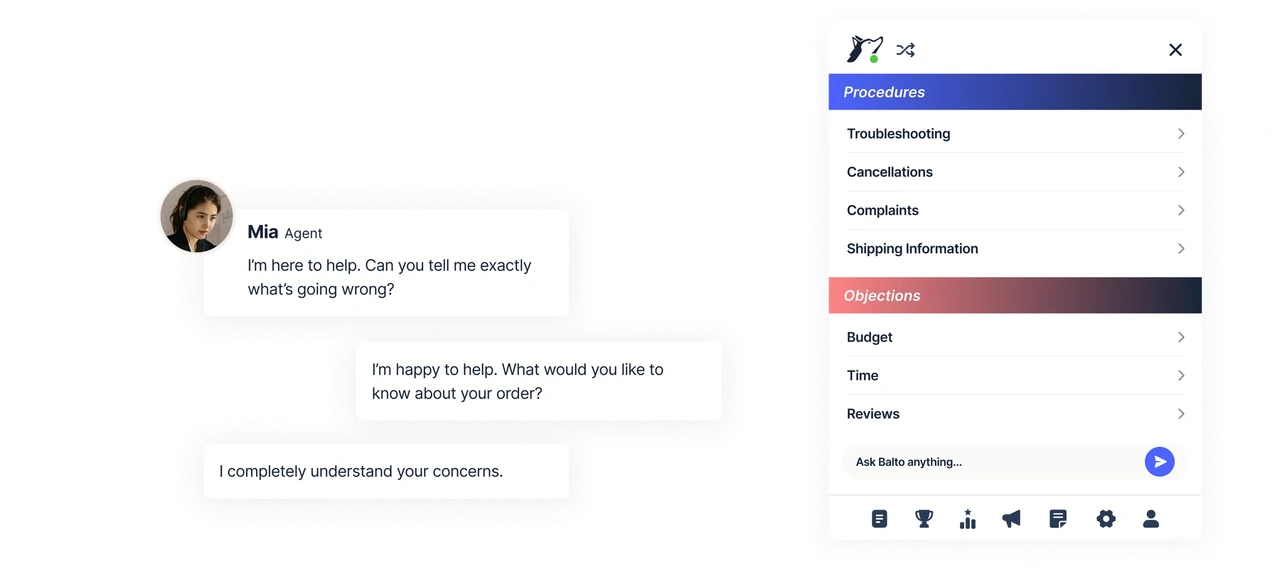
Balto is built around what an agent does on a live call. Agent Assist surfaces required script elements in real time. AI Answers brings knowledge to the screen when an agent or customer raises a topic. AgentGPT handles natural-language operator queries during the conversation. Customer History pulls account context from your CRM at the start of every call, so even a brand-new frontline agent arrives ready.
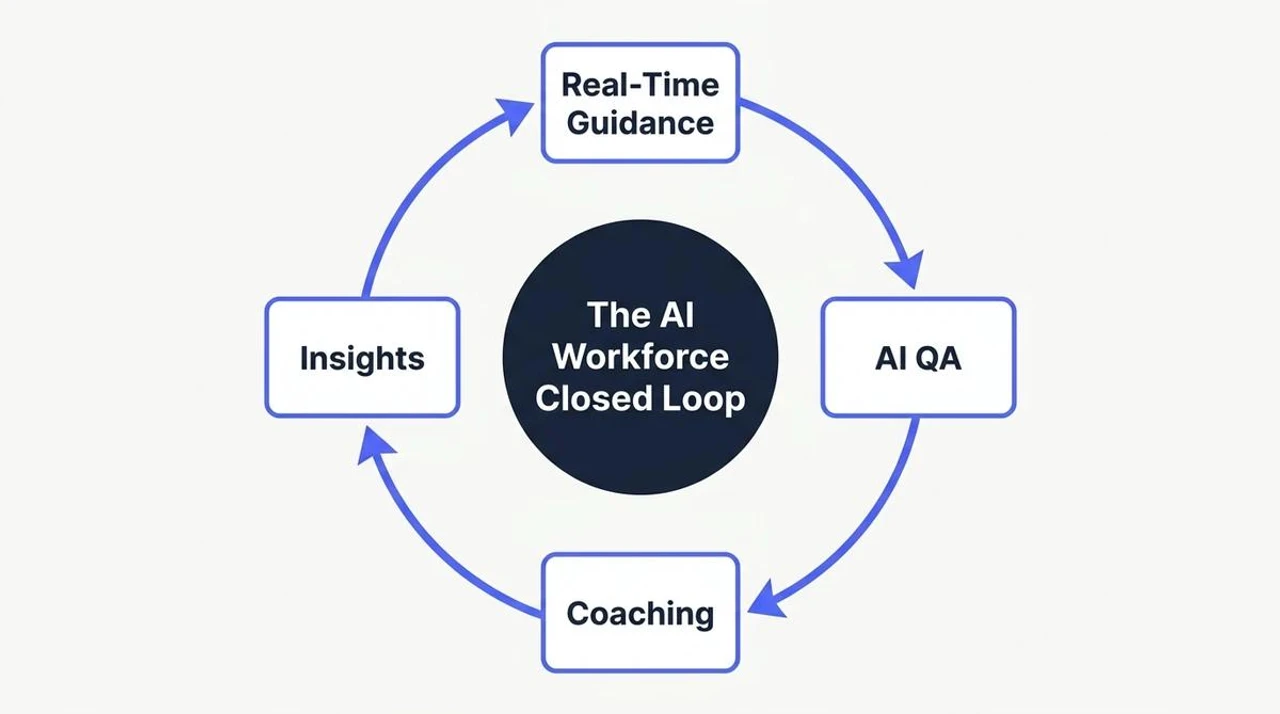
Those signals don't disappear when the call ends. They become the input the QA pillar scores on shared standards, which auto-feeds the Coaching Inbox, which feeds Insights that update what the AI surfaces on the next call. The closed loop runs across Agent Assist, QA, coaching, and insights without a manual handoff in the middle.
Balto was the first company to bring agent assist to market in 2017. Today the platform powers more than 300 customers and has guided over 500 million interactions in real time across BPO, financial services, insurance, healthcare, and home improvement. Balto holds a 4.8-star G2 rating across 587 reviews, ranks #1 reviewed Agent Assist on G2 and Capterra, was rated #1 out of 51 evaluated QA solutions in CMP Research's 2026 evaluation, and was named Pioneering (top tier of 5) in CMP Research's Prism for Automated QA/QM with the highest perception score (6.4 out of 7) of any vendor evaluated.
What is CallMiner?
CallMiner was founded in 2002 by Jeff Gallino, Cliff LaCoursiere, and Kim Brown, and is headquartered in Waltham, Massachusetts. The company has offices in the UK and Prague and approximately 320 employees. CallMiner is still independent, backed by a $75 million growth equity investment from Goldman Sachs in 2019. No acquisitions or strategic pivots in 2025 to 2026.
The original product was post-call speech analytics. The Eureka platform is the flagship and the architectural origin of everything CallMiner ships today. The full module catalog: Eureka (flagship platform), Analyze (auto-scoring and dashboards), Coach (supervisor workflows), Visualize (Tableau-powered analytics), Capture (omnichannel interaction capture), RealTime (live agent guidance and supervisor alerts, added 2018), Outreach (customer feedback and survey, added 2025), AI Assist (agentic AI overlay, launched October 2024), plus supporting modules (Redact, Alert, API).
CallMiner's customer base is heaviest in BPO, banking and financial services, collections, telecom, healthcare, retail, and energy and utilities. Named publicly: Sitel Group / Foundever (processes 3.5 million daily interactions through Eureka) and NTT BPO division (published case study). CallMiner Eureka carries a 4.5-star G2 rating across 223 reviews and was placed in the Leading tier of CMP Research's Prism for Automated QA/QM, one tier below Balto's Pioneering placement.
Balto vs CallMiner: feature-by-feature comparison
The filterable matrix below covers 25+ features across eight categories. Use the chips above the matrix to filter. Matching rows highlight and the matrix scrolls to that section. Below the matrix, three narrative blocks unpack the highest-stakes dimensions.
Real-time agent guidance. Both vendors have real-time agent assist. The honest distinction is design center and architectural maturity at real-time. Balto built real-time first in 2017 as the trigger of the closed loop. CallMiner shipped the RealTime module in 2018 as an addition to the Eureka speech-analytics engine. Eight years of CallMiner real-time vs nine years of Balto real-time, with fundamentally different architectural origins: Balto was real-time-native; CallMiner layered real-time on top of post-call speech analytics.
AI Quality (Auto QA) and analytics depth. CallMiner's Analyze module is a genuine strength. Speech analytics is their 20+ year core engineering investment, and Visualize adds Tableau-powered dashboards on top. Balto's QA edge is the integration: failed items auto-feed Coaching on shared standards by default, with no module orchestration in between. If you want deep post-call speech analytics as the primary program design, CallMiner has the longer track record at that scale. If you want QA-to-coaching automation on shared standards by default, Balto is the simpler buy.
Independent third-party validation (CMP Research Prism). CMP Research's Prism for Automated QA/QM placed Balto in the Pioneering tier (top of 5 tiers) with the highest perception score of any vendor evaluated (6.4 out of 7) and a perfect 4 out of 4 for innovation. CallMiner was placed in the Leading tier, one rung below. Independent third-party scoring matters when buyer committees ask for analyst validation alongside customer reviews.
Pricing and packaging: Balto vs CallMiner
Pricing transparency is a real difference here.
Balto. Per agent per month, with bands shared during evaluation. Pricing scales with seat count and contract length. Implementation is typically included on multi-year deals.
CallMiner. Enterprise-only, no public per-seat pricing. The 60-agent minimum is consistent across third-party sources. CallMiner offers two licensing models: annual inventory of hours analyzed (voice plus text) OR seat-based pricing across three tiers. Average annual contract: approximately $102,000 per Vendr buyer-guide data. Mid-market deployments run $50,000 to $200,000 per year. Enterprise deployments with 100% omnichannel analysis can exceed $500,000 per year. CallMiner has an AWS Marketplace listing but it is 'Private Offer Only' with no published price card.
Pricing summary
| Feature | Balto | CallMiner |
|---|---|---|
| Pricing model | Per agent per month | Enterprise-only. Two licensing models: hours-analyzed inventory OR seat-based across 3 tiers. |
| Public per-seat anchor | Bands shared during evaluation | None published |
| Minimum commitment | Flexible by seat | 60-agent minimum |
| Average annual contract | Shared during evaluation | Approximately $102,000 (Vendr buyer-guide data) |
| Mid-market range | Shared during evaluation | $50,000 to $200,000 per year |
| Enterprise omnichannel | Shared during evaluation | Can exceed $500,000 per year |
| Implementation | Typically included on multi-year | Typically involves professional services engagement |
Deployment, integrations, and time-to-value
Typical time-to-value. Balto: 4 to 6 weeks from kickoff to first live value. CallMiner: 3 to 6 or more months per third-party reports (ringly.io, alpharun.com). The roughly 2 to 5 month delta compounds when CFOs are timing AI ROI by the quarter.
Telephony integrations. Both vendors integrate with the major CCaaS platforms: Five9, NICE CXone, Genesys Cloud CX, Talkdesk, and Dialpad. Balto has built more than 60 integrations across telephony, CRM, and adjacent contact-center systems, with a dedicated integration team on every deployment.
CRM integrations. Both integrate with Salesforce, HubSpot, and Zendesk. Specific integration counts and certifications vary by quarter. Confirm against your current stack before contracting.
Operational independence. Balto's playbook editor is self-service. Supervisors update prompts, scorecards, and compliance triggers without filing a vendor ticket. CallMiner deployments typically involve professional services engagement given the platform's analytics depth and module breadth.
Time-to-value: 2 to 5 months faster with Balto
Weeks: Balto kickoff to live
Out-of-box closed loop. Self-service playbook editor. No engineering team required.
Months: CallMiner typical
Module-by-module deployment across Eureka, Analyze, Coach, Visualize, Capture, RealTime, AI Assist, and active extensions.
Balto integrations built
Dedicated integration team on every deployment.
The closed-loop difference: real-time-first vs analytics-first
Both Balto and CallMiner have all four pillars. The structural difference is the design center.
Balto built real-time first in 2017. Agent Assist was the original product and the trigger of the closed loop. The scorecards Agent Assist uses are the same scorecards QA uses, which auto-feed Coaching on the same standards, which feed Insights that update what the AI surfaces on the next call. No module orchestration required.
CallMiner built post-call speech analytics first in 2002. Eureka is the engine. The RealTime module (2018) layered live agent guidance on top of the post-call architecture. AI Assist (October 2024) added a generative-AI overlay. The pillars are individually capable, and Analyze is a recognized strength, but the loop runs through module orchestration rather than as a default behavior across shared scorecards.
The reason this matters is what happens when AI gets deployed alongside agents. Most AI tools create friction with the people they're supposed to help. Agents see them as a threat. That fear kills adoption, and AI never gets the data it needs. Balto runs the opposite play. One system where AI and frontline agents work together and learn from each other.
Walk through each pillar in Balto's loop to see how it works in practice.
The 4 pillars in Balto's loop
Agent Assist: the loop trigger
What an agent does on a live call (AI Checklist completion, AI Answers usage, compliance prompt adherence) is the data the QA pillar will score against next, on the same scorecards. CallMiner's RealTime module captures real-time signals too, but the unified flow into QA on shared standards across modules is configured per deployment.
AI QA: scored on shared standards
Balto's QA scores roll into coaching automatically because the scorecards are shared with Agent Assist. CallMiner's Analyze module is widely cited as strong. The handoff to coaching as a unified workflow on shared standards across modules requires configuration.
Coaching: auto-fed from QA
Balto's Coaching Inbox shows items like 'Talked over the customer' alongside the related call recordings, generated automatically from QA scoring on shared standards. CallMiner's Coach module supports this flow with cross-module workflow configuration.
Insights: feed real-time on the next call
Balto's Insights use the same scorecards as the other three pillars, so trends update what the AI surfaces in real time on the next call. CallMiner's Visualize layer is Tableau-powered analytics; cross-module standards-sharing that feeds back into real-time prompts requires orchestration.
Independent third-party validation backs the architectural distinction. CMP Research's Prism for Automated QA/QM placed Balto in the Pioneering tier (top of 5) with the highest perception score of any vendor evaluated (6.4 out of 7). CallMiner was placed in the Leading tier, one rung below.
See Balto's Agent Assist in action
Watch a 90-second product walkthrough of how Balto's live in-call guidance starts the closed loop.
How Balto vs CallMiner compares for your industry
Different industries weight different capabilities. BPO leads on real-time agent ramp and per-client scorecards. Banking and financial services lives or dies by audit and live compliance. Collections lives or dies by Reg F and mini-Miranda enforcement on every call. Telecom needs high-volume customer service and complaint resolution. Insurance needs scripted disclosure prompts during open enrollment. Use the tabs below to see the comparison through your industry's lens.
BPO: real-time ramp plus per-client scorecards

CallMiner's BPO depth is real. Sitel/Foundever processes 3.5M daily interactions through Eureka. NTT BPO division is a published case study. 20+ years of speech-analytics engineering at scale.
Balto's BPO advantage is real-time-first ramp on shared standards. New-agent first calls get AI Checklist guidance out of the box. Per-client scorecards are first-class. No engineering team required.
100% real-time plus 100% AI QA on the same standards from day one (Balto) vs Eureka plus Analyze plus RealTime module orchestration (CallMiner).
Self-service playbook editor for client-specific compliance prompts (Balto) vs vendor-managed or professional-services-engaged configuration (CallMiner).
Ramp without an engineering team: yes (Balto). CallMiner deployments at BPO scale typically involve professional services engagement.
Banking and Financial Services: compliance, audit, multi-channel
Live compliance prompts during the call (Balto) vs detected post-call via Analyze plus RealTime alerts (CallMiner).
SOC 2 Type II on both. Standard banking and financial-services controls on both.
Multi-channel: Balto Omni-Channel covers calls, emails, chats, SMS on shared standards. CallMiner Capture is the omnichannel ingestion layer; cross-channel standards-sharing happens through Eureka orchestration.
Audit-ready trail: shared scorecards across all four pillars by default (Balto). CallMiner Eureka module orchestration with Visualize reporting (CallMiner).
Self-service playbook editor for state-specific variations and changing regulations (Balto) vs professional-services configuration cycles (CallMiner).
Collections: TCPA, Reg F, mini-Miranda enforcement in real time
Mini-Miranda enforcement: real-time prompt fires before the call moves on (Balto). CallMiner RealTime can alert on compliance triggers; Balto's loop-on-shared-standards keeps the enforcement and coaching loop unified.
Reg F right-party contact: live prompts walk the agent through validation (Balto). CallMiner Analyze plus RealTime detects validation issues; coaching follow-up flows through Coach module orchestration.
Abusive-language detection: real-time supervisor alerts on at-risk calls (Balto). CallMiner Eureka's analytics depth catches abusive-language patterns at scale.
Settlement-offer compliance: live checklist enforces required elements (Balto). CallMiner Analyze can score settlement-offer scripts retrospectively.
Coaching from compliance failures: auto-scheduled from QA on shared standards (Balto). CallMiner Coach module supports this with cross-module workflow configuration.
Telecom: high-volume customer service and complaint resolution
CallMiner's telecom track record is substantial. Large-volume post-call analytics for service interactions is exactly the use case Eureka was built for.
Balto's telecom advantage is real-time intervention on complaint and retention calls, with live AI Answers for plan and policy lookup mid-call.
Customer-distress detection: CallMiner's analytics depth includes behavioral and sentiment patterns. Balto's Agent Assist surfaces de-escalation prompts in real time.
100% interaction coverage: both vendors score 100% of calls. Balto on shared scorecards across all pillars; CallMiner through Eureka and module orchestration.
Time-to-value at telecom scale: 4 to 6 weeks (Balto) vs 3 to 6+ months (CallMiner deployments at this scale).
Insurance: claims, open enrollment, and compliance
Live disclosure prompts during the call (Balto) vs detected post-call via Analyze plus RealTime alerts (CallMiner).
Seasonal agent ramp during open enrollment: out-of-box on Balto's Agent Assist. CallMiner ramps slower given the module-by-module deployment pattern.
Errors caught before they reach the customer (Balto, real-time prompts) vs caught in retrospective QA (CallMiner's original strength).
Audit-ready reporting on shared standards (Balto) vs Visualize reporting depth (CallMiner's strength via Tableau-powered analytics).
Coverage of state-specific variations and changing regulations: self-service playbook editor (Balto) vs professional-services configuration (CallMiner).
Customer evidence and ratings
Both platforms have customer bases. The shape of those bases is the strongest single signal on this page.
Balto holds a 4.8-star G2 rating across 587 reviews. CallMiner Eureka holds a 4.5-star rating across 223 reviews. Balto carries 2.6 times the review volume at a 0.3-star delta higher rating. The closer ratings reflect CallMiner's longer time in market and substantial enterprise installed base.
Third-party G2 comparison findings: reviewers say compared to CallMiner Eureka, Balto is easier to set up, easier to admin, and more usable.
Independent analyst validation: Balto was named Pioneering (top tier) in CMP Research's Prism for Automated QA/QM with the highest perception score of any vendor evaluated. CallMiner was placed in the Leading tier, one rung below.
What customers say about Balto on G2
Ana Maria M.
Trainer
It’s guided scripts, being able to see a summary after calls, and using it every day helps to improve call quality. It provides great ideas for handling difficult topics with customers. The screen is adjustable and customizable, great for adapting to your needs.
Arielle J.
Inside Sales Representative
What I like most about Balto is the call summary that is given at the end of each call.
Paul G.
Internal Sales Rep
Balto keeps me on track when I am not sure of what to say. The ease of implementation into our other software makes the rebuttals smooth, as they effortlessly seem to appear with 3 options, which they check for you once verbalized in the call. This keeps efficiency and focus more centered in every call.
Raphael R.
Stabilization Manager
Balto has been phenomenal! I truly appreciate how Balto ensures our customer service is up to par and of top tier quality.
Ruth A.
ACA Sales Agent
Helps me keep compliant with ACA regulations.
When CallMiner might be the better fit for you
Scenario 1: centers with mature post-call speech-analytics programs at scale
CallMiner has 20+ years of speech-analytics engineering. The Eureka platform is battle-tested at high volume, and the module suite (Analyze for auto-scoring and dashboards, Visualize for Tableau-powered analytics, Capture for omnichannel ingestion, Coach for supervisor workflows) is genuine domain expertise in retrospective audit. If your contact center is running deep post-call analytics across millions of interactions, your QA analyst team owns the scoring workflow end to end, and your existing workflows are built around CallMiner's stack, the switching cost may outweigh the closed-loop benefit Balto adds. Buyer profile: 500 to 5,000 agent enterprise center, mature batch-review QA culture, dedicated QA analyst team that has invested significantly in CallMiner workflows. What to do next: evaluate whether Balto's closed-loop value is enough to justify replacing entrenched CallMiner workflows.
Scenario 2: large BPO operations with multi-million-interaction post-call analysis needs
CallMiner's flagship BPO customers operate at extreme scale. Sitel Group / Foundever processes 3.5 million daily interactions through Eureka. NTT BPO division is a published case study. 20+ years of speech-analytics engineering at high volume is genuine track record. If your operation is at that scale and your primary unmet need is post-call analytics infrastructure proven at multi-million-interaction-per-day volume, CallMiner's specific BPO depth is real domain expertise. Buyer profile: BPO operation processing millions of interactions daily across multiple client programs, post-call analytics infrastructure is the central program design.
If CallMiner isn't your fit, see how it stacks up against the wider field of alternatives .
Why contact center leaders pick Balto over CallMiner
Real-time built first, not added later
Balto launched Agent Assist in 2017 as the original product and the trigger of the closed loop. CallMiner RealTime module shipped in 2018 as an addition to a post-call speech-analytics engine that has been the architectural origin since 2002. Both vendors have real-time. The architectural origin matters when real-time is the unmet need.
Independent third-party validation
CMP Research's Prism for Automated QA/QM named Balto Pioneering (top tier of 5) with the highest perception score of any vendor evaluated (6.4 out of 7) and a perfect 4 out of 4 for innovation. CallMiner was placed in the Leading tier, one rung below.
Closed loop runs out of the box
Agent Assist, AI QA, Coaching, and Insights run on the same scorecards by default. A failed QA item auto-feeds Coaching. Insights update what the AI surfaces on the next call. No module orchestration required.
4 to 6 weeks to first live value
CallMiner deployments typically run 3 to 6 or more months per third-party reports. Balto's out-of-box closed loop ships faster because it doesn't require module-by-module configuration across an analytics platform.
Works without an engineering team or professional services
Balto's playbook editor is self-service. Supervisors update prompts, scorecards, and compliance triggers without filing a vendor ticket. CallMiner deployments typically involve professional services engagement.
How to switch from CallMiner to Balto: 60-day migration plan
A typical migration from CallMiner to Balto runs 60 days end-to-end in three phases. Most centers run the parallel phase deliberately. It lowers risk and gives supervisors a calibration window, especially for confirming that Balto's Agent Assist plus AI Answers plus Coaching covers the post-call analytics depth the team built around Eureka.
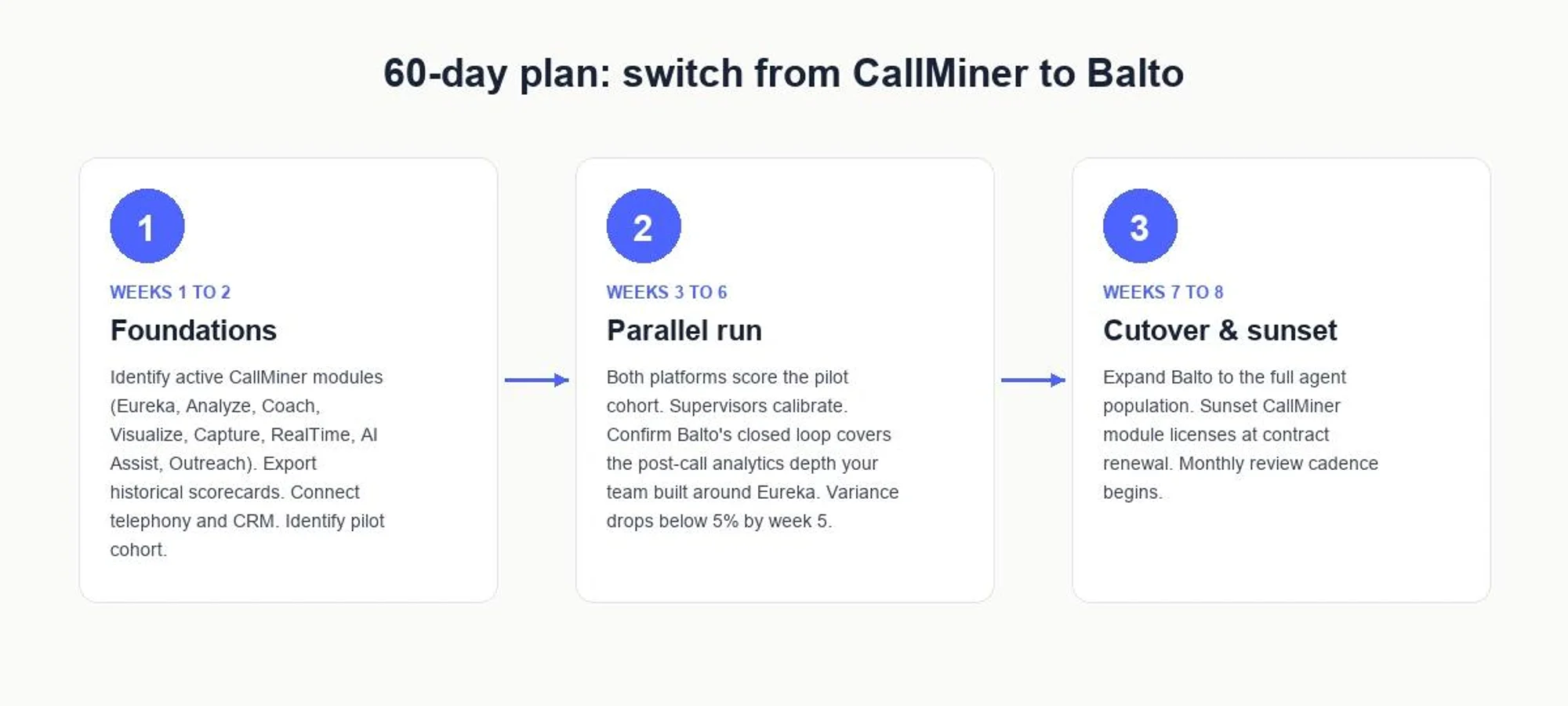
Phase 1: foundations (weeks 1 to 2). Identify which CallMiner modules are currently active: Eureka, Analyze, Coach, Visualize, Capture, RealTime, AI Assist, Outreach, and any supporting modules. Export historical scorecard data and analytics dashboards from Visualize. Map existing scorecards into Balto's shared-standards model. Connect telephony (Five9, NICE, Genesys) and CRM (Salesforce, HubSpot, Zendesk) integrations. Identify the pilot agent cohort, typically 10 to 20% of the floor.
Phase 2: parallel run (weeks 3 to 6). Both platforms score the pilot cohort in parallel. Supervisors calibrate Balto outputs against the CallMiner baseline week by week. Pay particular attention to whether Balto's Agent Assist plus AI Answers plus Coaching covers the post-call analytics depth your team has built around Eureka. By week 5, scorecard variance between the two platforms typically drops below 5%.
Phase 3: cutover and sunset (weeks 7 to 8). Expand Balto to the full agent population. Sunset CallMiner module licenses at the next renewal point. Most centers time the switch to a contract anniversary to avoid double-paying. Establish the monthly review cadence and feedback loop with the Balto CSM.
Centers that skip the parallel-run phase typically regret it. Running both in parallel for a month lets you confirm the closed-loop QA, coaching, and insights flow is producing equivalent or better outputs before committing the entire floor.
Is Balto right for you?
Three questions. We'll tell you honestly, including when CallMiner may be the better fit for your contact center.
What would switching save you?
Estimate the operational value of switching from CallMiner to Balto. Inputs default to mid-market values. Adjust to your numbers. The CallMiner annual cost field defaults to approximately $102K based on Vendr buyer-guide data; enterprise omnichannel deployments can exceed $500K per year.
Real-world outcomes across verticals


FAQs: Balto vs CallMiner
Balto built real-time agent assist first in 2017 and runs a closed loop across Agent Assist, AI QA, Coaching, and Insights on shared standards out of the box. CallMiner Eureka built post-call speech analytics first in 2002 and added real-time agent guidance (RealTime module, 2018) and generative AI (AI Assist, October 2024) on top of the analytics-first architecture. Both vendors have all four pillars. The honest distinction is the design center and how the closed loop runs. Balto's loop runs on shared scorecards by default. CallMiner's pillars ship as modules that orchestrate across each other. Balto holds 4.8/587 G2 reviews and was named Pioneering in CMP Research's Prism for Automated QA/QM. CallMiner Eureka holds 4.5/223 G2 reviews and was placed in the Leading tier.
Balto carries 2.6 times the G2 review volume (587 vs 223) at a 0.3-star higher rating (4.8 vs 4.5). CMP Research's Prism for Automated QA/QM placed Balto in the Pioneering tier (top of 5) with the highest perception score of any vendor evaluated (6.4 out of 7), and CallMiner in the Leading tier, one rung below. That said, CallMiner is the right call for some contact centers, specifically centers with mature post-call speech-analytics programs at scale and large BPO operations processing multi-million-interaction post-call analysis volumes.
Yes. CallMiner introduced the RealTime module as part of the Eureka platform in 2018. Features include Live Insights (mid-call desktop alerts to agents), Live Listen (supervisor barge-in), Agent Call for Help (agent-initiated escalation), next-best-action prompts, and compliance alerts. CallMiner AI Assist (launched October 2024) added a generative-AI overlay with real-time summarization and AI classifiers. The honest distinction is architectural orientation, not capability presence. Balto was real-time-native from 2017. CallMiner layered real-time on top of a post-call speech-analytics engine that has been the architectural origin since 2002.
CallMiner is enterprise-only with no public per-seat pricing. The 60-agent minimum is consistent across third-party sources. CallMiner uses two licensing models: annual inventory of hours analyzed (voice plus text) or seat-based pricing across three tiers. Average annual contract: approximately $102,000 per Vendr buyer-guide data. Mid-market deployments run $50,000 to $200,000 per year. Enterprise omnichannel deployments can exceed $500,000 per year. Balto's pricing model is per agent per month, with bands shared during evaluation. Request a custom Balto quote for your specific seat count and contract terms.
CallMiner has a 60-agent minimum to get started, consistent across third-party pricing analyses (Alpharun, Vendr, CheckThat.ai). The enterprise-sales motion is the standard go-to-market. CallMiner's average annual contract is approximately $102,000 per Vendr data, with mid-market deployments running $50K to $200K per year. Balto supports flexible seat counts and works with contact centers below 60 agents through enterprise scale. Bands are shared during evaluation.
As of June 2026, Balto holds a G2 rating of 4.8 stars across 587 reviews. CallMiner Eureka holds 4.5 stars across 223 reviews. Balto carries 2.6 times the review volume at a 0.3-star higher rating. Third-party G2 comparison findings: reviewers say compared to CallMiner Eureka, Balto is easier to set up, easier to admin, and more usable. Balto is also ranked #1 reviewed Agent Assist on G2 and Capterra and #1 out of 51 evaluated QA solutions in CMP Research's 2026 evaluation. Verify the current numbers on each vendor's G2 profile before any final selection.
CallMiner Eureka is the flagship platform, the 2002-origin post-call speech analytics engine that everything CallMiner ships builds on. Modules within Eureka: Analyze (auto-scoring and dashboards), Coach (supervisor workflows), Visualize (Tableau-powered analytics), Capture (omnichannel interaction capture). CallMiner RealTime is the in-call module added to Eureka in 2018, providing Live Insights, Live Listen, and Agent Call for Help. CallMiner AI Assist, launched October 2024, is a generative-AI overlay across Eureka and RealTime that adds real-time summarization, AI classifiers, and supports in-platform actions.
Balto: 4 to 6 weeks from kickoff to first live value. CallMiner: 3 to 6 or more months per third-party reports (ringly.io, alpharun.com). The roughly 2 to 5 month delta reflects CallMiner's module-by-module configuration across Eureka, Analyze, Coach, Visualize, Capture, RealTime, AI Assist, and any active extensions. Balto's out-of-box closed loop ships faster because it doesn't require module-by-module configuration across an analytics platform.
CMP Research's Prism for Automated QA/QM evaluates contact-center AI vendors across multiple dimensions. Balto was named Pioneering, the top tier of 5 tiers (Pioneering > Leading > Core Performing > Up and Coming > Emerging), with the highest perception score of any vendor evaluated (6.4 out of 7) and a perfect 4 out of 4 for innovation. CallMiner was placed in the Leading tier, one rung below Balto. The tier-position difference is the cleanest citable proof point for independent third-party analyst validation of the two vendors.
A typical 60-day migration runs in three phases. Weeks 1 to 2 are foundations: identify active CallMiner modules (Eureka, Analyze, Coach, Visualize, Capture, RealTime, AI Assist, Outreach), export historical scorecard data and analytics dashboards, map scorecards into Balto's shared-standards model, connect telephony and CRM integrations. Weeks 3 to 6 are a parallel run, with both platforms scoring the pilot cohort while supervisors calibrate. Weeks 7 to 8 are cutover. Balto rolls out to the full agent population and CallMiner module licenses sunset at renewal.
Both Balto and CallMiner integrate with the major CCaaS platforms: Five9, NICE CXone, Genesys Cloud CX, Talkdesk, and Dialpad. Both also integrate with the major CRMs: Salesforce, HubSpot, and Zendesk. Balto has built more than 60 integrations across telephony, CRM, and adjacent contact-center systems, with a dedicated integration team on every deployment. Specific integration counts and certifications vary by quarter. Confirm with each vendor against your current telephony and CRM stack before committing.
The most common reasons cited by Balto customers: real-time built first in 2017 vs added 2018 on top of a 2002 post-call analytics engine. Independent third-party validation (CMP Research Pioneering tier vs Leading tier). The closed loop runs out of the box on shared scorecards by default. 4 to 6 weeks to first live value vs 3 to 6 or more months for CallMiner. Works without an engineering team or professional services. That said, CallMiner is the right choice for some contact centers. See the When CallMiner might be the better fit section above for the two scenarios where CallMiner's analytics depth and BPO scale references are genuinely the better match.
Ready to see Balto in action?
Book a 15-minute demo. We'll show you Balto's closed loop running on a call from your industry. No slideware, no pre-recorded demos.
How we built this comparison. Last updated June 19, 2026. Sources: G2 reviews (587 for Balto, 223 for CallMiner Eureka as of build date, verified direct from g2.com/sellers/balto and g2.com/products/callminer-eureka/reviews); vendor product documentation (balto.ai and callminer.com); CallMiner press releases via Businesswire (AI Assist launch October 2024, Eureka platform with RealTime module launch 2018, Goldman Sachs $75M investment 2019); pricing references (CallMiner's own pricing FAQ, Alpharun pricing analysis, Vendr buyer guide, CheckThat.ai vendor overview); CMP Research Prism for Automated QA/QM (Balto Pioneering tier, CallMiner Leading tier); Balto customer evidence from 39 case studies, 19 testimonials, and 25 G2 reviews. Refresh cadence: quarterly. If you spot something out of date, let us know.