Balto vs Cresta: Which Contact Center AI Platform Has Happier Customers?
Both vendors have all four pillars. The honest distinction: Balto carries 4.8 stars on G2 across 575 reviews. Cresta carries 4.2 across 43.
Balto and Cresta both promise to make your team better. They take different paths to get there. Balto , the #1 Rated Agent Assist, QA Automation, and Agentic Insights platform, runs a closed loop where Agent Assist, AI QA, coaching, and insights work on the same standards out of the box. Cresta is a full-suite contact-center AI platform with strong developer tooling and the latest agentic features. The honest distinction: customer satisfaction. Balto carries a 4.8-star G2 rating across 575 reviews. Cresta carries 4.2 across 43.
What this comparison covers:
- How Balto's out-of-box closed loop differs from Cresta's developer-tooling-led approach
- Side-by-side feature matrix across 25+ capabilities, filterable by what you care about
- Verified pricing bands ($60K to $150K per year per Cresta module) and what each tier includes
- How the comparison plays out for BPO, insurance, financial services, home improvement, and travel & hospitality
- Where Cresta is honestly the better fit for some contact centers
- A defensible 60-day plan to switch if you decide to move
Balto vs Cresta at a glance
| Feature | Balto | Cresta |
|---|---|---|
| Founded | 2017 | 2017 |
| HQ | St. Louis, MO | Mountain View, CA |
| Primary design center | Customer-satisfaction-proven closed loop. Agent Assist fires in-call. QA, coaching, and insights close it on shared standards out of the box. | Developer-tooling-led full-suite platform. Modules orchestrated via Conductor or vendor implementation. |
| G2 rating | 4.8 ★ (575 reviews) | 4.2 ★ (43 reviews) |
| Best for | Contact centers that want a closed-loop platform that works on day one without an in-house AI engineering team. | Enterprise centers with $300K+ platform budget and in-house AI dev capacity for custom agent build-out. |
| Pricing model | Per agent per month. Bands shared during evaluation. | Per module. AWS Marketplace lists Agent Assist at $150,000 per year per channel. Realistic enterprise band $60K to $150K per year per module. |
| Typical time-to-value | 4 to 6 weeks | 8 to 16 weeks (depending on module count and Conductor build-out) |
Closed-Loop Scorecard: out-of-box vs orchestrated
| Pillar | Balto: Exists | Balto: Native | Balto: Closed-loop | Cresta: Exists | Cresta: Native | Cresta: Closed-loop |
|---|---|---|---|---|---|---|
| Agent Assist | Y | Y | Y | Y | Y | Partial |
| AI Quality (Auto QA) | Y | Y | Y | Y | Y | Partial |
| Coaching Workflow | Y | Y | Y | Y | Y | Partial |
| Shared-Standards Insights | Y | Y | Y | Y | Y | Partial |
What is Balto?
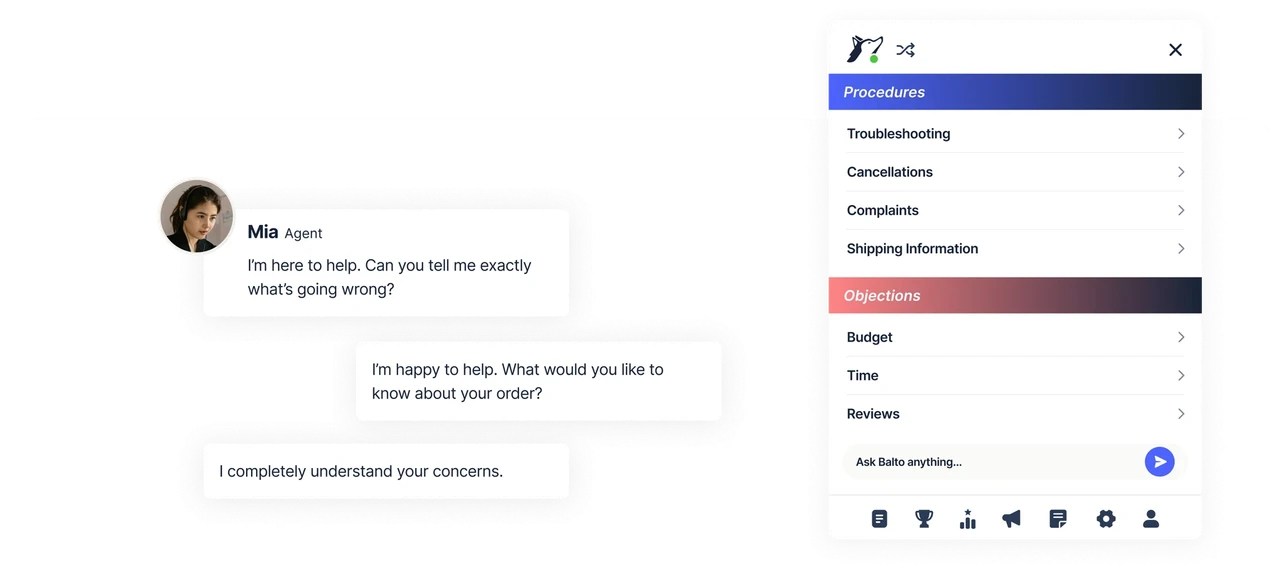
Balto is built around what an agent does on a live call. Agent Assist surfaces required script elements in real time. AI Answers brings knowledge to the screen when an agent or customer raises a topic. AgentGPT handles natural-language operator queries during the conversation. Customer History pulls account context from your CRM at the start of every call, so even a brand-new frontline agent arrives ready.
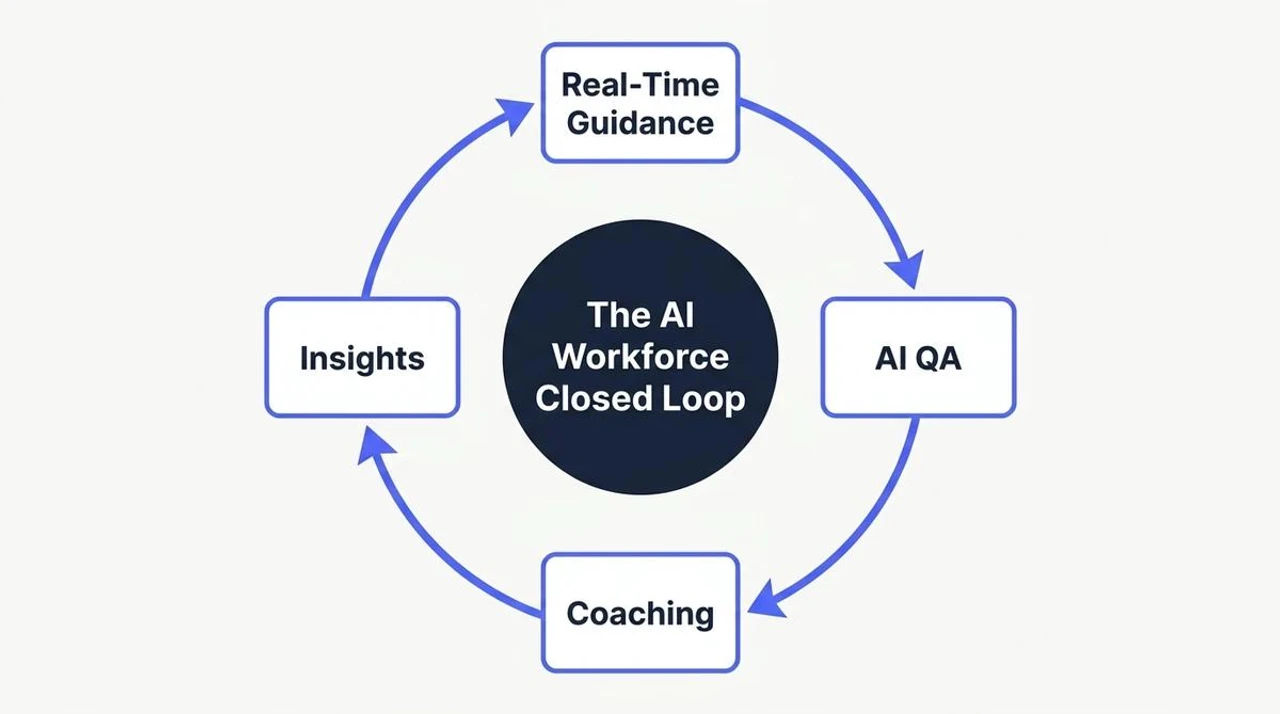
Those signals don't disappear when the call ends. They become the input the QA pillar scores on shared standards, which auto-feeds the Coaching Inbox, which feeds Insights that update what the AI surfaces on the next call. The closed loop runs across Agent Assist, QA, coaching, and insights without a manual handoff in the middle.
Balto was the first company to bring agent assist to market in 2017. Today the platform powers more than 300 customers and has guided over 500 million interactions in real time across BPO, financial services, insurance, healthcare, and home improvement. Balto holds a 4.8-star G2 rating across 575 reviews, ranks #1 reviewed Agent Assist on G2 and Capterra, and was rated #1 out of 51 evaluated QA solutions in CMP Research's 2026 evaluation.
What is Cresta?
Cresta is a full-suite contact-center AI platform founded in 2017 and headquartered in Mountain View, California. The platform spans Agent Assist (for chat and voice), Conversation Intelligence, Quality Management, Coach, Knowledge Agent, AI Agent, and Conductor, the developer-tooling layer for building custom AI agents on the platform.
The current product cadence is fast. Knowledge Agent launched in March 2026 as an agentic assistant with ambient listening capabilities. Synthetic Customers launched in May 2026 as a way to generate AI personas from real conversation data for agent training. Conductor launched June 11, 2026, positioned as 'the agent for AI agent development' with a claim of deploying production-grade AI agents 2x faster. TELUS Digital was named Cresta's preferred implementation partner on June 15, 2026.
Cresta carries a 4.2-star G2 rating across 43 reviews and serves enterprise contact centers and BPOs with technical teams that can build and tune custom AI agents on the Cresta platform.
Balto vs Cresta: feature-by-feature comparison
The filterable matrix below covers 24+ features across eight categories. Use the chips above the matrix to filter. Matching rows highlight and the matrix scrolls to that section. Below the matrix, three narrative blocks unpack the highest-stakes dimensions.
Agent Assist. Both vendors have native agent assist. The honest distinction is design center. Balto's Agent Assist is the trigger of the closed loop. What the frontline agent sees and does in the call becomes the input the rest of the platform scores against, on the same scorecards, by default. Cresta's Agent Assist is one module among several. To behave as part of a unified closed loop on shared standards, you orchestrate via Conductor or contract TELUS Digital for implementation services on top of the platform license.
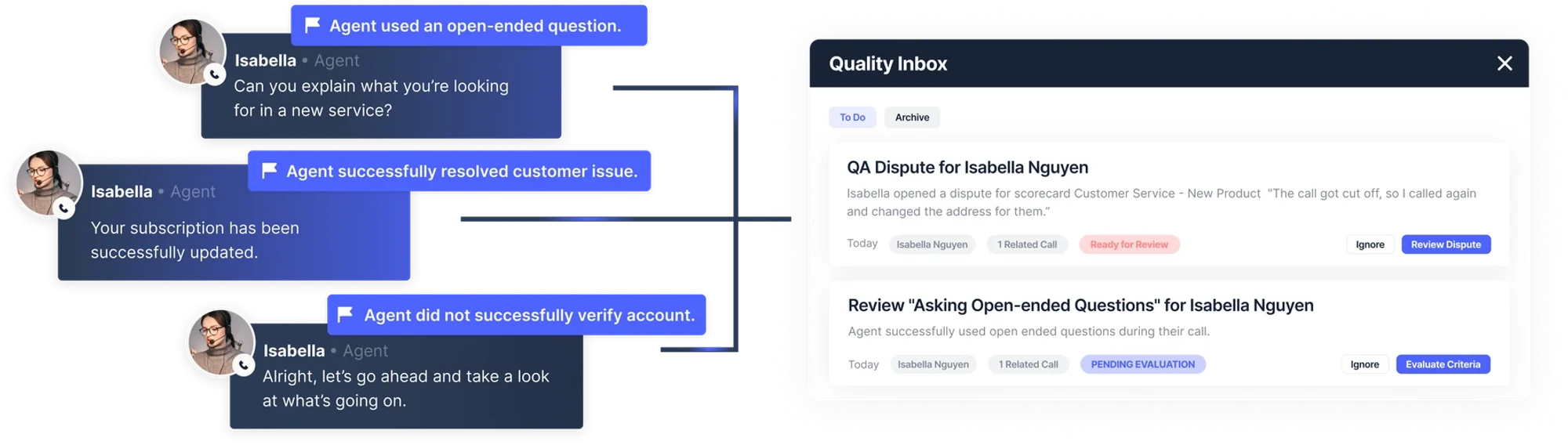
AI Quality (Auto QA). Both platforms score 100% of calls automatically and support configurable scorecards. Cresta's Quality Management module is a recognized strength. Balto's QA edge sits in the integration. A failed QA item auto-feeds the Coaching Inbox on shared standards, with no Conductor build, no CSV export, no supervisor handoff in the middle. Cresta's QA-to-Coaching workflow needs to be configured or built before it runs as a unified loop.
Pricing transparency and total cost. Balto publishes pricing per agent per month and shares specific bands with serious evaluators. Cresta has no public pricing page. AWS Marketplace lists Agent Assist at $150,000 per year per channel (chat or voice) with usage caps. Realistic enterprise band is $60K to $150K per year per module, and most enterprises buy 3 to 5 modules. Implementation is typically 15-30% of subscription on top. For procurement teams running side-by-side cost modeling, the transparency gap matters.
Pricing and packaging: Balto vs Cresta
Pricing is one of the places where the two vendors take genuinely different positions.
Balto. Per agent per month, with bands shared during evaluation. Pricing scales with seat count and contract length. Implementation is typically included on multi-year deals.
Cresta. No public pricing page. AWS Marketplace lists Agent Assist at $150,000 per year per channel (chat or voice) with usage caps of 125,000 chats or 100,000 calls. Overages run $1.20 per chat and $1.50 per call. The realistic enterprise band is $60K to $150K per year per module. Knowledge Agent, Synthetic Customers, Conductor, Coach, Conversation Intelligence, and AI Agent are priced separately. Implementation TCO is typically 15-30% of subscription, increasingly delivered by TELUS Digital under the June 2026 partnership.
Pricing summary
| Feature | Balto | Cresta |
|---|---|---|
| Pricing model | Per agent per month | Per module. Not officially published. |
| Per-agent or per-module band | Shared during evaluation | $60K to $150K per year per module (AWS Marketplace anchor: $150K/year per channel) |
| Implementation fees | Typically included on multi-year | 15-30% of subscription, TELUS Digital is the preferred partner |
| Minimum commitment | Flexible by seat | 50 to 100 agents, annual contracts standard |
| Published transparency | Bands shared on request | cresta.com/pricing returns a 404 |
Deployment, integrations, and time-to-value
Typical time-to-value. Balto: 4 to 6 weeks from kickoff to first live value. Scorecard mapping, playbook design, telephony integration, and supervisor enablement run in parallel. Cresta: 8 to 16 weeks, depending on module count and Conductor build-out. The TELUS Digital partnership formalized on June 15, 2026 is built to accelerate enterprise implementation, but it's a service contract on top of the platform.
Telephony integrations. Both vendors integrate with the major CCaaS platforms: Five9, NICE CXone, Genesys Cloud CX, Talkdesk, and Dialpad. Balto has built more than 60 integrations across telephony, CRM, and adjacent contact-center systems, with a dedicated integration team on every deployment.
CRM integrations. Both integrate with Salesforce, HubSpot, and Zendesk. Specific integration counts and certifications vary by quarter. Confirm against your current stack before contracting.
Operational independence. Balto's playbook editor is self-service. Supervisors update prompts, scorecards, and compliance triggers without filing a vendor ticket. Cresta's configuration is vendor-managed or built via Conductor by your in-house engineering team. For organizations without a dedicated AI engineering org, that's a meaningful difference in day-to-day operations.
Time-to-value: 6 to 10 weeks faster with Balto
Weeks: Balto kickoff to live
Out-of-box closed loop. Self-service playbook editor. No engineering team required.
Weeks: Cresta typical
Module-by-module orchestration plus Conductor build-out or TELUS implementation.
Weeks faster (median delta)
Compounds when CFOs are timing AI ROI by the quarter.
The closed-loop difference: out-of-box vs orchestrated
Both Balto and Cresta have all four pillars. The structural difference is how the loop runs.
Balto's loop runs on shared standards out of the box. The scorecards Agent Assist uses are the same scorecards QA uses, which auto-feed Coaching on the same standards, which feed Insights that update what the AI surfaces on the next call. No Conductor build, no vendor ticket, no engineering org required. Cresta's pillars are individually strong but ship as separate modules. To behave as a unified loop on shared standards, you orchestrate them via Conductor (which requires AI engineering capacity in-house) or you contract TELUS Digital for implementation services on top of the platform license.
The reason this matters is what happens when AI gets deployed alongside agents. Most AI tools create friction with the people they're supposed to help. Agents see them as a threat. That fear kills adoption, and AI never gets the data it needs. Balto runs the opposite play. One system where AI and frontline agents work together and learn from each other. Agents see AI making them better, not replacing them. And the AI gets smarter because agents are actually using it.
Walk through each pillar in Balto's loop to see how it works in practice.
The 4 pillars in Balto's loop
Agent Assist: the loop trigger
What an agent does on a live call (AI Checklist completion, AI Answers usage, compliance prompt adherence) is the data the QA pillar will score against next, on the same scorecards. Cresta's Agent Assist module captures real-time signals too, but the unified flow into QA on shared standards is configured, not default.
AI QA: scored on shared standards
Balto's QA scores roll into coaching automatically because the scorecards are shared with Agent Assist. Cresta's Quality Management is widely cited as strong in G2 reviews. The handoff to Coaching as a unified workflow requires building.
Coaching: auto-fed from QA
Balto's Coaching Inbox shows items like 'Talked over the customer' alongside the related call recordings, generated automatically from QA scoring on shared standards. Cresta's Coach module supports this flow, but auto-population from QA scoring is part of the Conductor build.
Insights: feed real-time on the next call
Balto's Insights and the Insights Tab use the same scorecards as the other three pillars, so trends update what the AI surfaces in real time on the next call. Cresta's analytics layer is strong but cross-module standards-sharing requires tuning.
Customer satisfaction proves which approach delivers in practice. Balto holds 4.8 stars across 575 G2 reviews. Cresta holds 4.2 across 43. A 13x review-volume gap at a higher star rating is not a coincidence. It's the cumulative output of 9 years of production deployments where the loop runs on day one instead of after a Conductor build.
See Balto's Agent Assist in action
Watch a 90-second product walkthrough of how Balto's live in-call guidance starts the closed loop.
How Balto vs Cresta compares for your industry
Different industries weight different capabilities. BPO leaders care about real-time agent ramp and per-client scorecards. Insurance leaders care about open enrollment scripting and compliance disclosures. Financial services lives or dies by audit and multi-channel coverage. Home improvement converts on appointment-setting in the moment. Travel and hospitality navigates complex policies under emotional pressure. Use the tabs below to see the comparison through your industry's lens.
BPO: real-time ramp plus per-client scorecards without an engineering team

Real-time agent assist for new-agent first calls. Balto's Agent Assist is out-of-box. Cresta's requires module orchestration; the TELUS Digital partnership is the enterprise services answer.
Per-client scorecards in Balto are first-class. Cresta supports multi-tenant but per-client setup is configured per module.
100% real-time plus 100% AI QA on the same standards from day one (Balto) vs Conductor-built orchestration to get unified standards across modules (Cresta).
Self-service playbook editor for client-specific compliance prompts (Balto) vs vendor-managed or AI-engineered configuration (Cresta).
BPO operations leaders pick Balto when the program needs to ramp without a dedicated AI engineering team.
Insurance: open enrollment scripting and compliance disclosures
Real-time prompts for required disclosures during open enrollment (Balto) vs flagged in post-call QA (Cresta).
AI Answers surface eligibility rules during a quote (Balto) vs Knowledge Agent module (Cresta) that requires separate licensing and tuning.
Errors caught before they reach the customer (Balto) vs caught in QA after the call (Cresta).
Seasonal agent ramp: out-of-box for Balto. Cresta requires Synthetic Customers plus Conductor build for similar training acceleration.
Audit-ready reporting on shared standards (Balto) vs strong reporting depth requiring tuning (Cresta).
Financial Services: compliance, multi-channel, and audit
Live compliance prompts on every call (Balto) vs caught post-call or via Conductor-built real-time logic (Cresta).
SOC 2 Type II and standard financial-services controls on both platforms.
Multi-channel: Balto Omni-Channel covers calls, emails, chats, SMS on shared QA. Cresta covers channels but each is a separate module priced individually.
Audit-ready trail: shared scorecards across all four pillars (Balto) vs module-by-module audit (Cresta).
Customer satisfaction in regulated industries: Balto's 4.8 G2 across 575 reviews carries more weight than Cresta's 4.2 across 43 when the buying committee asks 'do current customers actually like it?'
Home Improvement: appointment-setting conversion lift
Live appointment-setting guidance: AI checklist surfaces required offer elements during the call (Balto) vs real-time available but newer to home improvement (Cresta).
Objection handling at the moment: AI Answers surface objection responses live (Balto) vs Knowledge Agent module (Cresta).
High-value call alerting: live supervisor alerts (Balto) vs post-call review on high-value calls (Cresta).
Script consistency across franchises: self-service playbook editor (Balto) vs vendor-managed or Conductor-built (Cresta).
Conversion rate visibility: insights dashboards tied to call behavior on shared standards (Balto) vs module-by-module reporting (Cresta).
Travel & Hospitality: upsell and complex policy navigation
Live upsell prompts on cancellation, change-fee, and loyalty calls (Balto) vs Conductor-built real-time logic (Cresta).
Customer History pulls booking plus loyalty plus prior-call context before the agent says hello (Balto). Cresta has Conversation Intelligence but pre-call CRM-pull is configured per integration.
Seasonal agent ramp: out-of-box (Balto) vs Synthetic Customers plus Conductor build (Cresta).
100% of guest interactions scored on the same standards across all four pillars (Balto) vs module-by-module scoring (Cresta).
Customer satisfaction matters more in CX-led industries. Balto's higher G2 rating is signal not noise.
Customer evidence and ratings
Both platforms have customer bases. The size and satisfaction of those bases is the strongest single signal on this page.
Balto holds a 4.8-star G2 rating across 575 reviews. Cresta holds a 4.2-star rating across 43 reviews. That's a 13x review-volume gap at a higher star rating. Real customers in production, leaving reviews over years. Verify the current numbers on each vendor's G2 profile before any final selection.
What customers say about Balto on G2
Ana Maria M.
Trainer
It’s guided scripts, being able to see a summary after calls, and using it every day helps to improve call quality. It provides great ideas for handling difficult topics with customers. The screen is adjustable and customizable, great for adapting to your needs.
Arielle J.
Inside Sales Representative
What I like most about Balto is the call summary that is given at the end of each call.
Paul G.
Internal Sales Rep
Balto keeps me on track when I am not sure of what to say. The ease of implementation into our other software makes the rebuttals smooth, as they effortlessly seem to appear with 3 options, which they check for you once verbalized in the call. This keeps efficiency and focus more centered in every call.
Raphael R.
Stabilization Manager
Balto has been phenomenal! I truly appreciate how Balto ensures our customer service is up to par and of top tier quality.
Ruth A.
ACA Sales Agent
Helps me keep compliant with ACA regulations.
When Cresta might be the better fit for you
Scenario 1: enterprise centers with in-house AI engineering and a 6-figure platform budget
If you have a dedicated AI/ML team in-house, $300K+ annual platform budget, and a 2,000+ agent footprint, Conductor and Synthetic Customers are real assets. Conductor lets your team build and tune custom AI agents on the Cresta platform. The TELUS Digital implementation partnership backstops the engineering lift if you want services support. Buyer profile: enterprise CX leader with technical capacity, willing to invest in custom build-out, comfortable with a 6-figure platform spend. What to do next: evaluate Conductor and Synthetic Customers alongside Balto's out-of-box closed loop. Compare actual deployment time and total spend including implementation services.
Scenario 2: centers prioritizing latest agentic AI features over years of production proof
Cresta ships fast on the agentic-AI side. Knowledge Agent (March 2026), Conductor (June 2026), Synthetic Customers (May 2026) are real differentiators if those features are weighted heavily in your evaluation. For an organization that wants to bet on the latest agentic capabilities over a multi-year track record, Cresta is a defensible choice. Buyer profile: a contact center that explicitly weights the newest agentic AI capabilities in vendor scoring, less concerned with current customer satisfaction reviews. What to do next: run a side-by-side trial. Weight customer satisfaction reviews appropriately if your buying committee cares about production proof and adoption.
If Cresta isn't your fit, see how it stacks up against the wider field of alternatives .
Why contact center leaders pick Balto over Cresta
Customer satisfaction is not close
Balto 4.8 across 575 G2 reviews. Cresta 4.2 across 43. A 13x review-volume gap at a higher star rating is the single strongest signal from real customers in production. Feature checklists don't ship calls. Real users do.
Works without an engineering team
Balto's playbook editor is self-service. Supervisors update prompts, scorecards, and compliance triggers without filing a vendor ticket. Cresta's Conductor requires AI engineering capacity in-house or a TELUS Digital implementation contract on top.
Closed loop runs out of the box
Agent Assist, AI QA, Coaching, and Insights run on the same scorecards by default. A failed QA item auto-feeds Coaching. Insights update what the AI surfaces on the next call. No Conductor build, no orchestration layer.
Proven over 9 years
First to bring agent assist to market in 2017. 300+ customers, 500M+ interactions guided in real time. #1 reviewed Agent Assist on G2 and Capterra. #1 of 51 evaluated QA solutions per CMP Research.
60+ integrations with a dedicated integration team
Balto handles implementation directly. No separate services contract layered on top to get the platform live. The integration team works with your telephony and CRM stack to make sure the connection is solid out of the gate.
How to switch from Cresta to Balto: 60-day migration plan
A typical migration from Cresta to Balto runs 60 days end-to-end in three phases. Most centers run the parallel phase deliberately. It lowers risk and gives supervisors a calibration window.
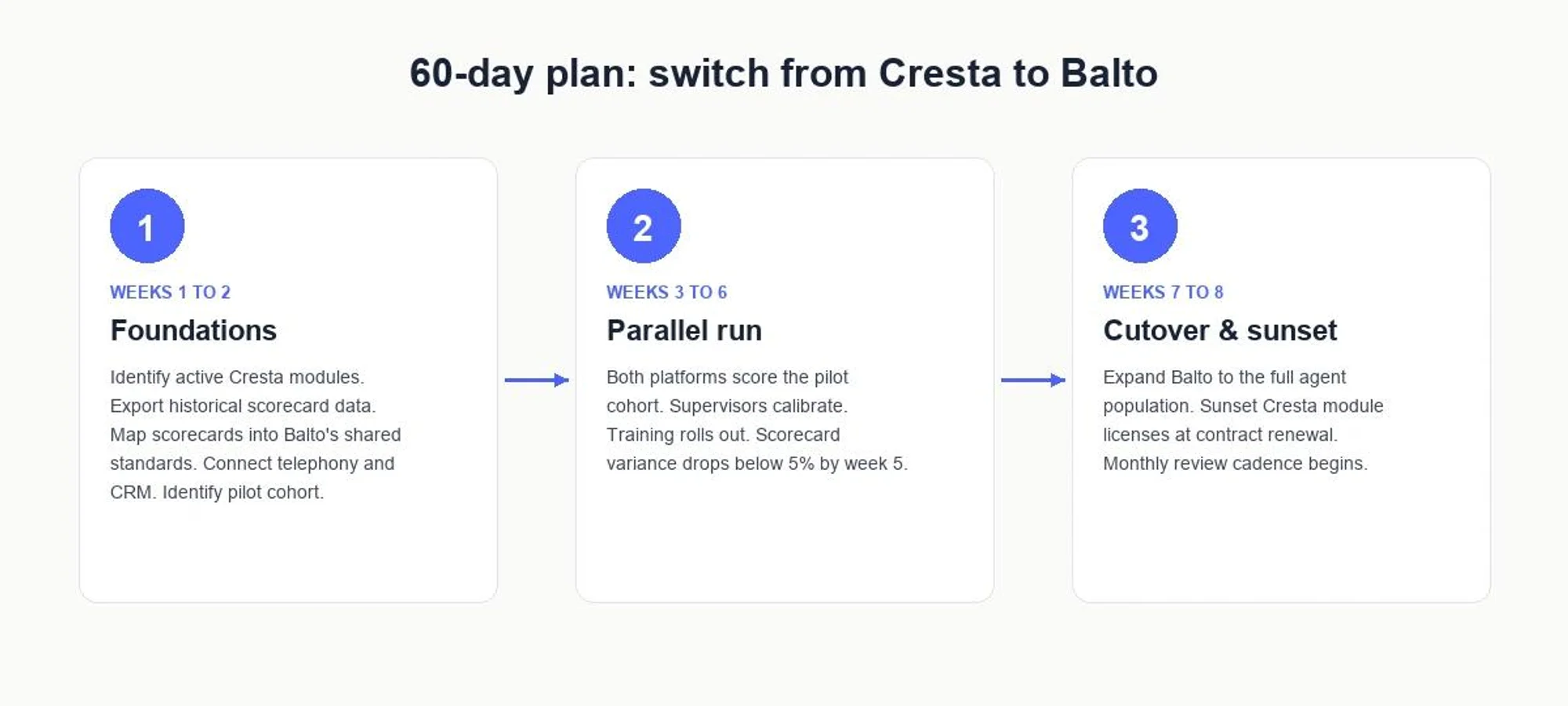
Phase 1: foundations (weeks 1 to 2). Export historical scorecard data from Cresta. Identify which Cresta modules are currently active (Agent Assist, Quality Management, Coach, Knowledge Agent, AI Agent, Conversation Intelligence) and map their scorecards into Balto's shared-standards model. Connect telephony (Five9, NICE, Genesys) and CRM (Salesforce, HubSpot, Zendesk) integrations. Identify the pilot agent cohort, typically 10 to 20% of the floor, weighted toward representative call mix.
Phase 2: parallel run (weeks 3 to 6). Both platforms score the pilot cohort in parallel. Supervisors calibrate Balto outputs against the Cresta baseline week by week. Training rolls out for the real-time plus coaching workflow. By week 5, scorecard variance between the two platforms typically drops below 5%, the sign program leadership has finished calibrating. Balto's Coaching Inbox auto-populates from QA scoring on shared standards from day one, which removes the manual handoff most teams build around in Cresta.
Phase 3: cutover and sunset (weeks 7 to 8). Expand Balto to the full agent population. Sunset Cresta module licenses at the next renewal point. Most centers time the switch to a contract anniversary to avoid double-paying. Establish the monthly review cadence and feedback loop with the Balto CSM.
Centers that skip the parallel-run phase typically regret it. Running both in parallel for a month lets you confirm the closed-loop QA, coaching, and insights flow is producing equivalent or better outputs before committing the entire floor.
Is Balto right for you?
Three questions. We'll tell you honestly, including when Cresta may be the better fit for your contact center.
What would switching save you?
Estimate the operational value of switching from Cresta to Balto. Inputs default to mid-market values. Adjust to your numbers. Outputs show estimated AHT savings, QA coverage value, and the combined annual operational value, not a fabricated cost comparison.
Real-world outcomes across verticals


FAQs: Balto vs Cresta
Both Balto and Cresta are AI platforms for contact centers, but they're built around different design centers. Balto runs a closed loop where Agent Assist, AI QA, coaching, and insights work on the same scorecards by default. The loop runs on day one without an in-house AI engineering team. Cresta is a full-suite platform with strong developer tooling (Conductor) and the latest agentic AI features (Knowledge Agent, Synthetic Customers). Its pillars are individually capable but ship as separate modules. To behave as a unified loop, you orchestrate them via Conductor or contract TELUS Digital for implementation services. The honest distinction is customer satisfaction and how the loop runs out of the box.
Balto carries a 4.8-star G2 rating across 575 reviews. Cresta carries 4.2 across 43. That's a 13x review-volume gap at a higher star rating, which is the single strongest signal from real customers in production. That said, Cresta is the right call for some contact centers, specifically enterprise centers with strong in-house AI engineering teams and 6-figure platform budgets that want to build custom AI agents on Conductor. For most other contact centers, Balto's out-of-box closed loop delivers compounding outcomes faster.
Cresta does not publish pricing officially. AWS Marketplace lists Agent Assist at $150,000 per year per channel (chat or voice) with usage caps of 125,000 chats or 100,000 calls. Overages run $1.20 per chat and $1.50 per call. The realistic enterprise band is $60K to $150K per year per module, with most enterprises buying 3 to 5 modules. Implementation TCO is typically 15-30% of subscription on top. Balto's pricing model is per agent per month, with bands shared during evaluation. Both vendors negotiate on contract length and seat volume. Request a custom Balto quote for your specific seat count and contract terms.
As of June 2026, Balto holds a G2 rating of 4.8 stars across 575 reviews. Cresta holds 4.2 stars across 43 reviews. That's roughly 13x the review volume at a higher star rating. Balto is also ranked #1 reviewed Agent Assist on G2 and Capterra and #1 out of 51 evaluated QA solutions in CMP Research's 2026 evaluation. Verify the current numbers on each vendor's G2 profile before any final selection. Ratings refresh weekly.
Cresta Knowledge Agent, launched March 2026, is an agentic AI assistant with ambient listening capabilities that surfaces information to contact center workers during interactions. It's a separate Cresta module with its own licensing. Balto's equivalent is the combination of three out-of-box capabilities: AI Answers (surfaces relevant knowledge on screen when an agent or customer raises a topic), AgentGPT (handles natural-language operator queries during the call), and Customer History (pulls CRM context at the start of every call). These are part of Agent Assist by default, not a separately licensed module.
For full-loop deployment across modules on shared standards, yes. Cresta's Conductor (launched June 2026) is a developer-first agentic engine for building and orchestrating custom AI agents on the platform. It requires AI engineering capacity in-house. The TELUS Digital partnership announced June 15, 2026 is the alternative path: contract TELUS for implementation services on top of the Cresta platform license. Balto's playbook editor is self-service. Supervisors update prompts, scorecards, and compliance triggers without filing a vendor ticket and without writing code.
Conductor is Cresta's developer tooling layer, launched June 11, 2026. It lets technical teams build, configure, and orchestrate custom AI agents on the Cresta platform. Cresta describes it as 'the agent for AI agent development.' You don't need an equivalent for Balto because Balto's closed loop is out-of-box. The self-service playbook editor handles what Cresta requires Conductor for. Supervisors update prompts and compliance triggers directly in the Balto Cloud UI. No code or engineering team required.
Yes. Balto's AI agent is called Togo. It handles routine inbound and outbound calls end-to-end (scheduling, account verification, lead qualification, policy questions) 24/7. The Togo Voice product is live, with Outbound and Campaigns, SMS, and Chat extensions on the roadmap through 2026. Where Balto's AI agent strategy differs from Cresta's is integration. Togo learns from the same call data that powers Agent Assist for frontline agents, and it operates on the same shared standards as the QA and coaching pillars. It's part of the closed loop, not a separately tunable agentic module.
A typical 60-day migration runs in three phases. Weeks 1 to 2 are foundations: identify active Cresta modules, export historical scorecard data, map scorecards into Balto's shared-standards model, connect telephony and CRM integrations. Weeks 3 to 6 are a parallel run, with both platforms scoring the pilot cohort while supervisors calibrate. Weeks 7 to 8 are cutover. Balto rolls out to the full agent population and Cresta module licenses sunset at renewal. Most centers time the cutover to a contract anniversary to avoid double-paying.
Both Balto and Cresta integrate with the major CCaaS platforms: Five9, NICE CXone, Genesys Cloud CX, Talkdesk, and Dialpad. Both also integrate with the major CRMs: Salesforce, HubSpot, and Zendesk. Balto has built more than 60 integrations across telephony, CRM, and adjacent contact-center systems, with a dedicated integration team on every deployment. Specific integration counts and certifications vary by quarter. Confirm with each vendor against your current telephony and CRM stack before committing.
Cresta is well-suited for enterprise centers with technical teams that want to build custom AI agents using Conductor and Synthetic Customers. The TELUS Digital partnership extends that reach into BPO services delivery for enterprises that want a managed implementation path. That said, Balto serves both segments natively. Balto's playbook editor and out-of-box Agent Assist support sales motions without requiring an engineering build, and Balto's multi-tenant, per-client scorecards and seat scalability are designed for BPOs running diverse client books. The choice depends on whether you want a developer-tooling platform you build on (Cresta) or a closed-loop platform that ships ready to deploy (Balto).
The most common reasons cited by Balto customers: customer satisfaction is not close (4.8/575 G2 reviews vs Cresta's 4.2/43). The closed loop runs out of the box, with QA-to-coaching automation on shared standards by default. Faster time-to-value: 4 to 6 weeks vs 8 to 16 weeks. Works without an in-house engineering team or a separate implementation services contract. Proven over 9 years with 300+ customers and 500 million interactions guided in real time. That said, Cresta is the right choice for some contact centers. See the When Cresta might be the better fit section above.
Ready to see Balto in action?
Book a 15-minute demo. We'll show you Balto's closed loop running on a call from your industry. No slideware, no pre-recorded demos.
How we built this comparison. Last updated June 16, 2026. Sources: G2 reviews (575 for Balto, 43 for Cresta as of build date); vendor product docs; Cresta press announcements via PRNewswire (Conductor June 11, 2026; Knowledge Agent March 17, 2026) and Newswire.ca (TELUS Digital partnership June 15, 2026); pricing references (AWS Marketplace Cresta listings, Prospeo, Eesel, Ringly, PricingNow, CheckThat.ai); Balto customer evidence from 39 case studies, 19 testimonials, and 25 G2 reviews. Refresh cadence: quarterly. If you spot something out of date, let us know.