








Best AI Tools for Managing Call Center Service Levels in 2026


The best AI tools for managing call center service levels work across three separate layers, and treating service level as a single-tool problem is why most contact centers over-invest in one lever and still miss their SLA targets during peak. Balto , the AI Workforce for the contact center, sits at the top of the Agent Assist layer, alongside workforce management (WFM) platforms that own the primary scheduling lever and AI agents that deflect volume before it hits the queue.
Service level is fundamentally a queue-speed-of-answer metric (the classic industry benchmark is 80/20, meaning 80% of calls answered within 20 seconds). Getting there depends on three things happening together: right people scheduled at the right time, agents handling contacts fast enough to clear the queue, and deflection tools keeping routine calls from ever hitting the queue. Each lever has its own category of AI, and the best deployments compound all three.
Here are the top platforms across all three layers:
Layer 1: WFM / Workforce Management AI (schedule accuracy is the primary lever)
- 1. NICE CXone WFM: Best for enterprise WFM with AI forecasting inside the CXone stack
- 2. Verint Workforce Optimization: Best for compliance-heavy enterprise WFM (now includes Calabrio ONE under the Verint umbrella)
- 3. Assembled: Best for modern digital-first CX teams and fast-growing contact centers
- 4. Genesys Cloud WEM: Best for Genesys Cloud CX users wanting native workforce engagement management
Layer 2: Agent Assist AI (protects service level by cutting AHT and transfers)
- 5. Balto: Best for real-time Agent Assist that cuts AHT 20-30% and multiplies scheduled WFM capacity
- 6. Cresta: Best for sales-heavy contact centers where AHT reduction ties to conversion
- 7. Observe.AI: Best for QA-integrated agent assist with post-call analytics depth
Layer 3: AI Agents (reduce call volume against the SL calculation)
- 8. Cognigy: Best for enterprise conversational AI across voice, chat, and messaging
- 9. Sierra: Best for consumer-brand autonomous AI agents handling routine inbound end-to-end
Here are the five criteria the guide walks through to evaluate each tool:
- 1. SL lever. Which of the three (schedule, AHT, deflection) does the tool actually move?
- 2. Real-time integration. How native is the CCaaS connection for adherence, forecast, and queue signals?
- 3. Impact attribution. Can the tool attribute lift per queue, per interval, and per skill group?
- 4. Deployment complexity. Weeks or quarters to production?
- 5. Multi-layer compounding. How does it play with the other two layers?
The rest of this guide walks through each tool, when to use it, and how the layered approach compounds service-level gains that no single tool can deliver alone.
What Service Level Really Measures (and Why AI Moves It)
Service level is the percentage of inbound calls answered within a target time. The classic contact center SLA is 80/20 (80% answered within 20 seconds), though targets vary widely by vertical: sales lines tend toward faster targets (90/15), while support lines with complex issues often relax to 70/30 or 80/60.
Service level differs from average speed of answer (ASA) in one important way. ASA is a mean; service level is a distribution threshold. Two contact centers with the same 30-second ASA can have very different service levels depending on the shape of the wait-time curve. That distinction matters because customers experience the outlier calls, not the average.
Three levers move service level, and each maps to a different category of AI tool:
- 1. Schedule accuracy. Are the right agents logged in during the intervals when call volume actually arrives? This is a Layer 1 (WFM) problem. Miss the forecast by 15% at peak and no amount of Agent Assist saves the SLA that morning.
- 2. Time-per-contact. How long does each interaction take? Every second cut off AHT frees capacity to handle more contacts against the same scheduled headcount. A 25% AHT reduction is math-equivalent to a 25% larger workforce during peak. This is a Layer 2 (Agent Assist) problem.
- 3. Call volume against the queue. Every routine call an AI agent handles end-to-end is a call that never enters the SL calculation. This is a Layer 3 (AI agent / deflection) problem.
The contact center utilization math breaks down how these levers compound across a workforce. For service level specifically, the practical implication is that fixing the wrong layer produces disappointing returns. Buying WFM when the drag is AHT bloat means better-scheduled agents still can't clear the queue. Buying Agent Assist when the forecast is off by 15% means faster agents still get swamped at peak.
How to Evaluate AI Tools for Service Level Management
Not every "AI contact center platform" moves service level the same way. Before you shortlist, ask five questions:
- 1. Which SL lever does the tool move? Schedule accuracy, time-per-contact, or call deflection. A vendor that promises "service level improvement" without naming a specific lever usually moves none of them meaningfully.
- 2. How native is the CCaaS integration? Real-time queue signals, adherence data, and forecast inputs need to flow both ways with your CCaaS. A tool requiring manual data exports won't move service level at contact center scale.
- 3. How does it attribute lift? The interval that breaks your SLA is rarely the fleet-wide average. Look for tools that report lift per queue, per interval, per skill group so you can see where the actual gain is happening.
- 4. What's the deployment timeline? A WFM tool that improves SL by 5 points but takes nine months to roll out won't hit this year's target. Check three real customer deployments before signing.
- 5. How does it compound with your other layers? The best deployments run WFM, Agent Assist, and AI agents against shared data. Ask each vendor how their tool plays with the other two layers, not just their own.
Comparison Table: 9 AI Tools for Service Level Management
| Platform | Layer | Service Level Lever | Best For | Deployment |
|---|---|---|---|---|
| NICE CXone WFM | Layer 1 (WFM) | Schedule accuracy + forecasting | Enterprise NICE CXone deployments | 6-12 months |
| Verint Workforce Optimization | Layer 1 (WFM) | Schedule accuracy + compliance | Compliance-heavy enterprises | 6-9 months |
| Assembled | Layer 1 (WFM) | Schedule accuracy + intraday | Modern digital-first teams | 4-8 weeks |
| Genesys Cloud WEM | Layer 1 (WFM) | Schedule accuracy + WEM suite | Genesys Cloud CX deployments | 3-6 months |
| Balto | Layer 2 (Agent Assist) | AHT + transfers + escalations | Cutting AHT to protect SL without adding headcount | 4-6 weeks |
| Cresta | Layer 2 (Agent Assist) | AHT + conversion behavior | Sales-heavy contact centers | 6-10 weeks |
| Observe.AI | Layer 2 (Agent Assist) | AHT + QA depth | Compliance-heavy verticals | 6-10 weeks |
| Cognigy | Layer 3 (AI Agents) | Call deflection + containment | Enterprise omni-channel deflection | 8-16 weeks |
| Sierra | Layer 3 (AI Agents) | Autonomous inbound deflection | Consumer brands with routine inbound | 6-12 weeks |
The comparison isn't about which tool is objectively best. It's about which lever your service level is dragging on, and which tool actually moves that lever at your contact center's scale.
Layer 1: WFM / Workforce Management AI
Layer 1 is where service level lives or dies. Get scheduling wrong and no amount of Agent Assist saves the SLA. Get it right and the other two layers compound the return. Every second saved from a call cycle is a second of productive capacity added.
1. NICE CXone WFM: Best for Enterprise WFM with AI Forecasting

NICE CXone WFM is the flagship enterprise WFM platform inside the NICE CXone suite. It combines AI-powered forecasting, automated scheduling, real-time adherence, and intraday management, all natively integrated with the CXone CCaaS, QA, and analytics stack.
Best for: enterprise contact centers already standardized on NICE CXone for CCaaS.
Key features:
- AI-powered forecasting and demand modeling
- Automated multi-skill scheduling
- Real-time adherence and intraday management
- Native integration with NICE CXone CCaaS, QA, and WEM
Pricing: Custom. Typically bundled with NICE CXone tiers.
2. Verint Workforce Optimization: Best for Compliance-Heavy Enterprise WFM

*Note: Verint acquired Calabrio in 2025. Calabrio ONE now sits inside the Verint CX Automation Platform as a distinct mid-market SKU, while Verint Workforce Optimization remains the enterprise flagship.*
Verint Workforce Optimization is a mature enterprise WFM platform with a strong track record in regulated industries. Its WEM suite combines workforce management, quality monitoring, and speech analytics.
Best for: compliance-heavy enterprise contact centers (financial services, insurance, healthcare, collections).
Key features:
- AI forecasting and scheduling
- Real-time adherence and intraday management
- Quality management and speech analytics integration
- Compliance-specific reporting and audit trails
Pricing: Enterprise custom pricing.
3. Assembled: Best for Modern Digital-First CX Teams

Assembled is a cloud-native WFM platform purpose-built for modern digital-first support teams. It provides AI forecasting, intraday flexibility, and native integrations with modern CCaaS and support platforms (Zendesk, Intercom, Front, Kustomer).
Best for: fast-growing mid-market and digital-native support operations.
Key features:
- AI-powered forecasting across voice and digital channels
- Intraday scheduling and self-service shift management
- Native integrations with modern CCaaS and helpdesk platforms
- Clean, agent-friendly interface
Pricing: Custom, seat-based tiering.
4. Genesys Cloud WEM: Best for Genesys Cloud CX Users Wanting Native WFM

Genesys Cloud WEM is the workforce engagement management suite native to the Genesys Cloud CX platform. It combines AI-powered forecasting and scheduling with performance management, quality management, and gamification in a single integrated package.
Best for: contact centers already running Genesys Cloud CX as their CCaaS platform.
Key features:
- AI forecasting and automated scheduling
- Real-time adherence monitoring
- Performance management and gamification
- Native integration with Genesys Cloud CX and QA
Pricing: Bundled with Genesys Cloud CX tiers.
Layer 2: Agent Assist AI (Protects SL by Cutting AHT and Transfers)
Layer 2 is the compound multiplier. WFM schedules the right headcount, but Agent Assist ensures scheduled agents handle contacts fast enough that the SLA holds. A 20-30% AHT reduction is math-equivalent to 20-30% more agents on shift, without the hiring or the scheduling headache. For contact centers already running solid WFM, Layer 2 is often the fastest path to a service-level lift.
5. Balto: Best for Real-Time Agent Assist That Cuts AHT 20-30% and Multiplies Scheduled Capacity

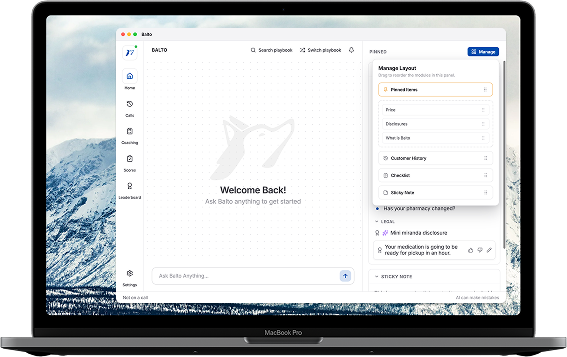
Balto is a purpose-built AI platform for real-time Agent Assist . Frontline agents get dynamic prompts during live calls that surface knowledge base answers, next-best actions, and objection responses in the moment they're needed. AI Notes automate post-call summaries into the CRM, and automated QA scores 100% of calls against the same behavioral standards.
Best for: any contact center where scheduled headcount is stretched thin and AHT reduction is the fastest path to protecting service level.
Key features:
- Real-time dynamic prompts on live calls
- AgentGPT knowledge base chat assistant for agent lookup
- AI Notes automating call summaries into CRM (cuts ACW by 60s/call)
- Automated QA + Coaching on shared behavioral standards
- Agentic Insights across 100% of calls with LLM-driven analytics
- 60+ native integrations (Genesys, NICE CXone, Five9, Talkdesk, Amazon Connect, Salesforce, RingCentral, 8x8)
Pricing: Custom. Contact sales for a demo.
6. Cresta: Best for Sales-Heavy Contact Centers Where AHT Ties to Conversion

Cresta specializes in real-time behavioral coaching during live conversations, with custom generative AI models trained on top-performer calls. Its coaching layer surfaces winning patterns that the rest of the team can apply in the moment.
Best for: sales-motion contact centers running outbound, retention, or high-conversion inbound calls.
Key features:
- Real-time behavioral coaching prompts
- AI models trained on top-performer conversations
- Conversation intelligence and post-call analytics
- Native integrations with modern CCaaS platforms
Pricing: Custom.
7. Observe.AI: Best for QA-Integrated Agent Assist with Post-Call Analytics Depth

Observe.AI combines Agent Assist with 100% automated QA and generative post-call summaries. The QA-first orientation makes it a natural fit for compliance-heavy verticals where post-call analytics depth matters as much as real-time Agent Assist.
Best for: compliance-heavy verticals (financial services, healthcare, debt collection).
Key features:
- 100% call coverage with automated QA scoring
- Real-time compliance monitoring
- Generative AI post-call summaries
- Coaching workflow integration
Pricing: Custom.
Layer 3: AI Agents (Reduces Call Volume Against SL)
Layer 3 is the deflection layer. Every routine call an AI agent handles end-to-end (verification, scheduling, policy questions, lead qualification) is a call that never enters your service level calculation. For contact centers with high inbound volume dominated by routine requests, Layer 3 has the largest structural impact on SL because it reduces the denominator of the equation, not just the wait time.
8. Cognigy: Best for Enterprise Conversational AI Across Voice, Chat, and Messaging

Cognigy is a mature enterprise conversational AI platform for voice and digital channels. It provides no-code conversation building, deep CCaaS integrations, and multi-language support that makes it a common choice for global contact center operations.
Best for: enterprises with sophisticated omni-channel deflection needs.
Key features:
- AI agents across voice, chat, SMS, and messaging
- No-code conversation builder for business teams
- Enterprise CCaaS integrations
- Multi-language support at scale
Pricing: Enterprise custom pricing.
9. Sierra: Best for Consumer-Brand Autonomous AI Agents Handling Routine Inbound End-to-End

Sierra is a newer entrant purpose-built for consumer brands (retail, hospitality, DTC) that want autonomous AI agents handling routine inbound end-to-end. Its focus is on conversational fluency and brand-aligned interactions for high-volume consumer scenarios.
Best for: consumer brands with high routine inbound volume where deflection at scale is a priority.
Key features:
- Autonomous AI agents handling full conversations end-to-end
- Voice, chat, email, and SMS coverage
- Brand-tuned conversational fluency
- Fast deployment for consumer use cases
Pricing: Custom, usage-based.
Common Mistakes When Trying to Improve Service Level with AI
Every SL-improvement project I see makes at least one of the mistakes below. These are the reasons so many contact centers add AI tooling and still miss their SLA quarter after quarter.
- 1. Buying WFM and expecting it to fix AHT drag. WFM schedules; it doesn't reduce time-per-call. If your AHT is bloated, better schedules just staff the same overrun more efficiently. Diagnose the drag before buying.
- 2. Buying Agent Assist without fixing the forecast. Cutting AHT 25% doesn't help if you're understaffed by 15% during the peak. Layer 1 has to be reasonable before Layer 2 pays off.
- 3. Ignoring the deflection layer entirely. Every routine call an AI agent handles is capacity you didn't have to schedule. If your inbound is 40%+ routine, Layer 3 is the largest structural lever available.
- 4. Optimizing for the vendor demo, not the SLA-breach interval. Vendors demo their best-day dashboards. Ask about the interval when queue depth doubled. That's the interval that breaks your SLA.
- 5. Treating the three layers as separate projects. The best deployments compound: WFM, Agent Assist, and AI agents running against shared adherence and behavioral data. Buying them piecemeal leaves compounding gains on the table.
Service Level Diagnostic: Which Layer Should You Fix First?
Different service-level problems point to different layers. This 5-question diagnostic routes you to the layer most likely dragging your number, along with the platform category that will move it fastest.
Key Contact Center Service Level Statistics
Bring It All Together
Service level isn't a one-tool KPI. It responds to three separate levers, and each lever has its own category of AI. Buying WFM and expecting it to fix Layer 2 drag is the most common mistake, but the reverse is just as costly: buying Agent Assist without fixing your forecast produces disappointing returns.
Start with the layer that's actually dragging your number. If the drag is schedule accuracy, Layer 1 (WFM) is where the biggest lift lives. If the drag is time-per-contact, Layer 2 (Agent Assist) is where the compound multiplier lives. If the drag is call volume overwhelming scheduled capacity, Layer 3 (AI agents) is the structural fix.
For contact centers that already have Layer 1 in decent shape, Layer 2 is typically the fastest path to a service-level lift because Agent Assist deploys in weeks, not quarters, and every second cut off AHT is a second of scheduled capacity recovered.
FAQs
A call center service level is the percentage of inbound calls answered within a target time. It's typically written as two numbers separated by a slash, like 80/20, meaning 80% of calls are answered within 20 seconds.
Service level differs from average speed of answer (ASA). ASA is a mean; service level is a threshold. Two contact centers with the same 30-second ASA can have very different service levels depending on how the wait-time distribution is shaped.
The classic industry benchmark is 80/20, meaning 80% of calls answered within 20 seconds. Sales lines typically aim for faster targets (90/15 or 80/10) because speed of answer directly affects conversion.
Support lines with complex issues often relax to 70/30 or 80/60, particularly in verticals like technical support or healthcare where a longer wait is acceptable if the resolution is thorough. Target selection should align with customer expectations for the specific line of business.
The biggest impact depends on which of the three levers is dragging your number. If schedule accuracy is the drag, Layer 1 WFM tools like NICE CXone WFM or Verint Workforce Optimization have the largest impact.
If time-per-contact is the drag, Layer 2 Agent Assist tools like Balto have the biggest lever because a 20-30% AHT cut is math-equivalent to 20-30% more scheduled agents. If routine call volume is overwhelming the queue, Layer 3 AI agents like Cognigy or Sierra have the largest structural impact.
Agent Assist AI alone can move service level significantly if your forecast and schedule are already reasonable. Cutting AHT 20-30% frees the same scheduled headcount to handle proportionally more contacts, which directly improves SL attainment.
But if your forecast is off by 15% or more during peak, no amount of Agent Assist saves the SLA at that interval. In practice, the strongest results come from Layer 1 and Layer 2 running together: accurate schedules plus fast handling.
AI agents reduce the denominator of the service level equation. Every routine call an AI agent handles end-to-end (verification, scheduling, policy lookup, lead qualification) is a call that never hits the queue that your human agents are working against.
For contact centers with high routine inbound volume, Layer 3 deflection is often the largest structural lever available. A 30% deflection rate is functionally equivalent to a 30% increase in effective agent capacity, without any hiring or scheduling adjustment.
ASA is the average wait time before a call is answered. Service level is the percentage of calls answered within a target time threshold. Both measure queue speed, but they capture different aspects of the wait-time distribution.
Two contact centers can have the same ASA but different service levels if one has a tighter distribution and the other has occasional very long waits. Customers experience the tail, not the mean, which is why service level is often the metric SLAs are written against.
The timeline varies significantly by layer. Layer 2 Agent Assist tools like Balto typically show measurable AHT reductions within the first month of deployment, which translates into service-level improvements almost immediately.
Layer 1 WFM deployments take longer (typically 6-12 months for enterprise implementations) because forecast tuning and schedule optimization compound over multiple weekly cycles. Layer 3 AI agent deployments range from 6-16 weeks depending on complexity and channel coverage.
For executive dashboards, service level (the SLA attainment percentage) matters most because it directly ties to customer experience commitments. ASA is a useful operational metric, but SLA attainment is what boards and leadership teams monitor.
For deeper analysis, executives typically want to see SLA attainment broken down by queue, interval, and skill group. Fleet-wide averages hide the specific intervals that break the SLA and mask the operational drag that needs fixing.
Yes, that's the practical case for AI in service level management. Layer 2 Agent Assist cuts AHT, which frees existing scheduled capacity to handle more contacts. Layer 3 AI agents deflect routine calls, reducing the volume against the queue.
Both effects mean the same headcount handles higher effective volume without additional hiring. Contact centers routinely report SL improvements of 5-15 percentage points from combined Layer 2 and Layer 3 deployments, holding scheduled headcount constant.
Liked What You Read? See Balto in Action.
Balto helps leading contact centers turn insights into outcomes, in real time. Book a live demo to discover how our AI powers better conversations, coaching, and conversions.