









Best Call Center Software for Insurance Companies in 2026


The best call center software for insurance companies is not a single platform. It’s the right combination of three distinct layers: a phone system for routing and infrastructure, an AI brain for real-time guidance, QA, and coaching, and a CRM for customer and policy data. Balto , the AI Workforce for the contact center, sits in the middle layer, connecting guidance, QA, coaching, and insights into one closed-loop system that gets smarter with every call.
Insurance contact centers operate under HIPAA, TCPA, and dozens of state-specific regulations. A single HIPAA violation can cost between $145 and $2,190,294 depending on culpability tier. A TCPA class action from a high-volume outbound campaign can involve thousands of individual violations simultaneously. The software you choose is not just an operational decision, it’s a risk management one.
This guide covers:
- The 3-layer insurance contact center stack and why the distinction matters
- The best phone system and routing tools (CCaaS) for insurance
- The best AI brain tools for real-time guidance, QA, and coaching
- The best CRM options for insurance contact centers
- A comparison table, evaluation checklist, and answers to the most common questions
Here is a quick overview of all tools by layer:
Layer 1, Phone System & Routing:
- NICE CXone: Enterprise contact center platform with deep workforce management, AI-powered QA, and compliance reporting for large insurance carriers
- Genesys Cloud CX: AI-native omnichannel platform for insurers managing complex customer journeys across voice, chat, email, and digital channels
- Talkdesk: Insurance Experience Cloud with purpose-built autonomous AI agents for self-service claims and policy servicing
- Five9: Cloud CCaaS with a strong predictive dialer for insurance sales, quote follow-up, and renewal campaigns
- Dialpad AI: HIPAA-compliant mid-market contact center with real-time transcription and agent coaching (also overlaps with Layer 2)
- Convoso: Outbound contact center built for TCPA-compliant insurance sales with AI-powered dialing and consent management
Layer 2, The AI Brain:
- Balto: The AI Workforce for the contact center, a closed-loop system where guidance, QA, coaching, and insights run on shared standards and get smarter with every call
- Observe.AI: AI workforce platform that analyzes 100% of insurance calls for Auto QA, agent coaching, compliance scoring, and conversation analytics
Layer 3, CRM:
- Salesforce Financial Services Cloud: Enterprise CRM purpose-built for insurance carriers with deep policy data integration, AI-powered next-best actions, and the largest partner ecosystem
- HubSpot CRM: Flexible mid-market CRM with fast implementation and strong integrations for insurance agencies that don’t need enterprise-level complexity
The 3-Layer Insurance Contact Center Stack
Most software comparison lists treat all call center tools as interchangeable. In insurance, they are not. Each layer solves a different problem, and buying the wrong category of tool will not close the right gap.
Layer 1: Phone System & Routing is the infrastructure layer. It handles call routing, queuing, workforce management, and omnichannel delivery. Every insurance contact center needs this layer. Examples: Genesys, NICE, Five9, Talkdesk.
Layer 2: The AI Brain sits on top of your existing phone system and adds intelligence. It surfaces real-time guidance during live calls, automates QA across 100% of conversations, triggers coaching from QA findings, and feeds insights back into frontline behavior. This is the layer that prevents compliance failures before they happen and continuously raises the performance floor of your entire team. Examples: Balto, Observe.AI.
Layer 3: CRM stores customer and policy data that both your phone system and AI brain pull from. It manages contact history, policy details, claims records, and sales pipelines. Choosing the right CRM is a separate, specialized decision from your contact center stack. Examples: Salesforce Financial Services Cloud, HubSpot CRM.
Most insurance contact centers already have a phone system. The biggest gaps are usually in Layer 2 and Layer 3. A CCaaS with no AI intelligence layer leaves compliance enforcement to agent memory, QA to manual spot-checks covering 2-5% of calls, and coaching to whatever managers have time for.
How the Tools Compare
How the Tools Compare
| Tool | Layer | HIPAA Compliant | Real-Time AI Guidance | 100% QA Coverage | Pricing Model |
|---|---|---|---|---|---|
| Balto | Layer 2: AI Brain | Custom | |||
| NICE CXone | Layer 1: Phone System | ✅ (add-on) | Custom enterprise | ||
| Genesys Cloud CX | Layer 1: Phone System | With add-on | From ~$75/agent/mo | ||
| Five9 | Layer 1: Phone System | Partial | Limited | From ~$149/agent/mo | |
| Talkdesk | Layer 1: Phone System | With add-on | From $85/agent/mo | ||
| Dialpad AI | Layer 1: Phone System | Limited | From $95/agent/mo | ||
| Convoso | Layer 1: Phone System | Partial | Custom | ||
| Observe.AI | Layer 2: AI Brain | Partial | Custom | ||
| Salesforce FSC | Layer 3: CRM | From ~$225/user/mo | |||
| HubSpot CRM | Layer 3: CRM | With add-ons | Free tier; from $90/seat/mo |
Layer 1: Phone System & Routing
The phone system is the foundation of your contact center stack. It routes calls, manages queues, handles omnichannel delivery, and provides workforce management. The tools below are the most widely deployed CCaaS platforms in insurance contact centers. Choosing between them comes down to your scale, channel mix, and whether you need insurance-specific out-of-the-box workflows.
NICE CXone: Best for Enterprise Insurance Carriers

NICE CXone is one of the most established enterprise contact center platforms in regulated industries, rated a Leader in the Gartner Magic Quadrant for CCaaS for multiple consecutive years. For large insurance carriers running hundreds or thousands of seats across multiple channels, it provides the workforce management depth, AI-powered quality tools, and compliance reporting that enterprise operations require.
Its automated quality management suite scores calls against defined criteria without manual reviewer involvement, and its WFM capabilities handle complex scheduling across time zones and insurance product lines that vary by state regulation. For carriers where workforce costs represent 60-70% of total contact center operating costs, accurate demand forecasting directly affects the bottom line.
Best for: Large P&C and health insurance carriers (500+ seats) that need enterprise-grade WFM, omnichannel routing, and integrated compliance reporting as a single platform, and have the implementation resources to deploy it.
Key features:
- Omnichannel ACD routing across voice, email, chat, SMS, and social channels
- CXone WFM: AI-powered agent scheduling and demand forecasting
- Automated QA with AI-based call scoring
- CXone Expert: knowledge management surfaced to agents during calls
- Compliance recording, archiving, and reporting
Pricing: Custom enterprise pricing.
Genesys Cloud CX: Best for Omnichannel Insurance Customer Journeys

Insurance customers do not interact through a single channel. They start a claim on your website, email to follow up, and call when they need a resolution. Genesys Cloud CX handles that reality, routing customers intelligently across every channel with full context carrying between touchpoints, so agents never have to ask customers to repeat themselves.
Its open API architecture makes it highly customizable for insurance-specific workflows: claims routing logic, escalation trees, and integrations with policy management systems. For carriers that need deep workflow customization without building a platform from scratch, it’s a strong foundation. For more on how AI is reshaping these interactions, see conversational AI in insurance .
Best for: Insurance carriers managing complex multi-channel customer journeys, claims, policy servicing, and renewals, across voice, chat, email, and messaging, where routing logic and channel context continuity are critical.
Key features:
- AI-powered omnichannel routing across voice, email, chat, and messaging
- Predictive engagement: proactive outreach before customers need to call
- Genesys AI: agent assist, bots, and sentiment analysis
- Workforce management and agent scheduling
- Open API and marketplace integrations for custom insurance workflows
Pricing: From approximately $75/agent/month for voice; higher for full omnichannel packages.
Five9: Best for Insurance Outbound Sales and Renewal Campaigns
If your insurance contact center runs high-volume outbound, renewals, quote follow-up, cross-sell, or re-engagement, Five9’s predictive dialer is among the strongest available. Predictive dialers typically increase agent talk time by 100-300% compared to manual dialing by eliminating the idle time between live connections. Five9 maximizes this by predicting agent availability and connecting calls proactively, keeping agents on live conversations rather than waiting for the next dial.
Its CRM integrations with Salesforce, ServiceNow, and Microsoft Dynamics are well-established, making it a natural fit for insurers who track customer lifecycles across policy management and CRM systems simultaneously.
Best for: Insurance carriers and agencies with significant outbound call volume, renewals, quote follow-up, Medicare enrollment, cross-sell campaigns, where dialer efficiency and CRM integration are the primary decision factors.
Key features:
- Predictive, power, and preview dialing modes
- AI routing and Intelligent Virtual Agent (IVA)
- Real-time agent dashboards and performance analytics
- Salesforce, ServiceNow, and major CRM integrations
- Voice authentication
Pricing: From approximately $149/agent/month.

Talkdesk: Best for AI-Native Insurance Customer Experience
Talkdesk built its Insurance Experience Cloud specifically for P&C and life insurance, including autonomous AI agents that handle self-service claims status inquiries, policy change requests, and first notice of loss, without routing to a human agent. AI-powered self-service deflection can handle 30-40% of routine insurance inquiries without human intervention when properly configured, freeing agent capacity for complex coverage and sales conversations.
For insurers looking to deflect routine inquiries to AI and reserve human agents for complex coverage conversations and high-value sales interactions, Talkdesk’s out-of-the-box insurance workflows reduce the custom development that most general-purpose platforms require.
Best for: P&C and life insurers looking to automate routine customer inquiries, claims status, billing questions, policy lookups, with autonomous AI, while keeping human agents focused on complex coverage conversations.
Key features:
- Talkdesk Autopilot: autonomous AI agent for insurance self-service inquiries
- Insurance Experience Cloud: pre-built insurance-specific workflows
- Proactive outreach automation for renewals and policy expiration follow-ups
- Sentiment and intent analysis
- HIPAA-eligible cloud infrastructure
Pricing: From $85/agent/month (CX Cloud Essentials).

Dialpad AI: Best for Mid-Market Insurance Contact Centers

Most enterprise CCaaS platforms are designed for operations with hundreds of seats, and priced accordingly. Dialpad AI fills the mid-market gap: HIPAA-compliant voice communications, real-time transcription, and live coaching at pricing accessible to insurers running 50-300 seats.
Its Assist Cards surface relevant information during live calls, similar to real-time guidance but more lightweight. For mid-market insurance carriers that want AI-assisted agent support without enterprise platform overhead or extended implementation timelines, it’s a practical starting point.
Best for: Mid-market insurance carriers (50-300 seats) that need HIPAA-compliant communications with real-time AI coaching and transcription, without the cost or complexity of enterprise CCaaS platforms.
Key features:
- HIPAA-compliant voice and messaging
- Real-time call transcription and live call summaries
- Assist Cards: AI-generated agent prompts during live calls
- Live sentiment analysis visible to supervisors in real time
- Analytics and QA scoring dashboards
Pricing: From $95/agent/month for Contact Center plan.
Convoso: Best for TCPA-Compliant Insurance Outbound Calling

Outbound insurance sales, leads, renewals, Medicare enrollment, ACA campaigns, operate under TCPA rules that define exactly how and when you can contact prospects. A single unintentional TCPA violation runs $500-$1,500 per call; willful violations can reach $1,500 per call and expose insurers to class action risk. Convoso’s entire platform is built around TCPA compliance for outbound-heavy contact centers.
Its consent management system tracks opt-in records for every contact. Its AI-powered dialer avoids calling modes that trigger TCPA risk. Real-time DNC scrubbing removes numbers from calling queues automatically before a dial is placed. For insurance sales teams running high-volume outbound, this is purpose-built infrastructure, not a compliance checkbox layered onto a general-purpose platform.
Best for: Insurance sales teams running high-volume outbound campaigns, Medicare, ACA, P&C leads, renewal campaigns, where TCPA consent management, DNC compliance, and dialer efficiency are the primary operational priorities.
Key features:
- TCPA consent management with full opt-in record tracking
- AI-powered predictive dialing with TCPA risk avoidance logic
- Real-time DNC list scrubbing before each dial
- Local presence dialing for improved contact rates
- Compliance alerts and full audit logging
Pricing: Custom. Contact Convoso for a quote.
Bonus Pick: Amazon Connect, Best for AWS-Native Insurance Operations
Amazon Connect is AWS’s cloud contact center service, priced on a pay-as-you-go model with no per-agent seat fees. For insurance carriers already running their infrastructure on AWS, it offers significant cost flexibility and deep integration with AWS services: Lex for conversational AI, Lambda for custom workflow logic, and Contact Lens for post-call analytics.
It is not a turnkey solution. Configuration requires engineering resources, and building insurance-specific compliance workflows takes meaningful development time. For carriers with that technical capacity and an existing AWS footprint, it’s a highly customizable foundation that scales to very specific insurance requirements without forcing a vendor’s pre-built framework.
Layer 2: The AI Brain
The AI brain layer sits on top of your phone system and adds the intelligence that CCaaS platforms alone cannot provide. These tools handle real-time guidance during live calls, automated QA across every conversation, and the feedback loops that turn call data into coaching and performance improvement. This is the layer that closes the compliance gap that a phone system leaves open, and it works with whatever CCaaS you already have.
Balto: Best for Insurance Contact Centers That Want a Closed-Loop AI System

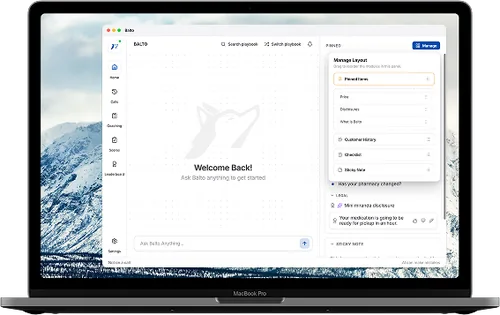
Balto is the AI Workforce for the contact center: a closed-loop system where real-time guidance, automated QA, coaching, and insights run on shared standards and get smarter with every call. In an insurance contact center, that means compliance checklists that fire during live calls before a disclosure is missed, automated QA that scores every conversation instead of 2-5%, coaching triggered by QA findings instead of waiting for a manager’s schedule, and BaltoGPT insights that reveal compliance trends across the full call population.
Each piece reinforces the others. What agents do on calls informs QA scores. QA scores drive targeted coaching. Coaching results feed back into what guidance Balto surfaces in real time on the next call. The loop closes, and the operation improves continuously without adding headcount or manual oversight at every step.
Balto works on top of your existing phone infrastructure, not as a replacement for it. The National General Insurance deployment shows what this looks like in practice: after rolling out Balto across 750 agents, the carrier saw a 16% increase in conversions and a 53-second reduction in handle time per rep, the equivalent of one additional call per agent per day at that scale.
Best for: Insurance contact centers that want a connected AI system, not separate guidance, QA, and coaching tools that don’t communicate with each other. Highest-fit for health, Medicare, supplemental, and high-regulation P&C operations where compliance consistency and agent performance improvement are ongoing priorities.
Key features:
- AI Checklist: dynamic compliance prompts that adapt in real time as conversations unfold
- AI Answers: instant access to policy, coverage, and product information during live calls
- Automated QA: 100% call scoring without manual reviewer involvement
- AI Notes: automated after-call summaries that reduce agent wrap time
- BaltoGPT: executive-level insights on compliance trends and agent performance patterns
Pricing: Custom. Contact for a pricing quote.
Want to see how Balto’s closed-loop AI system connects guidance, QA, and coaching for insurance contact centers? See it in action →
Observe.AI: Best for AI-Powered Conversation Intelligence in Insurance Contact Centers

Most insurance contact center QA programs review 2-5% of calls. The remaining 95-98% include compliance violations, missed disclosures, and coaching opportunities that go completely undetected. Observe.AI closes that gap by analyzing every call automatically, transcribing conversations, scoring them against compliance frameworks, and surfacing coaching actions directly to supervisors.
For insurance operations, Observe.AI’s Auto QA scores every recorded conversation against custom criteria, including HIPAA disclosure requirements, TCPA consent language, and state-specific script compliance. Its agent coaching workflows connect QA findings directly to targeted development actions, so supervisors spend time coaching rather than identifying which calls to review. Teams focused on insurance fraud detection in the contact center will also find Observe.AI’s pattern recognition useful for surfacing anomalous conversation patterns across the full call population.
Best for: Insurance contact centers that want AI-powered post-call analysis, Auto QA across 100% of conversations, and coaching workflows that connect QA findings to agent development, without replacing their existing CCaaS infrastructure.
Key features:
- Auto QA scoring across 100% of calls with customizable compliance criteria
- HIPAA and PII redaction for insurance transcript compliance
- Agent coaching workflows tied directly to QA findings and conversation insights
- Live AI assist for real-time guidance during active calls
- Conversation analytics and trend reporting for compliance and performance teams
Pricing: Custom enterprise pricing.
Layer 3: CRM
The CRM is the third layer of your insurance contact center stack. It stores the customer and policy data that both your phone system and AI brain pull from: contact history, policy details, claims records, household relationships, and sales pipelines. Your CCaaS routes calls using CRM data. Your AI brain surfaces coaching and insights that connect back to customer records.
Choosing the right CRM is a separate, specialized decision from your contact center technology. The two tools below are the most common starting points for insurance contact centers evaluating their CRM layer.
Salesforce Financial Services Cloud: Best for Enterprise Insurance Carriers

Salesforce Financial Services Cloud is the enterprise standard for insurance carriers that need a deeply integrated CRM connecting policy data, claims history, agent activity, and customer interactions in one platform. Its insurance-specific data model ships with the objects and relationships that matter in insurance: policies, claims, households, and financial accounts, reducing the custom development that general-purpose CRMs require.
For contact centers, the integrations with CCaaS platforms in Layer 1 are well-established. Genesys, Five9, NICE, and Talkdesk all have documented Salesforce integrations, meaning agent screens can surface full customer context, open claims, policy details, and prior interaction history, before a call even begins.
Best for: Enterprise insurance carriers and large agencies that need a deeply integrated CRM connecting policy data, claims history, agent activity, and customer interactions in one platform.
Key features:
- Insurance-specific data model: policies, claims, households, and financial accounts out of the box
- AI-powered next-best-action recommendations for agents and advisors
- Deep integrations with major CCaaS and telephony platforms
- Compliance and regulatory tracking across jurisdictions
- Agent productivity dashboards with pipeline and activity visibility
Pricing: Custom enterprise pricing. Starts around $225/user/month for Financial Services Cloud.
HubSpot CRM: Best for Mid-Market Insurance Agencies

HubSpot CRM is built for mid-market insurance agencies and carriers that need clean pipeline management and contact tracking without the implementation overhead of enterprise platforms. Its free tier makes it a low-risk starting point for operations that have outgrown spreadsheets but don’t yet need the complexity of Salesforce Financial Services Cloud.
Its integration marketplace connects with major CCaaS platforms, and telephony integrations allow call logging and contact activity to sync automatically. For agencies managing high-volume outbound sales pipelines, renewal tracking, and lead follow-up workflows, HubSpot’s deal pipeline and sequence automation deliver meaningful operational efficiency.
Best for: Mid-market insurance agencies and carriers (under 200 seats) that need a clean, easy-to-use CRM without the implementation overhead of enterprise platforms.
Key features:
- Contact and deal pipeline management with drag-and-drop simplicity
- Email and activity tracking across the full customer lifecycle
- Reporting dashboards for pipeline visibility and agent activity
- Integrations with telephony and CCaaS platforms
- Free CRM tier available with paid upgrades for advanced features
Pricing: Free CRM tier; Sales Hub from $90/seat/month for professional features.
Key Insurance Call Center Statistics
Insurance contact centers carry more compliance and performance pressure than most industries. These numbers explain why the software choices in this guide carry real operational weight.
Why Your Stack Needs All 3 Layers Working Together
The tools in this guide each solve a specific problem within their layer. CCaaS handles routing and infrastructure. The AI brain catches compliance issues, scores calls, and coaches agents. CRM stores the customer and policy data both layers depend on. Each one does its job.
But most insurance contact centers that deploy these tools separately run into the same problem: the layers don’t talk to each other. A compliance issue caught in post-call QA doesn’t automatically sharpen the real-time checklist for the next conversation. A coaching gap identified by a manager doesn’t automatically adjust how agents are guided in the moment. Customer data sitting in the CRM doesn’t automatically surface during a live call when an agent needs it most. The insights stay siloed. The system doesn’t learn.
A closed-loop AI system in Layer 2 solves the most critical version of this. Instead of separate guidance, QA, and coaching tools that each improve a slice of performance, a closed-loop system connects all three so that what happens on one call makes the next call better. Insights become guidance. Guidance becomes coaching. Coaching becomes automation. The entire workforce runs on shared standards and improves continuously.
This also matters when customers move between AI and human agents. When an AI handles the first part of a call and transfers to a human, that human should have full context, not start from zero while the customer repeats themselves. A connected stack across all three layers, phone system, AI brain, and CRM, ensures context carries across every handoff, so the experience stays consistent regardless of who or what is handling the conversation.
For insurance contact centers, where every call carries real compliance weight and agent performance directly affects revenue, a system that learns from every conversation is the difference between managing performance and building it. For a deeper look at QA options in the AI brain layer, see best contact center QA software .
How to Build Your Insurance Contact Center Stack
Not every insurance contact center needs every tool on this list. The right starting point depends on where your biggest compliance and performance gap sits today.
Step 1: Start with your compliance exposure.
HIPAA-regulated health insurers need a Business Associate Agreement from every vendor that touches protected health information: their CCaaS, QA platform, and recording system. Outbound-heavy insurers face TCPA exposure that requires consent management and DNC automation. State-specific insurance regulations may mandate exact disclosure language that needs to be prompted in real time, not remembered by agents under pressure. See Balto’s compliance resources for a deeper breakdown.
Step 2: Evaluate your Layer 1 foundation.
Most insurance contact centers already have a CCaaS. If yours works, don’t replace it. Evaluate whether it covers your channel mix, scales to your seat count, and integrates with the Layer 2 and Layer 3 tools you need. If you’re shopping for a new phone system, match the tool to your scale: NICE or Genesys for enterprise, Talkdesk or Dialpad for mid-market, Convoso for outbound-heavy operations.
Step 3: Close the Layer 2 gap.
This is where most insurance contact centers have the biggest hole. A CCaaS will not fix a live-call compliance gap. A real-time guidance tool will not replace your dialer. For your AI brain layer: guidance, QA, coaching, and insights, evaluate whether a closed-loop system that connects all four will serve you better than assembling separate point solutions. For a side-by-side view of QA metrics, see call center QA metrics .
Step 4: Align your Layer 3 CRM selection to your scale.
CRM is a separate decision. Salesforce Financial Services Cloud is the right choice for enterprise carriers that need an insurance-specific data model and the largest integration ecosystem. HubSpot is the right starting point for mid-market agencies that need operational simplicity and a lower implementation barrier. Don’t over-engineer the CRM layer if your immediate gap is in Layer 2.
Step 5: Require insurance-specific references.
A vendor’s HIPAA compliance claim only matters if other insurance carriers use them successfully at your scale. Ask for case studies from insurers in your specific segment, health, P&C, Medicare, specialty lines. Generic enterprise testimonials do not tell you how a platform handles HIPAA audit requests, state regulatory exam data requests, or TCPA litigation discovery.
The right call center software stack for insurance is not determined by which vendor has the longest feature list. It is determined by which combination of tools closes your specific compliance gaps, covers your QA blind spots, and makes your agents more effective on the calls that carry the most risk.
Your phone system provides the routing infrastructure. Your AI brain handles what happens during and after live calls, real-time guidance, QA, and coaching. Your CRM gives both layers the customer and policy context they need to operate well. Insurance contact centers that perform best treat these as distinct layers with distinct problems, and choose tools that solve each one directly.
FAQs
The best call center software for insurance companies is not one platform. It’s the right combination across three layers: a phone system for routing and infrastructure, an AI brain for real-time guidance, QA, and coaching, and a CRM for customer and policy data. The right stack depends on where your biggest compliance and performance gap sits today.
For the phone system layer, Genesys Cloud CX and NICE CXone are the strongest full-platform options for enterprise carriers. For the AI brain layer, Balto leads for insurance contact centers that want a closed-loop system connecting guidance, QA, coaching, and insights. Observe.AI is a strong option for AI-powered post-call QA, agent coaching, and conversation intelligence. For CRM, Salesforce Financial Services Cloud serves enterprise carriers; HubSpot serves mid-market agencies.
A phone system (CCaaS) handles the infrastructure layer: routing calls to the right agent, managing queues, enabling omnichannel delivery, and providing workforce management. It moves conversations. An AI brain sits on top of the phone system and adds intelligence to those conversations: surfacing compliance checklists in real time, scoring 100% of calls automatically, triggering coaching from QA findings, and feeding insights back into frontline behavior.
The most common gap in insurance contact centers is Layer 2. Most operations have a CCaaS. Far fewer have a dedicated AI brain that connects guidance, QA, and coaching in a closed loop. That gap is where compliance failures happen, and where the biggest performance improvement opportunity sits.
Any insurance contact center that handles protected health information, health insurance, Medicare, supplemental plans, long-term care, must use HIPAA-compliant software. This means signing a Business Associate Agreement with every vendor that touches PHI, whether that is your CCaaS, QA platform, or call recording system.
P&C and life insurance carriers that do not handle health data may not face direct HIPAA requirements, but still operate under state insurance regulations and TCPA rules for outbound communications. Compliance exposure varies significantly by product line. Check with legal counsel before assuming a platform’s HIPAA eligibility covers your specific use case.
Insurance call centers need capabilities that go beyond standard CCaaS features. HIPAA-compliant call recording and transcription, real-time compliance script enforcement so agents deliver required disclosures consistently, and automated QA coverage beyond the 2-5% that manual review achieves are the core requirements for most insurance operations.
Outbound insurance teams also need TCPA consent management, DNC scrubbing, and dialer efficiency tools. The specific feature priority shifts significantly based on whether your contact center is primarily inbound, claims, service, policy questions, or outbound, sales, renewals, enrollment campaigns.
Insurance call centers face multiple overlapping regulatory frameworks. HIPAA applies to operations handling protected health information, health insurance, Medicare, and long-term care. TCPA governs all outbound calling and texting, requiring prior written consent for autodialed calls to cell phones, with civil penalties of $500-$1,500 per violation.
State insurance regulations add another layer: required disclosure language, agent licensing rules, and product-specific script requirements that vary by state and product line. Recording consent laws, one-party versus two-party consent, also vary by state and affect how call recording must be disclosed to customers at the start of each interaction.
Real-time agent guidance software listens to live calls and surfaces relevant information as conversations unfold. For insurance agents, this means compliance checklists that prompt required disclosures at the right moment, instant access to policy and coverage information without putting customers on hold, and alerts when a conversation is approaching a compliance risk area.
The practical result is fewer missed disclosures, shorter handle times, and more consistent performance across agents regardless of tenure. National General Insurance saw a 16% increase in conversions and a 53-second AHT reduction after deploying real-time guidance, without changing their existing phone infrastructure or retraining their entire team.
The Telephone Consumer Protection Act restricts how businesses contact consumers by phone and text. For insurance contact centers, the most significant rules govern autodialed calls to cell phones, which require prior written consent, and the use of prerecorded voice messages. The FCC’s 2024 ruling added restrictions on AI-generated voice calls, directly affecting carriers using synthetic voice for outbound insurance campaigns.
Violations carry civil penalties of $500 per call for unintentional violations and $1,500 for willful ones. For high-volume outbound teams running Medicare, ACA, or P&C lead campaigns, TCPA compliance software is essential infrastructure, not optional. A single class action from a TCPA violation can involve thousands of individual calls simultaneously.
Manual QA in most insurance contact centers covers 2-5% of calls. Conversation intelligence platforms like Observe.AI analyze 100% of calls automatically, transcribing, scoring, and flagging each conversation against compliance scripts and quality standards without manual reviewer involvement. The result is full coverage without increasing QA headcount. For more detail on QA metrics that matter, see call center quality assurance metrics .
For real-time coverage during live calls, Balto combines in-call compliance guidance with automated post-call QA scoring, and feeds both back into coaching and performance standards automatically. This gives insurance operations immediate compliance enforcement during the conversation, full retrospective analysis afterward, and a system that continuously improves from every call.
Yes, when applied to the right part of the sales process. AI tools that provide real-time guidance during live sales calls help agents handle coverage objections more effectively, surface relevant product information at the right moment, and keep compliance disclosures from creating friction that derails a sale. Consistent agent performance across a team of hundreds compounds into significant conversion lift over time.
The National General Insurance deployment provides a specific benchmark: a 16% increase in conversions following Balto deployment across 750 agents. Insurers evaluating AI tools for conversion improvement should look for insurance-specific case studies with measurable outcomes rather than vendor claims. The variance between implementations is significant and depends heavily on how the tool is configured and rolled out.
Most insurance contact centers benefit from having a dedicated CRM separate from their CCaaS. CCaaS platforms manage call routing and agent workflows. CRMs store the customer and policy data that both the phone system and AI brain need to operate well: contact history, policy details, claims records, household relationships, and sales pipeline data.
Some CCaaS platforms include basic CRM-like features, but they rarely match the depth of a purpose-built CRM for insurance data management. Salesforce Financial Services Cloud is the standard for enterprise carriers that need insurance-specific data models. HubSpot is the practical starting point for mid-market agencies that need clean pipeline management without the implementation overhead of enterprise platforms.
Liked What You Read? See Balto in Action.
Balto helps leading contact centers turn insights into outcomes, in real time. Book a live demo to discover how our AI powers better conversations, coaching, and conversions.