Balto vs Gong: Contact Center AI or Revenue Intelligence for Sales?
Balto and Gong are both category leaders. Different categories. Balto is purpose-built for contact center customer service since 2017 with a real-time-first closed loop. Gong is purpose-built for B2B sales conversation intelligence since 2015 with post-call analytics, deal management, and forecasting.
Balto and Gong are both category leaders. Different categories. Balto , the #1 Rated Agent Assist, QA Automation, and Agentic Insights platform, was built for contact center customer service in 2017 and runs a real-time closed loop across Agent Assist, AI QA, Coaching, and Insights on shared standards. Gong was built for B2B sales conversation intelligence in 2015 and is the #1 vendor in G2's Revenue Operations and Intelligence category, with $500 million in ARR and customers including Anthropic, Cisco, Google, ADP, DocuSign, Thomson Reuters, and LinkedIn. Picking between them is not a head-to-head on identical capability. The question is which problem you are solving: contact center customer service and compliance work (Balto), or the B2B sales motion of pipeline, deals, and forecasting (Gong). Balto holds a 4.8-star G2 rating across 587 reviews and was named Pioneering, the top tier of CMP Research's Prism for Automated QA/QM, with the highest perception score (6.4 out of 7) of any vendor evaluated. Gong holds 4.7 across 6,672 reviews and serves a sales-team category that is roughly 10 times the size of the contact-center-AI category Balto leads.
What this comparison covers:
- How Balto and Gong serve fundamentally different teams (contact center vs B2B sales)
- Side-by-side feature matrix across 25+ capabilities, filterable by what you care about
- Verified Gong pricing: approximately $1,600 per user per year base plus $5K-$50K platform fees plus add-ons
- How the comparison plays out for BPO, Banking and Financial Services, Insurance, Healthcare, and SaaS Customer Support
- When Gong is honestly the better fit (B2B sales motions and revenue forecasting)
- When to add Balto for your contact center, even if Gong runs your sales team
Balto vs Gong at a glance
| Feature | Balto | Gong |
|---|---|---|
| Founded | 2017 | 2015 |
| HQ | St. Louis, MO | San Francisco, CA |
| Primary design center | Contact center AI. Real-time-first closed loop across Agent Assist, AI QA, Coaching, and Insights on shared standards. | Revenue Intelligence for B2B sales. Post-call conversation intelligence, deal management, forecasting, sales enablement. |
| G2 rating | 4.8 ★ (587 reviews) | 4.7 ★ (6,672 reviews) |
| Category leadership | Pioneering tier in CMP Research's Prism for Automated QA/QM. 6.4 out of 7 perception score, highest of any vendor evaluated. #1 Rated Agent Assist on G2 and Capterra. | #1 in G2's Revenue Operations and Intelligence category. Satisfaction 100, Market Presence 97, total G2 score 98. |
| Real-time in-call agent assist | Native since 2017. Live AI Checklist, AI Answers, AgentGPT, Customer History during the conversation. | No native real-time live-call guidance. Mission Andromeda (Feb 25, 2026) added Gong Assistant for conversational workflow chat. AI Call Reviewer operates post-call. |
| Best for | Contact centers serving inbound customer service or compliance-driven outbound. BPO, financial services, insurance, healthcare, collections, home improvement. | B2B sales teams. Outbound prospecting, deal management, pipeline forecasting, sales coaching, revenue operations. |
| Pricing model | Per agent per month. Bands shared during evaluation. | Approximately $1,600 per user per year base + $5,000 to $50,000 platform fees + $35,000 to $65,000 implementation + module add-ons. Total enterprise: $60,000 to $300,000+ per year. |
Closed-Loop Scorecard: agent loop vs deal loop
| Pillar | Balto: Exists | Balto: Native | Balto: Closed-loop | Gong: Exists | Gong: Native | Gong: Closed-loop |
|---|---|---|---|---|---|---|
| Agent Assist (real-time, in-call) | Y | Y | Y | N | N | N |
| AI Quality (Auto QA) | Y | Y | Y | Y (sales QA) | Y (post-call) | Partial (around the deal, not the agent) |
| Coaching Workflow | Y | Y | Y | Y (sales rep) | Y | Partial (AI Trainer Mission Andromeda) |
| Shared-Standards Insights | Y | Y | Y | Y | Y | N (anchored on deal lifecycle) |
The N and Partial scores in the Gong column are honest acknowledgments that Gong was not built for the contact-center agent loop. Gong's closed loop runs around the deal lifecycle (call recording, conversation analysis, deal-risk scoring, forecast revision, next deal cycle). Different loop. Different job.
What is Balto?
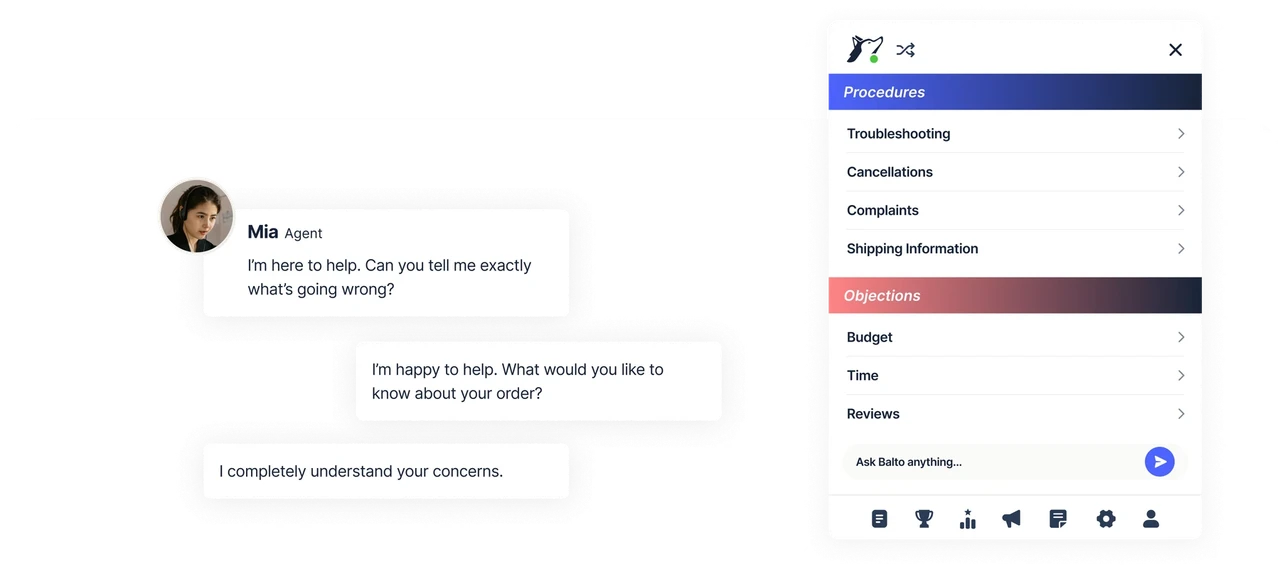
Balto is built around what an agent does on a live call. Agent Assist surfaces required script elements in real time. AI Answers brings knowledge to the screen when an agent or customer raises a topic. AgentGPT handles natural-language operator queries during the conversation. Customer History pulls account context from your CRM at the start of every call, so even a brand-new frontline agent arrives ready.
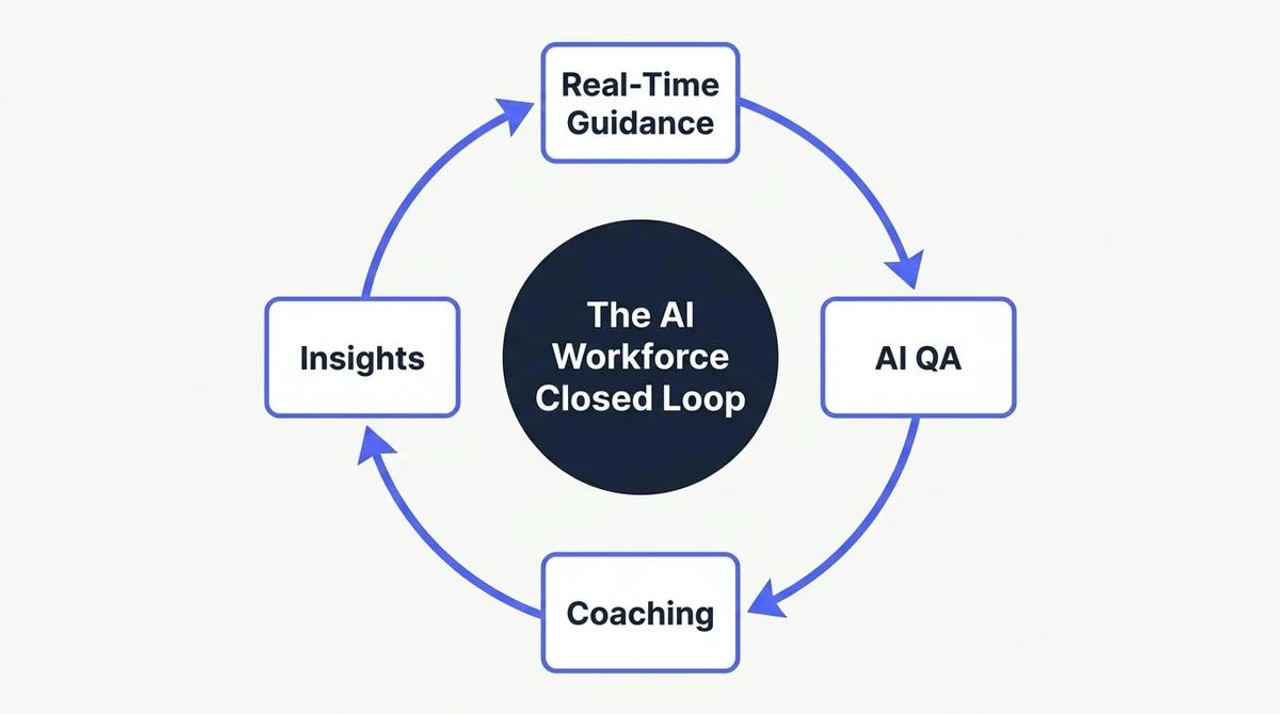
Those signals don't disappear when the call ends. They become the input the QA pillar scores on shared standards, which auto-feeds the Coaching Inbox, which feeds Insights that update what the AI surfaces on the next call. The closed loop runs across Agent Assist, QA, coaching, and insights without a manual handoff in the middle.
Balto was the first company to bring agent assist to market in 2017. Today the platform powers more than 300 customers and has guided over 500 million interactions in real time across BPO, financial services, insurance, healthcare, and home improvement. Balto holds a 4.8-star G2 rating across 587 reviews, ranks #1 reviewed Agent Assist on G2 and Capterra, was rated #1 out of 51 evaluated QA solutions in CMP Research's 2026 evaluation, and was named Pioneering (top tier of 5) in CMP Research's Prism for Automated QA/QM with the highest perception score (6.4 out of 7) of any vendor evaluated.
What is Gong?
Gong was founded in 2015 by Amit Bendov and Eilon Reshef, and is headquartered in San Francisco. The platform pioneered AI-powered conversation analysis for B2B sales teams and established the Revenue Intelligence category. Gong is the #1 vendor in G2's Revenue Operations and Intelligence category, with $500 million in ARR (announced 2026), 55%+ year-over-year growth, and more than 5,000 customers including Anthropic, Cisco, DocuSign, Google, ADP, Thomson Reuters, and LinkedIn. Half of the Fortune 10 use Gong.
Gong's product structure after the Mission Andromeda release (February 25, 2026) spans five modules. Foundation handles call recording, transcription, conversation intelligence, search, and basic coaching. Engage is outbound prospecting and email sequences, positioned as a Salesloft replacement. Forecast is AI pipeline forecasting and deal-risk scoring, positioned as a Clari replacement. Enable, launched in Mission Andromeda, is sales enablement with AI Call Reviewer (grades reps post-call) and AI Trainer. Gong Assistant is conversational always-on workflow chat. Deal Likelihood Scores combine 300+ signals into a single number per deal.
The 2026 Microsoft partnership extends Gong into Outlook, Teams, and Dynamics CRM. Primary buyers are CROs, VPs of Sales, VPs of Sales Operations, and VPs of Revenue Operations.
Balto vs Gong: the category distinction
Balto and Gong are both #1 in their respective categories. The buyer's job is to identify which category they are shopping in.
Balto's category: contact center AI. The closed loop runs around the agent. Real-time guidance during the live customer interaction. AI QA scoring 100% of calls on shared scorecards. Coaching auto-generated from QA failures. Insights that feed back into what the AI surfaces on the next call. The buyer is the VP of Customer Experience, the Director of Contact Center Operations, the Head of QA, or the COO of a BPO. The work is inbound customer service or compliance-driven outbound: HIPAA prompts in healthcare, mini-Miranda in collections, disclosure prompts in insurance, multi-client scorecards in BPO.
Gong's category: Revenue Intelligence for B2B sales. The closed loop runs around the deal. Call recording and transcription. Post-call conversation analysis. Deal-risk scoring across 300+ signals. Pipeline forecasting. Outbound prospecting sequences. Sales enablement and rep coaching tied to sales methodology (BANT, MEDDIC, MEDDPICC). The buyer is the CRO, the VP of Sales, or the VP of Revenue Operations. The work is closing B2B deals, managing the pipeline, hitting the quarterly forecast.
Most contact center leaders need Balto, not Gong. Most VPs of Sales need Gong, not Balto. Some companies need both, for different teams. The honest answer to "Balto or Gong?" is "which problem are you solving?"
Balto vs Gong: feature-by-feature comparison
The filterable matrix below covers 25+ features across eight categories. Use the chips above the matrix to filter. Matching rows highlight. Below the matrix, three narrative blocks unpack the highest-stakes dimensions.
Real-time vs post-call. Balto's Agent Assist runs during the live customer call. AI Checklist drives required script elements as the conversation unfolds. AI Answers surfaces knowledge when a topic comes up. AgentGPT handles natural-language operator queries mid-call. Customer History pulls account context at call start. Gong's analysis runs after the call. AI Call Reviewer (launched in Mission Andromeda) grades reps post-call. Search and trend insights work across recorded interactions. Gong Assistant, also launched in Mission Andromeda, is conversational workflow chat, not real-time in-call guidance during live customer conversations. Both vendors do conversation intelligence. Only Balto does it live.
Contact center customer service vs B2B sales motion. Balto's vertical templates cover collections, healthcare, BPO, insurance, financial services. The platform handles live compliance prompts for HIPAA, TCPA, Reg F, mini-Miranda, and state-specific disclosure rules. Balto's QA pillar scores 100% of contact-center interactions on shared scorecards that drive Coaching automatically. Gong's strength is the B2B sales motion: Deal Likelihood Scores with 300+ signals, Gong Engage for outbound prospecting, Gong Forecast for pipeline management, AI Trainer for sales-methodology coaching. Different problems. Different design centers.
Platform integration vs CRM integration. Balto integrates with the major CCaaS platforms (Five9, NICE CXone, Genesys Cloud CX, Talkdesk, Dialpad) and the major CRMs (Salesforce, HubSpot, Zendesk), with 60+ built integrations and a dedicated integration team. Gong's integration story is anchored on Salesforce and HubSpot CRMs and on the 2026 Microsoft partnership for Outlook, Teams, and Dynamics. Where you sit in the org determines which integration story matters. Contact-center leaders care about the CCaaS connection. Sales leaders care about the CRM and email connection.
Pricing and packaging: Balto vs Gong
Pricing transparency is a real difference here.
Balto. Per agent per month, with bands shared during evaluation. Pricing scales with seat count and contract length. Implementation is typically included on multi-year deals.
Gong. Foundations base lists at approximately $1,600 per user per year (around $130 to $160 per user per month at list, with bundled deals running $200 to $250 per user per month per third-party reporting). A mandatory platform fee of $5,000 to $50,000 per year applies regardless of team size. Enterprise implementation runs $35,000 to $65,000. Gong Engage and Gong Forecast are each separately priced at approximately $700 to $800 per user per year. Gong Enable (Mission Andromeda) is separately priced. Total enterprise deals run $60,000 to $300,000+ annually depending on team size and modules. Contracts include automatic renewal increases of 5 to 15% per year, which compounds to 15 to 45% above the original quote over a three-year contract.
Pricing summary
| Feature | Balto | Gong |
|---|---|---|
| Pricing model | Per agent per month | Per user per year + platform fees + module add-ons |
| Public per-seat anchor | Bands shared during evaluation | Approximately $1,600 per user per year (Foundations) |
| Mandatory platform fee | Bundled | $5,000 to $50,000 per year |
| Implementation | Typically included on multi-year | $35,000 to $65,000 |
| Common add-ons | None mandatory | Engage ~$800/user/yr, Forecast ~$700/user/yr, Enable separately priced |
| Total enterprise range | Shared during evaluation | $60,000 to $300,000+ per year |
| Auto-renewal increase | Standard | 5 to 15% per year (compounds 15 to 45% over 3 years) |
Deployment, integrations, and time-to-value
Typical time-to-value. Balto: 4 to 6 weeks from kickoff to first live value. Gong: enterprise deployments typically run 8 to 12 weeks driven by implementation services and module configuration. Mission Andromeda module rollouts can extend the timeline for teams adopting Enable, Engage, or Forecast alongside Foundation.
Telephony integrations. Balto integrates with the major CCaaS platforms: Five9, NICE CXone, Genesys Cloud CX, Talkdesk, Dialpad. Balto has built more than 60 integrations across telephony, CRM, and adjacent contact-center systems, with a dedicated integration team on every deployment. Gong is not a CCaaS-native product. The platform captures calls via integrations with major dialers and meeting platforms (Zoom, Microsoft Teams, Google Meet) and CRMs.
CRM and productivity integrations. Both integrate with Salesforce and HubSpot. Gong has deeper Microsoft 365 integration via the 2026 partnership (Outlook, Teams, Dynamics CRM). Balto integrates with Zendesk for support-team workflows.
Operational independence. Balto's playbook editor is self-service. Supervisors update prompts, scorecards, and compliance triggers without filing a vendor ticket. Gong deployments typically involve professional services on enterprise contracts for module configuration, scorecard setup, and sales-methodology customization.
Time-to-value: 4+ weeks faster with Balto
Weeks: Balto kickoff to live
Out-of-box closed loop. Self-service playbook editor. No engineering team required.
Weeks: Gong enterprise typical
Driven by professional services and module configuration across Foundation, Engage, Forecast, and Enable.
Balto integrations built
Dedicated integration team on every deployment.
The closed-loop difference: agent loop vs deal loop
Both Balto and Gong run a closed loop. They run it around different things.
Balto's loop runs around the agent. The live customer call is the trigger. AI Checklist, AI Answers, AgentGPT, and Customer History fire during the conversation. After the call, AI QA scores the interaction on the same scorecards Agent Assist used, so the scoring is consistent. Failed items auto-feed the Coaching Inbox. Insights surface trends across 100% of calls and feed back into what the AI surfaces in real time on the next call. The loop is on shared standards across all four pillars by default.
Gong's loop runs around the deal. Call recording is the trigger. Post-call conversation analysis extracts deal-relevant signals (objections, competitor mentions, stakeholder involvement, engagement cadence). Deal Likelihood Scores combine 300+ signals into a per-deal number. Forecast updates as activity happens. Sales reps get coaching tied to the deal and the sales methodology. The next deal cycle starts. The loop runs around the pipeline lifecycle, not the live customer call.
Both loops are valid. They serve different jobs.
Balto's design choice is that AI and frontline agents work together and learn from each other in real time. Most AI tools deployed in a contact center create friction with the people they're supposed to help. Agents see them as a threat. That fear kills adoption, and AI never gets the data it needs to be effective. Balto runs the opposite play. One system where AI and frontline agents collaborate during the live call. Gong's design choice is that sales reps need post-call analysis, deal-risk visibility, and pipeline forecasts to close more deals. That's a different job.
See Balto's Agent Assist in action
Watch a 90-second product walkthrough of how Balto's live in-call guidance starts the closed loop.
How Balto vs Gong compares for your industry
Different industries weight different capabilities. BPO leads on per-client scorecards and real-time agent ramp. Banking and Financial Services lives or dies by audit and live compliance for the customer service function (Balto), or by pipeline forecasting for the institutional sales function (Gong). Insurance needs disclosure prompts during open enrollment (Balto), or broker-sales intelligence (Gong). Healthcare needs HIPAA compliance and clinical script adherence (Balto), or healthtech-sales motion intelligence (Gong). SaaS Customer Support is the one vertical where both platforms could legitimately serve one company across two teams. Use the tabs below to see the comparison through your industry's lens.
BPO: contact center customer service at scale

Balto's BPO depth is the right tool here. Real-time AI Checklist drives per-client scripts and compliance. Customers include InteLogix, UGA, and Michael McMillan BPO.
Gong was not built for the BPO contact center. Gong's strength is B2B sales conversation intelligence, not multi-client contact-center scorecards.
100% real-time plus 100% AI QA on shared scorecards from day one (Balto). Per-client scorecard configuration is first-class.
Ramp without an engineering team: yes (Balto). Self-service playbook editor for client-specific compliance prompts.
If your BPO has both a contact-center function and a B2B sales-development function, Balto runs the contact center and Gong could run the sales side as separate deployments.
Banking and Financial Services: contact center compliance vs B2B sales
Two different jobs at the same bank. Balto handles the customer service function (Truist publicly cite-able). Gong handles the institutional B2B sales function.
Live compliance prompts during the call (Balto): SOC 2 Type II, plus banking-specific disclosure rules, plus state-specific variations.
Pipeline visibility on B2B sales deals (Gong): Deal Likelihood Scores, forecasting, account intelligence for commercial banking sales.
SOC 2 Type II on both. Standard banking and financial-services controls on both.
If the buying-committee weight is contact-center customer service, Balto is the fit. If the buying-committee weight is B2B commercial-banking sales, Gong is the fit. Most large banks run both for different teams.
Insurance: customer service + disclosure compliance vs broker sales
Balto handles the customer service and claims function (National General, Mylo, Franklin Madison as references). Live disclosure prompts during open enrollment.
Gong handles the B2B broker-sales motion: deal management, forecasting, sales-rep coaching tied to sales methodology.
Live disclosure prompts during the call (Balto) vs post-call sales-rep coaching on broker conversations (Gong). Different problems.
Errors caught before they reach the customer (Balto, real-time prompts) vs deal-risk caught in post-call analysis (Gong).
If your insurance company has both a customer service function (Balto) and a B2B broker-sales function (Gong), the two platforms serve different teams.
Healthcare: HIPAA + clinical script adherence vs healthtech sales
Balto handles the patient-facing customer service function. HIPAA BAA support. PHI redaction in transcripts. Real-time clinical script adherence. Customers include Humana, Northstar Health, Gonzaba, Pima, NYPCC, EmpiRx, Integris, and Redirect Health.
Gong handles the B2B healthtech-sales motion: SaaS sales reps closing health-system deals, pharma sales rep performance, healthtech pipeline forecasting.
HIPAA BAA support on both. PHI redaction native in Balto. Gong's healthcare use case is sales-rep conversations, not patient-facing customer service.
Audit trails for compliance review: shared scorecards across all pillars by default (Balto). Gong's audit trails are sales-conversation focused.
Time-to-value for a clinical-program rollout: 4 to 6 weeks (Balto) vs 8 to 12 weeks for a Gong sales-team rollout.
SaaS Customer Support: where both platforms genuinely overlap
This is the one vertical where one company genuinely uses both platforms. The B2B SaaS sales team uses Gong. The customer support team uses Balto.
Gong's strength: SaaS sales reps closing enterprise deals, pipeline forecasting, deal-risk visibility, outbound prospecting via Gong Engage.
Balto's strength: customer support agents resolving inbound tickets and customer-facing calls, AI Checklist for compliance and script adherence, 100% AI QA on support interactions.
Different buying committees: VP Sales (Gong) vs Head of Customer Support or VP Customer Experience (Balto).
Both integrate with Salesforce and HubSpot. The two platforms do not conflict; they serve different teams in the same SaaS company.
Customer evidence and ratings
Both platforms have substantial customer bases. The shape of those bases reflects the categories they serve.
Balto holds a 4.8-star G2 rating across 587 reviews. Gong holds a 4.7-star rating across 6,672 reviews. Gong has roughly 11 times the review volume because the sales-team category Gong serves is roughly 10 times the size of the contact-center-AI category Balto serves. Volume is not the proof point here.
Category position is the proof point. Balto was named Pioneering, the top tier of 5, in CMP Research's Prism for Automated QA/QM with the highest perception score of any vendor evaluated (6.4 out of 7) and a perfect 4 out of 4 for innovation. Gong is #1 in G2's Revenue Operations and Intelligence category with a Satisfaction score of 100 and a Market Presence score of 97, totaling a G2 score of 98.
Balto's publicly named customers include Humana, Truist, and Staples. Gong's publicly named customers include Anthropic, Cisco, DocuSign, Google, ADP, Thomson Reuters, and LinkedIn. Half of the Fortune 10 use Gong.
What customers say about Balto on G2
Ana Maria M.
Trainer
It’s guided scripts, being able to see a summary after calls, and using it every day helps to improve call quality. It provides great ideas for handling difficult topics with customers. The screen is adjustable and customizable, great for adapting to your needs.
Arielle J.
Inside Sales Representative
What I like most about Balto is the call summary that is given at the end of each call.
Paul G.
Internal Sales Rep
Balto keeps me on track when I am not sure of what to say. The ease of implementation into our other software makes the rebuttals smooth, as they effortlessly seem to appear with 3 options, which they check for you once verbalized in the call. This keeps efficiency and focus more centered in every call.
Raphael R.
Stabilization Manager
Balto has been phenomenal! I truly appreciate how Balto ensures our customer service is up to par and of top tier quality.
Ruth A.
ACA Sales Agent
Helps me keep compliant with ACA regulations.
When Gong might be the better fit for you
Scenario 1: B2B sales teams running outbound prospecting and deal management
Buyer profile: B2B sales organization (SaaS, enterprise software, services) with sales reps making outbound calls, managing pipelines, and forecasting revenue. RevOps function in place. CRO or VP of Sales as primary buyer. Sales-methodology framework (BANT, MEDDIC, or similar) in use. Gong is the category leader in Revenue Operations and Intelligence. The product is purpose-built for the B2B sales motion: Deal Likelihood Scores combining 300+ signals, Gong Forecast as a Clari replacement, Gong Engage as a Salesloft replacement for outbound sequences, and Gong Enable (Mission Andromeda) for sales-rep training. Anthropic, Cisco, Google, LinkedIn, ADP, and half of Fortune 10 use Gong. If your problem is sales pipeline visibility and rep performance on B2B sales calls, Gong is genuinely the better tool. What to do next: evaluate Gong directly.
Scenario 2: revenue intelligence and forecasting as the primary unmet need
Buyer profile: enterprise sales organization where the buying committee weight sits with the CRO, VP Sales Operations, or VP Revenue. Primary unmet need is pipeline visibility, deal-risk detection, and accurate revenue forecasting. Salesforce or HubSpot CRM in place, Microsoft 365 environment. Gong Forecast is positioned as a Clari replacement and has $500 million in ARR backing the maturity of that capability. Deal Likelihood Scores combine 300+ signals into a single per-deal number. The 2026 Microsoft partnership integrates Gong into Outlook, Teams, and Dynamics CRM. If revenue forecasting is the primary unmet need, Gong's category-leader maturity on this dimension is real. Balto is not in this category. What to do next: evaluate Gong Forecast against Clari and against your CRM's native forecasting.
If Gong isn't your fit, see how it stacks up against the wider field of alternatives .
Why contact center leaders pick Balto over Gong
Native real-time agent assist during the live customer call
Gong's analysis is post-call. Mission Andromeda added Gong Assistant for workflow chat, not real-time in-call guidance. If your need is the live conversation, Balto was built for that and Gong was not.
Pioneering tier in CMP Research's Prism for Automated QA/QM
Balto carries the highest perception score of any vendor evaluated (6.4 of 7) and a perfect 4 of 4 for innovation. The category here is automated QA / QM specifically, which is the dimension Balto is purpose-built for.
Closed loop on shared scorecards by default
Agent Assist, AI QA, Coaching, and Insights run on the same scorecards by default. A failed QA item auto-feeds Coaching. Insights update what the AI surfaces on the next call. No cross-module orchestration required.
Built for contact center compliance
HIPAA, TCPA, Reg F, mini-Miranda, state-specific disclosure rules, multi-client BPO scorecards. Gong's compliance story is sales-methodology compliance, not contact-center compliance.
60+ CCaaS, CRM, and contact-center integrations
With a dedicated integration team on every deployment. Gong's integration footprint is CRM-and-Microsoft-365 focused.
When to add Balto to your team, even if Gong runs your sales
This section is for the buyer whose sales team is happy with Gong and whose contact center needs its own tool. Most companies don't need to choose between Balto and Gong. The teams are different. Run both for the teams that need them.
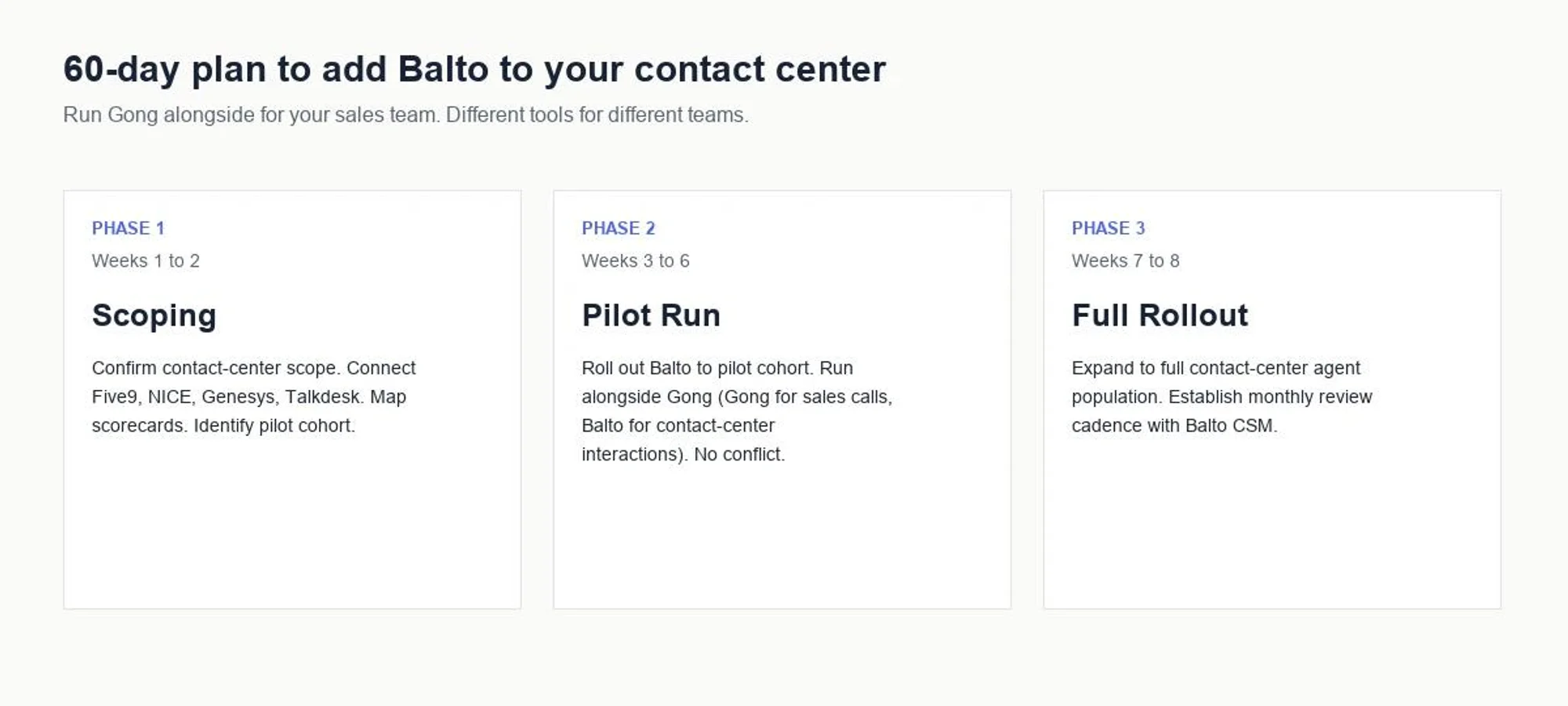
Phase 1: scoping (weeks 1 to 2). Confirm which teams are in scope. If your sales team is happy with Gong, leave it alone. Identify the contact-center team's unmet needs: real-time agent assist during live customer calls, AI QA on contact-center-specific scorecards, compliance prompts (HIPAA, TCPA, Reg F, mini-Miranda), coaching workflows tied to QA failures. Connect Balto's telephony integrations (Five9, NICE CXone, Genesys, Talkdesk, Dialpad) and CRM integrations (Salesforce, HubSpot, Zendesk). Identify the pilot agent cohort, typically 10 to 20% of the contact-center floor.
Phase 2: pilot run (weeks 3 to 6). Roll out Balto to the pilot cohort. Confirm the closed-loop QA + coaching + insights flow produces measurable outcomes on contact-center-specific metrics: AHT reduction, QA coverage going from manual sampling to 100% AI scoring, compliance violation reduction. If the sales team is running Gong in parallel, the two platforms do not conflict. Gong handles B2B sales calls; Balto handles contact-center customer interactions.
Phase 3: full rollout (weeks 7 to 8). Expand Balto to the full contact-center agent population. Establish the monthly review cadence with the Balto CSM. If the contact center had originally been rolled into a Gong deployment that was bought primarily for the sales team, sunset the Gong contact-center licenses at next renewal point (keep Gong for the sales team).
This is a parallel-deployment scenario, not a replacement scenario. Different tools for different teams.
Is Balto right for you?
Three questions. We'll tell you honestly, including when Gong is the better fit for your team.
What would Balto save your contact center?
Estimate the operational value of deploying Balto for your contact center. Inputs default to mid-market values. Adjust to your numbers. This calculator models contact-center savings (AHT reduction, QA coverage upgrade) only. It does not compare Balto cost to Gong cost because the two platforms are in different categories serving different teams.
Real-world outcomes across verticals


FAQs: Balto vs Gong
Balto and Gong are category leaders in different categories. Balto is purpose-built for contact center customer service since 2017 with a real-time-first closed loop across Agent Assist, AI QA, Coaching, and Insights on shared standards. Gong is purpose-built for B2B sales conversation intelligence since 2015 with post-call analytics, deal management (Deal Likelihood Scores from 300+ signals), pipeline forecasting (Gong Forecast as Clari replacement), and outbound prospecting (Gong Engage as Salesloft replacement). The question is not which is better, but which problem you are solving.
They are for different teams. Most contact center leaders need Balto. Most VPs of Sales need Gong. Balto is #1 Rated Agent Assist on G2 and Capterra, named Pioneering (top tier of 5) in CMP Research's Prism for Automated QA/QM with the highest perception score (6.4 out of 7) of any vendor evaluated. Gong is #1 in G2's Revenue Operations and Intelligence category with $500M in ARR, customers including Anthropic, Cisco, Google, LinkedIn, and half of Fortune 10. Both lead their respective categories.
No native real-time live-call agent assist. Gong's analysis runs after the call. Mission Andromeda (February 25, 2026) introduced Gong Assistant for conversational always-on workflow chat, which is a chat interface where users can ask natural-language questions about their pipeline and customer conversations. It is not real-time guidance during the live customer call. AI Call Reviewer, also launched in Mission Andromeda, operates post-call. Balto's Agent Assist runs during the live call with AI Checklist, AI Answers, AgentGPT, and Customer History.
Mission Andromeda is Gong's February 25, 2026 product release. It introduced Gong Enable (a separately priced sales enablement module with AI Call Reviewer and AI Trainer), Gong Assistant (conversational always-on workflow chat), and new account-management and AI interoperability capabilities. Mission Andromeda is the first of Gong's ongoing Missions cadence of product releases. Notable: AI Call Reviewer grades sales reps post-call, not in real-time during the live customer conversation.
Gong Foundations base lists at approximately $1,600 per user per year (around $130 to $160 per user per month). Bundled enterprise deals run $200 to $250 per user per month. Mandatory platform fee: $5,000 to $50,000 per year. Enterprise implementation: $35,000 to $65,000. Gong Engage and Forecast add-ons: approximately $700 to $800 per user per year each. Gong Enable separately priced. Total enterprise deals run $60,000 to $300,000+ annually. Balto's pricing is per agent per month with bands shared during evaluation. The categories differ, so head-to-head pricing comparison is apples to oranges. Request a Balto quote for your contact center.
Balto holds 4.8 stars across 587 reviews. Gong holds 4.7 stars across 6,672 reviews. Volume reflects category size. The sales-team category Gong serves is roughly 10 times the size of the contact-center-AI category Balto leads. Both are category leaders on G2: Balto in Agent Assist (#1 rated) and Gong in Revenue Operations and Intelligence (#1 vendor, Satisfaction 100, Market Presence 97, total G2 score 98). Balto is also Pioneering tier in CMP Research's Prism for Automated QA/QM with the highest perception score of any vendor evaluated.
Gong was not built for the contact center. The product is purpose-built for B2B sales: Deal Likelihood Scores, pipeline forecasting, outbound prospecting sequences, sales-methodology coaching (BANT, MEDDIC, MEDDPICC). Native real-time agent assist for live customer calls is not part of Gong's design. Contact-center compliance prompts (HIPAA, TCPA, Reg F, mini-Miranda), industry-specific contact-center templates (collections, healthcare, BPO), and the closed loop where QA failures auto-feed coaching on shared standards are also not Gong's design center. Use Balto for the contact center function instead.
Balto's primary design center is contact center customer service and compliance-driven outbound work, not B2B sales pipeline management. If your sales team uses Salesforce or HubSpot and needs deal-risk scoring, pipeline forecasting, outbound prospecting sequences, or sales-methodology coaching, Gong is the category leader for that work. Balto's Agent Assist can support inside-sales teams running script-driven outbound (where compliance prompts and AI Checklist matter), but full B2B sales motion tooling (CRM-anchored deal management plus forecasting plus prospecting) is Gong's category, not Balto's.
Balto: 4 to 6 weeks from kickoff to first live value. Gong: enterprise deployments typically run 8 to 12 weeks driven by implementation services ($35,000 to $65,000) and module configuration. Adding Engage, Forecast, or Enable modules extends the timeline. Both platforms work without engineering teams once deployed. Both involve professional services on enterprise contracts. Balto's playbook editor is self-service, so supervisors update prompts, scorecards, and compliance triggers without filing a vendor ticket.
Pick Balto when you have a contact center that needs real-time agent assist, AI QA on customer-service scorecards, coaching automation tied to QA failures, or contact-center-specific compliance (HIPAA, TCPA, Reg F, mini-Miranda, state disclosure rules). Pick Balto when your buying committee weight sits with the VP of Customer Experience, Director of Contact Center Operations, Head of QA, or COO of a BPO. Pick Balto when your team is doing inbound customer service or compliance-driven outbound work, not B2B sales prospecting.
Pick Gong when you have a B2B sales team and your primary unmet need is pipeline visibility, deal management, sales-rep coaching tied to sales methodology, or outbound prospecting. Pick Gong when your buying committee weight sits with the CRO, VP of Sales, or VP of Revenue Operations. Pick Gong when your team is closing B2B deals, managing the pipeline, and hitting the quarterly forecast. Gong is the category leader in Revenue Operations and Intelligence with $500M in ARR and customers including Anthropic, Cisco, Google, LinkedIn, ADP, and half of Fortune 10.
Balto integrates with the major CCaaS platforms (Five9, NICE CXone, Genesys Cloud CX, Talkdesk, Dialpad) and the major CRMs (Salesforce, HubSpot, Zendesk), with 60+ built integrations and a dedicated integration team. Gong is not a CCaaS-native product. The platform captures calls via integrations with dialers and meeting platforms (Zoom, Microsoft Teams, Google Meet) and CRMs (Salesforce, HubSpot). The 2026 Microsoft partnership extends Gong into Outlook, Teams, and Dynamics CRM. Where your team sits in the org determines which integration story matters.
Ready to see Balto in action?
Book a 15-minute demo. We'll show you Balto's closed loop running on a call from your industry. No slideware, no pre-recorded demos.
How we built this comparison. Last updated June 24, 2026. Sources: G2 reviews (587 for Balto, 6,672 for Gong as of build date, verified direct from g2.com/sellers/balto and g2.com/products/gong/reviews); vendor product documentation (balto.ai and gong.io); Gong press releases via PR Newswire (Mission Andromeda launch February 25, 2026; Gong-Microsoft partnership 2026; $500M ARR announcement 2026); Gong pricing analyses (MarketBetter, GetMaxiq, CloudTalk, Claap, Sybill, ItsConvo, RevenueGrid); CMP Research Prism for Automated QA/QM (Balto: Pioneering tier, 6.4 of 7 perception score); Balto customer evidence from 39 case studies, 19 testimonials, and 25 G2 reviews. What we couldn't verify: exact Gong enterprise contract values for specific customer references (custom-priced, no public anchor beyond per-seat list price plus platform fees); Gong Enable specific feature scope (launched February 2026, public documentation still building); whether any Balto customers explicitly switched from Gong to Balto (rare scenario, different categories). Refresh cadence: quarterly. If you spot something out of date, let us know.