










Top 10 Calabrio Alternatives & Competitors 2026
Looking for alternatives or competitors to Calabrio? When choosing a workforce and quality management platform, consider core features like forecasting accuracy and quality monitoring. The best Calabrio alternative is NICE, but other providers like Balto and Verint also deliver unique value.
What is Calabrio?
Calabrio is a workforce optimization and customer experience intelligence platform for contact centers. It unifies workforce forecasting, quality management, interaction analytics, and reporting to help teams staff accurately, evaluate performance, and improve service quality across every channel.
Calabrio Overview
Calabrio is best suited for mid-market and enterprise contact centers that need a unified platform for workforce forecasting, quality management, and interaction analytics. It’s ideal for operations teams that want stronger scheduling accuracy, consistent QA workflows, and better visibility into customer experience performance.
Calabrio Features and Capabilities
Pros
- checkUnified WFO suite that combines forecasting, scheduling, QA, and analytics in one place.
- checkAccurate WFM tools with flexible scheduling across voice and digital channels.
- checkStrong quality management with reliable recording and evaluation workflows.
- checkSolid reporting and dashboards for tracking agent performance and customer experience trends.
- checkWide CCaaS integrations with platforms like Genesys, Amazon Connect, NICE, and Five9.
Cons
- closeDated interface compared to newer, AI-first platforms and tools.
- closeLimited real-time guidance for in-the-moment agent coaching.
- closeComplex setup that can be heavy for smaller or less technical teams.
- closeBasic analytics that aren’t as advanced as tools like Observe AI, Balto, or Cresta.
- closeScaling costs may add up as more modules and features are added.
Calabrio Alternatives & Competitors 2026
Swipe to compare all vendors →
| Feature | Calabrio | NICE | Cogito / Verint | Genesys | Five9 | Talkdesk | Balto | CallMiner | Observe.AI | Level AI | Cresta |
|---|---|---|---|---|---|---|---|---|---|---|---|
| Workforce Forecasting & Scheduling | ✓ | ✓ | ✓ | ✓ | ✓ | ✓ | ✗ | ✓ | ✗ | ✗ | ✗ |
| Quality Management & Call Recording | ✓ | ✓ | ✓ | ✓ | ✓ | ✓ | ✓ | ✗ | ✓ | ✓ | ✓ |
| Speech & Text Analytics | ✓ | ✓ | ✓ | ✗ | ✓ | ✗ | ✓ | ✓ | ✓ | ✓ | ✓ |
| Real-Time and Historical Reporting | ✓ | ✓ | ✓ | ✓ | ✓ | ✓ | ✓ | ✓ | ✓ | ✓ | ✓ |
| Agent Performance & Coaching Tools | ✓ | ✓ | ✓ | ✓ | ✓ | ✓ | ✓ | ✓ | ✓ | ✓ | ✓ |
| Omnichannel Insights | ✓ | ✓ | ✓ | ✓ | ✗ | ✓ | ✓ | ✓ | ✓ | ✓ | ✓ |
| Real-Time Agent Guidance | ✗ | ✗ | ✗ | ✓ | ✓ | ✓ | ✓ | ✗ | ✗ | ✗ | ✓ |
| CRM & Platform Integrations | ✓ | ✓ | ✓ | ✓ | ✓ | ✓ | ✓ | ✓ | ✓ | ✓ | ✓ |
✓ Offered · ✗ Not offered
Top Calabrio Alternatives & Competitors
NICE
NICE is an enterprise workforce optimization and analytics suite that offers deeper automation, AI-driven insights, and broader scalability than traditional WFO platforms like Calabrio. While Calabrio focuses on forecasting, scheduling, and post-call quality, NICE delivers an extensive toolset for large, complex contact centers that need advanced analytics, omnichannel engagement, and AI-powered optimization.
Key features
- boltEnlighten AI analytics that surface behavioral insights Calabrio can’t match
- boltComprehensive forecasting and scheduling with deep automation
- boltInteraction analytics across voice and digital channels
- boltIntegrated omnichannel routing and engagement capabilities
- boltUnified coaching, QM, and performance management workflows
Pros
- checkExtremely robust WFO suite with advanced analytics and automation
- checkStrong scalability for enterprise teams and complex environments
- checkDeep AI-driven insights that go beyond Calabrio’s traditional reporting
- checkPowerful omnichannel support tied into NICE CXone
- checkBroad integrations and ecosystem support
Cons
- closeCan be expensive for mid-market teams
- closeMore complex to implement and manage compared to Calabrio
- closeHeavy feature set may be more than smaller teams need
- closeReal-time guidance is available, but typically requires Enlighten modules
- closeCustomization often involves longer cycles or technical support
Why Are Contact Centers Switching From Calabrio to Balto?
Improvements During the Call, Not After
Calabrio’s strength is post-call QA, scoring, and historical reporting, which means issues are identified only after the customer experience has already happened. Teams switch to Balto because it fixes problems in real time, not a week later in a QA review.
Instant Coaching Opportunities
Teams move to Balto because they want agents to perform consistently without relying on slow feedback loops. Balto provides instant prompts, no-code updates, and behavior reinforcement on every call.
Trusted by Top Contact Centers
Your business is in good hands with Balto. With a 4.8 rating and over 300 reviews on G2, Balto is the favorite real-time solution for top-performing contact centers.
Why You Should Choose Balto Over Calabrio
With our smarter AI, instant coaching, and real-time guidance, we think the choice is clear. We invite you to get a demo and see the difference for yourself
Get a DemoHere’s what our fans have to say on G2
"It is time sufficient & very useful since we are unable to memorize all scenarios[...]. It helps us also for holistic customer experience."
Benedict V.
Sr. Customer Service Assistant
"It gives the user a more effective way to assist the customer's concern through scripts & troubleshooting steps that pop up using audio cues. Because of this, I can efficiently assist the customer without wasting my time looking for resources."
Erica M.
Customer Service Representative
"I love having all the information I need right at my disposal and that it can be updated seamlessly as needed. Balto helps me meet and exceed my monthly quality assurance metrics each month."
Erica C.
Patient Balance Solution Advisor
"I really like Balto's note-taking ability live on the call. [...] Balto helps agents keep track of calls and provides insights into call volume and reasons for calls."
Farzan G.
Desktop Support II / Field Tech
"It keeps me in compliance, with a level of profesionalism, as well it keeps me in a good flow and order for the applications."
Tania S.
License Insurace Agent.
"Balto makes call reviews a breeze. Balto is a great call assistant for our support analysts. It provides reminders of critical call script items and helps guide the analysts through effective call handling. The best benefits start after the call. Analysts are provided customizable call summary information that can be used to fill out tickets, all calls are QA scored, and supervisors are provided AI powered search and analysis features. Balto has been extremely helpful with implementation and recommendations for effective usage."
Verified User
Enterprise, Customer Service & Sales
"Balto is amazing. I like how it captures the conversation. This saves me so much time when logging my call notes. It’s truly amazing and I use it with every call I receive or make. It’s very easy to incorporate words as well. Balto is so easy to use and the features that come with Balto are so helpful. Balto is also very easy to install and integrate into your company’s system."
Diana W.
Small Business, Customer Service
"Very Easy to Use. Balto is the simplest, easy to learn software I’ve used in the industry. I can’t think of a time when I didn’t use it in a call. I use Balto quite frequently throughout my day. Balto is also easy to integrate and implement into whatever software you use. The customer service is top notch and the number of features is fantastic!"
Isaiah
Mid-Market, Sales
"It automatically highlights what you can say to the customer with it's amazing recognition of what customer says. It also now has notes automatically."
Mary Jane M.
"I like that Balto can be tailored to how I specifically talk with customers. I love that it gives me tips when explaining the process to customers."
Lori-Ann H.
"What I love most about Balto is that it keeps me on track when I feel like I don't know where to go next of if I happen to forget what to do next."
Verified User
"I love the Checklist. It's so helpful to see what I've already said/done and the animations help make me feel happy and encourages me on a bad day"
Sha'Quan J.
"Being able to copy and paste the summary notes onto an appointment for a clear understanding by team and all involved of the situation discussed."
Jenna C.
appointment booking
"It's always there to share tips and ideas with how you can improve and allows you to see what you may have missed and needs to be stated."
Wardella B.
"I enjoy the ability to check if I missed any QA questions before an audit so that I can know what parts of the script I commonly overlook"
Denise R.
"The suggested script made it easier for me to ask open ended questions. This helps me converse with the customer and assess their needs."
Angelica B.
"What I like best is that it gives you tips or information while you are speaking. It is very accurate with what you are talking about."
esmeralda u.
CUSTOMER SERVICE ASSOCIATE
"I love the real-time listening. I'm not waiting until after the call to make adjustments, I can make them at the moment I need them."
Verified User
"how balto listens to you on a call, it hears what your saying and then tells you what you have hit and missed keeping you on track."
daniel k.
benefits consultant
"the 1st set of Questions were PERFECT and now you added more thats already and originally part of the Market Place requirement"
Marilyn T.
"Its very helpfull when I'm in need of ways to help get a payment for our company and helps me keep track of the conversation."
Lacy M.
"I like that Balto keeps me on track, helps me to review what I can do better on the next call, and gives real time rebuttals."
Verified User
"That it catches automatically the workflow and allows you to realize what part of the Script you havent said. As well it automatically detects rela..."
Yazmin P.
Account Manager
"That balto really helps out with the quality of service we provide."
Jonathan M.
customer service insurance supervisor
"Most of its features but more on the ability to review data, it help me to quantify the data that I need and help me analyze reports more accuratel..."
Romina T.
Operations Manager
"It's good, especially if it's an outbound calling campaign, because all the objections and what you say can be provided by Balto, and it won't be d..."
Krian S.
Scheduling Coordinator
"Balto can do anything & everything we could want. Which, could be overwhelming, if the content and features weren't explained/trained properly. The..."
Alexis K.
Manager of Guest Care
"My job requires detailed reviews of our phone calls; summaries of what the customer and agent discussed. Instead of trying to recall what was said ..."
Nashon C.
Sales manager
"It has made remote work and training seamless as Balto guides the agent new or experienced through the call, and with dynamic prompts to help with ..."
John Z.
Operations Manager
"Balto helps my team get through their calls and know where to go next without having to disrupt the "human" aspect of the call! They can form rela..."
Beth P.
Data Entry Manager
"Call explorer for myself but the checklist is very easy to utilize and custom with every agent"
Anna R.
Quality Assurance Supervisor and Training Assistant
"Balto has worked continuously with my company to find a happy medium on the kind of summary they are providing after calls. I am more than happy wi..."
Melissa T.
Assistant Account Manager
"I truly appreciate how Balto ensures our customer service is up to par and of top tier quality."
Raphael R.
Stabilization Manager
"Balto is very user friendly. This software is really simple to learn and use. Balto provides increase confidence in its users, let's not forget to ..."
Sarina T.
Assistant Account Manager
"Balto has been helpful for gaining insights, spotting trends, and coaching agents more effectively, which ultimately helps us improve our customer ..."
Aliyah H.
Contact Center Supervisor
"Having a partner like Balto has been great. The features are very helpful to our team and the implementation process was exceptional. Andrew and th..."
Tony J.
operations manager
"It is user friendly and accurate. It has helped me run my team's QA and helped me to be more efficient with feedback."
Tatiana G.
Internal Collections Supervisor
"Balto is fantastic. The company does an amazing job and is continually working to update and innovate."
Sam Wheaton
Contact Center Supervisor
"One of the best tools I’ve used! Whereas before, we took samples of calls, and did as much as we could, but we had hundreds of calls happening daily, and it was pretty impossible to capture all of that. Now people can see what’s actually being said, transcripts can be pulled up, instead of listening to hours of calls. We’ve seen noticeable improvements with close rates"
Alex D.
Call Center Supervisor
"We wanted to find a way to help our team members consistently provide a high level of patient experience every single phone call they had."
Pamela Velasquez
Manager
"This helps newly hired employees feel more comfortable on the phone right out of the gate."
Britni H.
Recovery Specialist Supervisor
"Balto helps guide the conversation and keeps our team consistent and compliant."
Luan D.
IT Leader or Manager
"Balto is Awesome. Balto is very using and populates quick responses and shows us exactly what to say and keeps us compliant."
Anonymous
Enterprise, Customer Service
"It actively listens to your call and suggests phrases to help you out with closing the client through the entire process."
Verified User
"It goes with your call flow. Easy to use, and it tells you how well you are doing along with your team and so much more!"
Lessette L.
"I appreciate how well the Balto app summarizes and organizes conversations. Its user-friendly interface makes it easy to navigate."
John Nero P.
Team Leader
"Balto solves quick objection rebuttals & real-time coaching, eliminating the need for hard copies of sales scripts. The leaderboard stats help me track key points in real-time, increasing my sales."
Mark M.
Sales Group Supervisor
"The software is great. But the implementation process was exceptional! The team we worked with was knowledgable, efficient, & did a fantastic job of getting us up & running with very limited interruption to the team."
Andrew M.
Owner
"It was very easy to write the play book and use the dynamic prompts."
Steven J.
Operations Director
"Everything! The checklist keep my agents on track, the agents love when they get a win and the confetti goes off. I love the dynamic prompts that h..."
Jessica P.
Call Center Director
"I love ho wbalto capture the essence of the conversation & How balto summarize every conversation and provided insights."
John-Nero P.
Associate Director of Admissions
"its AI feature for analytics, and the summarization of each interaction."
Vincent V.
Admissions director
"What I love most about Balto is the real-time coaching feature. It’s amazing how I can get live feedback and guidance during calls, helping me stay..."
Christian E.
ASSOCIATE DIRECTOR OF ADMISSIONS
"Balto's AI to detect what is being said in the call and the ability to prompt the agent on the phone with the right things to say in every scenario..."
Luis M.
Head of Operations
"I really love the real-time speech analytics tool Balto offers. It provides real-time insights into conversations, ensuring we cover everything nec..."
Matthew T.
Director of Portfolio Management
"We infused Balto into our ecosystem, we encourage our team members to utilize the different aspects of the tool, and over the last year, we’ve seen our NPS score take a gradual incline and over the last two months, a very steep incline. There’s a direct correlation with our percent of compliance to our Balto metrics. […] Over the last two months, we’ve consistently been in the 93-95% range and we’re now in a 65-70% range on our NPS score."
Barry Pritchett
VP of Care Logistics
"We had to scale fast and get new agents trained quickly,"
Ken Monroe
VP of Customer Service
"If you wanted to find one specific moment in a call,"
Chip Kennedy
VP of Shared Services
"Before Balto, our supervisors had to listen to each call manually. That’s just not scalable."
James Luxton
VP of Customer Service
"Our blueprint works; but we wanted to help our agents follow it and set them up for success,"
Jeremy Duane
Director of Sales
"Balto has fundamentally changed our onboarding process. We’ve reduced training time from about six months to one month."
Aaron Asher
Owner
"With Balto, agents had the right words at the right moment and our handle time dropped."
Mark Poisson
Director of AI
"If you wanted to find one specific moment in a call,"
Ivonne Ortiz
Director of Training & Quality
"Balto has been a great tool from a coaching perspective and gives our agents real-time rebuttals."
Tony F.
VP of Sales and Business Development
"Balto is a great tool for increasing compliance adherence, conversions, and suggestive call guidance."
Brandon T.
President
"We did a review with one of our agents, and she had been a consistently good agent but not a top sales performer. She was always mid to low in terms of closes. And so we brought Balto in and in that first year, after doing that, her conversion rate literally doubled, which was shocking because nothing else had changed."
Contact Center Technology Leader at Leading Flooring Company
Cogito / Verint
Verint, which now includes Cogito’s real-time behavioral coaching technology, is an enterprise workforce optimization and analytics platform with far deeper automation, analytics, and real-time intelligence than traditional WFO suites like Calabrio. Calabrio focuses on forecasting, scheduling, and post-call quality workflows, while Verint brings together advanced interaction analytics, large-scale WFO, and Cogito’s in-the-moment behavioral cues to drive both efficiency and live-agent performance.
Key features
- boltAdvanced forecasting and scheduling built for complex, multi-site operations
- boltInteraction analytics across voice and digital channels with deep AI-driven insights
- boltReal-time behavioral and empathy cues powered by Cogito
- boltUnified quality management, coaching, and performance management tools
- boltAutomation and workflow capabilities that reduce manual effort and streamline operations
Pros
- checkHighly scalable WFO suite with broader capabilities than Calabrio
- checkReal-time behavioral guidance from Cogito that improves agent tone and empathy
- checkDeep analytics for root-cause insights that extend beyond traditional QM
- checkExtensive automation tools that reduce repetitive work and improve efficiency
- checkStrong ecosystem that can replace multiple standalone platforms
Cons
- closeMore complex and resource-intensive to deploy than Calabrio
- closeHigher cost, especially when combining Verint’s modules with Cogito capabilities
- closeHeavy configuration requirements for teams without technical support
- closeSome capabilities may exceed what mid-market centers actually need
- closeReal time workflow guidance is behavioral, not process-specific, unless paired with additional tools
Genesys
Genesys is a cloud contact center platform with built-in workforce engagement tools, giving teams an all-in-one environment for routing, scheduling, quality management, and customer engagement. Calabrio focuses on WFM, QM, and analytics across many CCaaS platforms, while Genesys provides those features natively inside the same ecosystem that handles inbound and outbound interactions.
Key features
- boltNative WFM for forecasting and scheduling inside Genesys Cloud
- boltIntegrated quality management with call recording and evaluations
- boltInteraction analytics across voice and digital channels
- boltAI-powered Agent Assist for real-time support and workflow guidance
- boltUnified omnichannel routing that ties customer interactions to performance data
Pros
- checkAll-in-one CCaaS plus WEM platform that reduces tool sprawl
- checkStrong omnichannel capabilities baked directly into the core system
- checkSimplifies data, routing, and analytics since everything lives in one ecosystem
- checkReduces integration complexity compared to Calabrio’s multi-platform model
- checkSupports AI-driven agent assistance and automation for smoother workflows
Cons
- closeBest value is unlocked only for teams fully committed to Genesys Cloud
- closeLess flexible for organizations that want to mix and match CCaaS and WFO providers
- closeCan be costly for enterprise deployments with advanced features
- closeWFM and QM are strong but not as feature-dense as pure-play WFO suites
- closeMigration from legacy systems to Genesys Cloud can be resource-intensive
Five9
Five9 is a cloud contact center platform with built-in workforce engagement tools, giving teams routing, automation, WFM, QM, and analytics in a single environment. Calabrio integrates with many CCaaS platforms to handle scheduling, quality, and reporting, while Five9 provides these capabilities natively as part of its core contact center suite.
Key features
- boltNative WFM for forecasting and scheduling directly inside Five9
- boltIntegrated QA and call recording with customizable evaluation forms
- boltInteraction analytics with speech insights and add-on text analytics
- boltFive9 Agent Assist for real-time prompts and automation
- boltUnified inbound and outbound routing connected to agent performance data
Pros
- checkAll-in-one CCaaS and WEM platform that reduces reliance on outside tools
- checkStrong for teams that want routing, QA, and WFM tightly integrated
- checkSimplifies reporting since call data and performance workflows live in one system
- checkOffers real-time support through Five9 Agent Assist
- checkEasier for smaller and mid-market teams that want fewer vendors
Cons
- closeAnalytics depth is more limited than dedicated WFO platforms like Calabrio
- closeWFM and QM are solid but not as feature-rich as pure-play solutions
- closeAdvanced capabilities often require add-ons or higher-tier packages
- closeLess flexible for teams that want modular, mix-and-match WFO tools
- closeLarge-scale or highly customized enterprises may outgrow its WEM depth
Talkdesk
Talkdesk is a cloud contact center solution with integrated workforce engagement tools, giving teams routing, scheduling, QA, and AI capabilities inside one unified platform. Calabrio focuses on workforce optimization across many CCaaS environments, while Talkdesk brings WEM features directly into its own contact center ecosystem with a more modern, UI-friendly approach.
Key features
- boltNative WFM for forecasting and scheduling inside Talkdesk
- boltIntegrated QA and evaluations with customizable scorecards
- boltTalkdesk Speech Analytics for voice insights and developing text analytics
- boltTalkdesk AI Coach for real-time agent guidance and workflow suggestions
- boltOmnichannel routing tied to performance and customer experience data
Pros
- checkModern, intuitive UI that is often easier to navigate than traditional WFO tools
- checkStrong all-in-one contact center plus WEM approach that reduces vendor sprawl
- checkBuilt-in AI capabilities like AI Coach for real-time agent support
- checkSimplifies data flow since routing, QA, and WFM live in one system
- checkFlexible and approachable for mid-market teams adopting AI for the first time
Cons
- closeAnalytics are still maturing compared to dedicated WFO platforms like Calabrio
- closeWFM and QM are solid but not as deep as enterprise-grade WFO suites
- closeMany advanced AI features require higher-tier plans or add-ons
- closeLess ideal for organizations that need highly customizable WFO workflows
- closeLimited text analytics and weaker insights across some digital channels
Balto
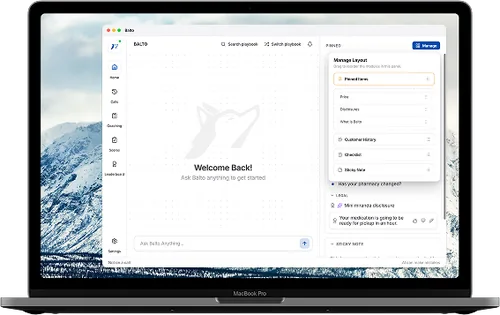
That’s usBalto is a real-time agent guidance and QA platform designed to improve live conversations, making it fundamentally different from traditional WFO tools like Calabrio. While Calabrio focuses on forecasting, scheduling, and post-call quality processes, Balto delivers in-the-moment prompts and coaching that help agents stay compliant, follow workflows, and resolve customer issues on the first call.
Key features
- boltReal-time agent guidance that listens to the call and provides instant prompts (vs. Calabrio’s post-call QA)
- boltReal-time QA that scores calls as they happen instead of relying solely on supervisor reviews
- boltLive coaching dashboards that show supervisors active calls and agent behaviors in the moment
- boltNo-code Playbook Builder for fast updates without engineering
- boltPost-call insights that connect real-time behaviors to outcomes
Pros
- checkImproves agent performance during the call, not after
- checkEnsures consistent, compliant call handling across teams
- checkAccelerates onboarding with in-the-moment support
- checkEasy to customize without technical help
- checkDesigned for high agent adoption with simple, clear prompts
Cons
- closeStrongest on voice, with lighter omnichannel coverage
- closeBest for teams that want humans in the loop rather than automation
- closeWorks best when leadership embraces real-time coaching
- closeDoes not include forecasting or scheduling like Calabrio
CallMiner
CallMiner is a conversation analytics and QA automation platform that focuses on extracting insights from 100 percent of customer interactions. While Calabrio provides WFM, QM, and reporting across channels, CallMiner is built for deeper speech and text analytics, automated scoring, and large-scale insight generation that goes beyond traditional quality management.
Key features
- boltAutomated scoring and QA across all recorded interactions
- boltSpeech and text analytics with advanced topic and sentiment detection
- boltReal-time and post-call insights that surface emerging issues
- boltCustomizable scoring models and category frameworks
- boltIntegrations with CCaaS and CRM platforms for tighter workflows
Pros
- checkMuch deeper analytics than Calabrio’s out-of-the-box capabilities
- checkAutomates QA scoring at scale, reducing manual evaluator workload
- checkSurfaces customer trends, root causes, and performance gaps quickly
- checkStrong for compliance, risk monitoring, and operational insights
- checkFlexible taxonomy and scoring frameworks for complex teams
Cons
- closeDoes not include WFM, scheduling, or broad WFO capabilities like Calabrio
- closeRequires solid data hygiene and configuration to get the most value
- closeBest suited for voice-heavy environments that already record all calls
- closeReal-time guidance is limited compared to agent-assist platforms
- closeCan be more complex for smaller teams without analytics resources
Observe AI
Observe AI is an AI-driven QA and conversation intelligence platform built to analyze and score 100 percent of customer interactions. Calabrio focuses on traditional WFM, scheduling, and post-call evaluations, while Observe AI delivers deeper automated scoring, advanced analytics, and faster insights that replace or supplement manual QA processes.
Key features
- boltAutomated QA scoring across voice and digital interactions
- boltSpeech and text analytics with advanced topic, sentiment, and intent detection
- boltReal-time alerts and post-call insights that surface compliance gaps and performance issues
- boltCoaching workflows based on AI-identified behaviors and trends
- boltIntegrations with leading CCaaS and CRM systems for streamlined QA
Pros
- checkAutomates QA at scale, reducing reliance on manual evaluators
- checkProvides deeper analytics than Calabrio’s native reporting
- checkHelps supervisors find coaching opportunities faster
- checkSurfaces compliance risks across all interactions, not just sampled ones
- checkStrong for teams wanting AI to modernize their quality program
Cons
- closeDoes not offer forecasting, scheduling, or WFM capabilities like Calabrio
- closeReal-time guidance is limited compared to agent-assist platforms
- closeSetup and taxonomy-building require upfront effort
- closeBest for teams with a strong call recording foundation
- closeDigital channel coverage is good but varies by implementation
Level AI
Level AI is a conversation intelligence and automated QA platform designed to analyze customer interactions and streamline QA processes with AI. While Calabrio workforce management focuses on forecasting, scheduling, call recording, and post-call evaluations, Level AI delivers deeper automated scoring, case summarization, and analytics that modernize how teams evaluate conversations across voice and digital channels.
Key features
- boltAutomated QA scoring across voice and digital interactions
- boltSpeech and text analytics with topic, sentiment, and intent detection
- boltAI-powered case summarization and after-call note support
- boltCoaching workflows based on AI-identified behaviors
- boltIntegrations with major CCaaS and helpdesk platforms
Pros
- checkAutomates large portions of QA, reducing manual evaluator workload
- checkStrong AI summarization that speeds up documentation and after-call work
- checkBetter analytics depth than Calabrio’s out-of-the-box insights
- checkIdentifies coaching opportunities faster with behavior-driven insights
- checkSolid coverage across voice and digital interactions
Cons
- closeNo forecasting, scheduling, or WFM tools like Calabrio
- closeLimited real-time guidance compared to agent-assist platforms
- closeRequires configuration and taxonomy-building to unlock value
- closeNot designed for highly complex performance management workflows
- closeWorks best when paired with a CCaaS that captures clean call data
Cresta
Cresta is a real-time agent assist and conversation intelligence platform built to improve live interactions and automate post-call workflows. While Calabrio focuses on forecasting, scheduling, and post-call quality management, Cresta delivers in-the-moment guidance, automated QA, and AI-driven insights that help agents perform better during the conversation and help supervisors coach more efficiently.
Key features
- boltReal-time agent assistance that delivers prompts and workflow guidance during live calls
- boltAutomated QA scoring and post-call summaries powered by generative AI
- boltSpeech and text analytics that surface behaviors, trends, and compliance gaps
- boltReal-time coaching dashboards for supervisors
- boltIntegrations with major CCaaS platforms for fast deployment
Pros
- checkImproves agent behavior during the call rather than relying solely on post-call reviews
- checkStrong real-time assist and summarization features that reduce handle time
- checkFaster QA and coaching cycles than Calabrio’s traditional workflows
- checkDeep analytics for identifying performance trends and insights
- checkHelps supervisors support more agents at once with live visibility
Cons
- closeNo WFM, scheduling, or broader WFO capabilities like Calabrio
- closeWorks best for teams comfortable adopting real-time agent-assist AI
- closeRequires workflow alignment to get the most from real-time guidance
- closeCan require upfront configuration to fine-tune AI prompts
- closePrimarily focused on voice, with digital channel coverage still evolving
Key Features to Consider When Choosing Contact Center Software
When evaluating contact center software, it is important to understand which features will actually move the needle for agent performance, compliance, and customer experience. A strong platform should include quality management, speech and text analytics, and real-time capabilities, among other core features.
Workforce Management
Evaluate how accurately the platform predicts volume and builds schedules that balance efficiency with service levels.
Quality Management
Look for reliable call recording, customizable scorecards, and workflows that make it easy to consistently evaluate agent performance.
Speech and Text Analytics
Ensure the tool can analyze 100% of interactions across voice and digital channels to uncover trends, compliance gaps, and coaching opportunities.
Real-Time Capabilities
Consider whether the system can guide agents or alert supervisors live instead of relying solely on post-call QA.
Agent Performance and Coaching Tools
Assess how well the platform supports ongoing coaching, performance tracking, and behavior improvement at scale.
Reporting and Customer Insights
Look for unified dashboards that combine operational, customer, and agent metrics into actionable insights across channels.
Integrations and Ecosystem Fit
Confirm that the platform integrates smoothly with your CCaaS, CRM, and other tools so data and workflows move cleanly across your stack.
When evaluating tools like NICE, Balto, and others, weigh how each performs in these key areas, balancing sophistication with usability to match your organization’s size, goals, and customer experience strategy.
Top Calabrio Alternatives
Top Calabrio alternatives include platforms like Balto, NICE, Verint, Genesys, Five9, Talkdesk, Observe AI, Cresta, and Level AI, each offering different strengths across real-time guidance, analytics, QA automation, and workforce engagement. When comparing them, buyers should look closely at real-time capabilities, analytics depth, coaching tools, and how well the platform improves agent performance during live customer interactions. Balto stands out because it delivers live prompts and QA that help agents get conversations right as they happen, improving compliance, customer satisfaction, and first-call resolution in ways post-call WFO tools cannot match.
FAQs
The top Calabrio competitors in 2026 include Balto, NICE, Verint, Genesys, Five9, Talkdesk, Observe AI, Cresta, and Level AI. These platforms offer different strengths across workforce management, QA automation, analytics, and real-time agent support.
Balto focuses on real-time agent guidance, real-time QA, and instant coaching, helping agents get conversations right as they happen. Calabrio centers on traditional WFM, post-call quality management, and reporting. Teams choose Balto when they want in-the-moment improvements rather than relying solely on Calabrio’s post-call evaluation cycles.
Calabrio is a well-established WFO and quality management platform, but it is not considered a leader in AI-driven contact center software. AI-first platforms like Balto, Cresta, and Observe AI offer stronger real-time guidance, automated scoring, and advanced analytics capabilities.
Balto is widely recognized as the leading solution for real-time agent coaching, delivering instant in-call prompts, real-time QA, and supervisor visibility during live conversations. While platforms like Cresta and Genesys Agent Assist offer real-time features, Balto is purpose-built for consistent, compliant, on-the-call performance.
When considering Calabrio workforce management alternatives, consider whether you need real-time guidance, deeper analytics, faster QA cycles, modern coaching workflows, or a more flexible and intuitive UI. Many teams move to solutions like Balto to improve agent performance during the call, increase compliance consistency, and reduce reliance on manual post-call evaluations.
Found What You Were Looking For? Discover the Better Alternative, Balto.
See how Balto outperforms other AI solutions with real-time guidance, QA automation, and insights that instantly improve agent performance.

Book by phone
+1 (405) 864-4645Call and speak directly with our AI agent to schedule your demo, available 24/7, no wait time.
Call now- Give agents the right answer in real time, pulled straight from your own knowledge base.
- Coach faster. Balto spots who needs it, does the prep, and takes you right to the coachable moments.
- See the trends driving your business out of the box, no setup required.
- QA every conversation automatically, so all that’s left is a quick review before it reaches leadership.