Not All Agent Assist Is The Same. Learn About The Levels of AI-Supported Real-Time Guidance
What if your contact center platform could tell agents exactly what to do without making them sound like robots? This webinar covers how AI-powered real-time checklists and dynamic prompts adapt to each call, helping agents focus on the customer instead of the script.
The Tension Every Contact Center is Trying to Solve
Every contact center faces the same challenge: agents need to follow a process, but you don't want them to sound like they're reading from a script. The quality of the agent experience directly translates to the customer experience. When guidance doesn't match how people actually talk, agents struggle to build rapport, miss nuances, and can come across as robotic.
One agent put it plainly in a recent G2 review : "Sometimes I get tongue twisted because it doesn't sound like I'm saying it from my heart." That kind of feedback matters, because agent frustration shows up in the customer experience.
Balto has guided more than half a billion real customer conversations across 300+ organizations. That depth of experience is what drove a meaningful update to how Balto's Agent Assist works.
Not all guidance requires the same approach
Some language genuinely must be verbatim (think insurance disclosures, mini-Mirandas, consent statements). Keyword and phrase-matching models work well for those. But much of what happens on a call is naturally fluid. There are countless ways to ask about a customer's project details or their experience with a previous provider. What matters in those moments is the topic being covered, not the exact words used.
When every item in your call flow is treated like a compliance script, agents miss the nuances that build real relationships. Balto's latest update addresses this directly.
AI checklist triggers
Balto's checklists can now trigger based on wider contextual reasoning using AI prompting. This opens up guidance for the full range of how agents actually talk.
When phrasing varies naturally from call to call, checklist items still trigger. When you need both an agent question and a customer response before something resolves, you can require that. When the outcome matters more than the exact language (i.e. an appointment booked, a decision-maker confirmed), you can track that too.
AI dynamic prompts
Dynamic prompts have long been a way to surface guidance when specific topics come up naturally mid-call. Now they've received the same upgrade as AI checklists. The same contextual flexibility that improved checklist triggers now applies to dynamic prompts as well, so agents get relevant guidance regardless of how a topic is raised.
Built to be Easy to Configure
Balto doesn't expect contact center leaders to also be AI experts. The updated platform includes an automatic prompt builder that works with you to capture your intent in language the AI can understand. In-editor testing tools let you validate and adjust before anything goes live. And your Balto customer success, prompt engineering, and implementation teams are there to support you throughout.
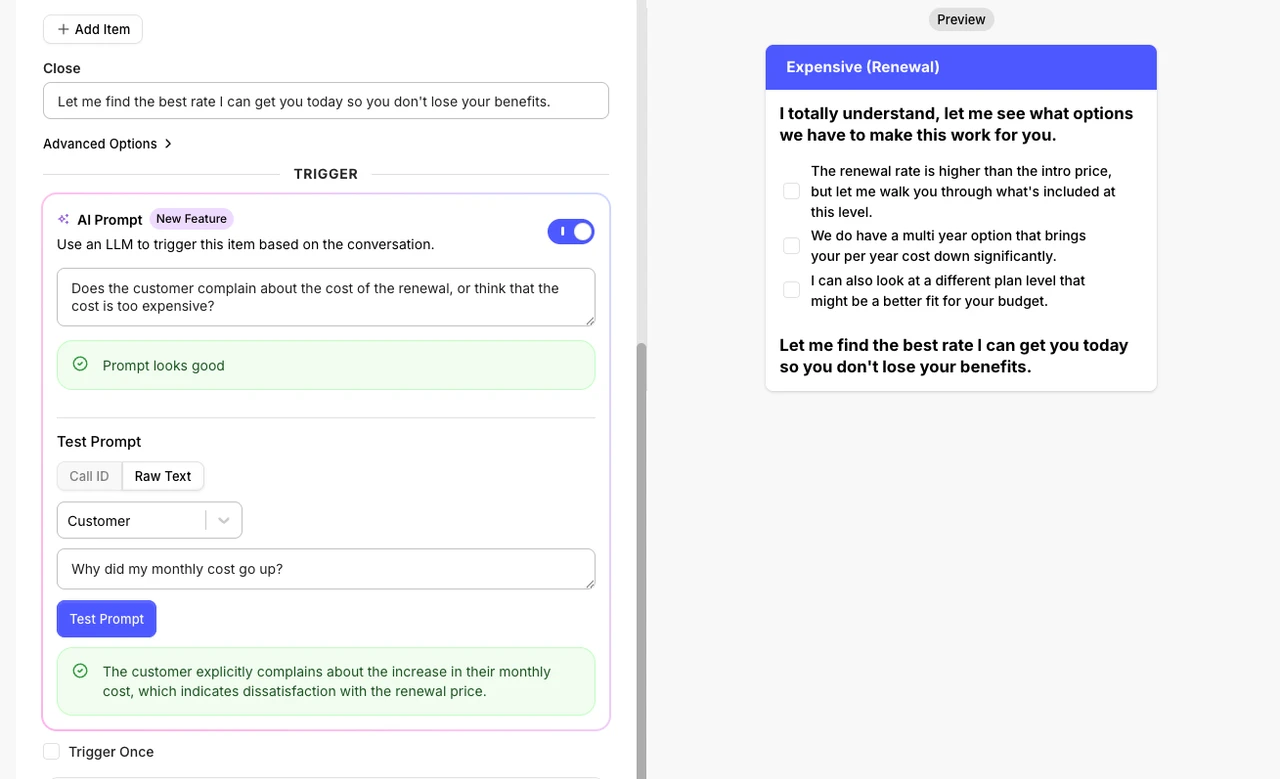
A Real-World Example
One of Balto's largest customers in healthcare sales has a call flow that spans verbatim compliance disclosures, items requiring both agent questions and customer confirmation, and open-ended discovery questions. Previously, no single system could handle all three well. With AI checklist triggers, the same platform now guides agents through all of these scenarios, adapting to how each conversation actually flows rather than demanding agents conform to a script.
What Better Agent Assist Actually Delivers
When your Agent Assist adapts to how your agents' conversations actually flow, calls feel better for your customers and your agents. Plus, your QA and compliance scores still reflect what matters to you without overly constraining your agents.
The contact centers that figure out how to provide compliant guidance while letting agents sound organic will ultimately deliver the best customer experience possible.
This is the next level of Agent Assist.


