










Choosing the best enterprise contact center solutions requires more than comparing feature lists or chasing the latest AI trend.
Enterprise contact centers operate at scale, across regions, systems, and regulatory environments, which means solutions must be secure, flexible, and able to improve performance without disrupting core operations.
This guide breaks down what “enterprise-ready” really means and highlights eight AI-powered solutions enterprise leaders commonly evaluate today:
- NICE: Enterprise-grade workforce optimization, quality management, and analytics designed for large, regulated environments.
- Genesys: AI-driven journey orchestration and routing embedded within a robust CCaaS platform.
- Five9: Cloud-native CCaaS with integrated AI for automation, analytics, and high-volume scalability.
- Balto: Real-time agent coaching and compliance guidance layered on top of existing contact center platforms.
- Cresta: AI-powered conversation intelligence focused on post-call performance insights and coaching trends.
- Cogito/Verint: Behavioral and emotional AI that supports agents during live, high-stakes conversations.
- Observe AI: Analytics-first AI platform that automates quality assurance and surfaces performance insights at scale.
- Level AI: Cross-channel interaction analytics that improve operational visibility and CX decision-making.
Together, these solutions illustrate how enterprises are building modern contact center stacks that balance stability with innovation, and performance gains with operational control.
What Makes a Contact Center Solution “Enterprise-Ready?”
An enterprise-ready contact center solution is defined by its ability to operate reliably at scale, integrate cleanly into a complex technology environment, and adapt to organizational change without disrupting day-to-day operations.
At a baseline level, enterprise readiness starts with scale and performance. The platform must support hundreds or thousands of agents across multiple regions, handle peak volumes, and offer global routing, redundancy, and uptime guarantees that meet strict SLAs.
Equally important is security and compliance. Enterprise contact centers often operate in regulated environments, which means solutions must support standards like SOC 2, GDPR, PCI, and HIPAA, where applicable.
Beyond certifications, enterprises need granular permissioning, audit logs, data residency controls, and secure integration patterns that satisfy internal IT and risk teams.
Integration flexibility is another defining factor. Enterprise contact centers rarely operate as standalone systems. They must integrate with CRMs, workforce management tools, data warehouses, analytics platforms, and custom internal systems.
Finally, enterprise readiness requires operational adaptability. Large organizations evolve constantly, and solutions must be configurable without heavy custom development, support phased rollouts, change management, and long-term optimization.
In short, enterprise-ready contact center solutions prioritize durability, governance, and flexibility over novelty. They are built to support complexity and to improve performance without forcing organizations to rebuild their entire stack.
Types of Enterprise Contact Center Solutions (Platforms vs Point Tools vs AI Layers)
Enterprise contact center technology generally falls into three categories. Understanding the difference is critical for making informed buying decisions and avoiding costly overhauls.
Platforms (CCaaS)
Platforms (CCaaS) form the foundation of the contact center. These systems handle core functions like call routing, omnichannel orchestration, IVR, workforce management, and system-level reporting.
Because they sit at the center of customer operations, replacing a CCaaS platform is disruptive, time-consuming, and often tied to multi-year contracts.
Point Tools
Point tools address specific operational needs, such as transcription, speech analytics, workforce scheduling, or survey collection. They can be effective in narrow use cases but often introduce complexity if deployed without a broader architectural plan.
Over time, too many point tools can create fragmented workflows and data silos.
AI Layers
AI layers sit on top of existing platforms to improve performance without replacing the core infrastructure. These solutions focus on real-time guidance, quality assurance , coaching, analytics, and automation.
Rather than handling calls directly, AI layers analyze conversations as they happen or after the fact, surfacing insights, recommendations, and compliance support to agents and managers.
For enterprises, AI layers offer a faster path to measurable gains in efficiency, quality, and customer experience.
Most enterprises choose to add AI on top of their existing CCaaS rather than rip and replace it. The reason is practical: replacing a platform can take months or years, requires significant change management, and carries substantial operational risk.
AI layers allow organizations to improve outcomes quickly while preserving system stability, existing integrations, and institutional knowledge. This layered approach reduces risk, accelerates ROI, and supports incremental transformation instead of all-at-once change.
8 Best AI-Powered Contact Center Solutions for Enterprise
Enterprise AI contact center solutions vary widely in scope, architecture, and impact.
The tools below represent a mix of platform-native AI and standalone AI layers, each designed to help large organizations improve efficiency, quality, and customer experience without introducing unnecessary operational risk.
1. NICE

NICE offers one of the most comprehensive AI-driven suites for enterprise contact centers, with deep roots in workforce optimization, quality management, and analytics. It is often chosen by large, regulated organizations that prioritize governance and reporting depth.
Core features:
- AI-powered QA and interaction analytics
- Workforce management and forecasting
- Omnichannel recording and insights
- Compliance monitoring and reporting
2. Genesys

Genesys embeds AI deeply into its CCaaS platform, with strengths in journey orchestration and intelligent routing. It is best suited for enterprises already standardized on Genesys infrastructure.
Core features:
- AI-driven routing and orchestration
- Predictive engagement tools
- Journey analytics across channels
- Native CCaaS integration
3. Five9

Five9 combines cloud-native CCaaS with embedded AI for automation, analytics, and agent assistance. It is frequently used in high-volume environments that want AI capabilities tightly coupled with the core platform.
Core features:
- Intelligent virtual agents
- AI-driven analytics and reporting
- Workforce engagement tools
- Omnichannel support
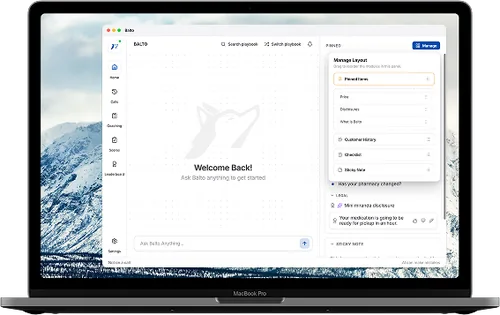
4. Balto

Balto focuses on real-time AI guidance that helps agents perform better during live conversations. It is designed to layer on top of existing CCaaS platforms without requiring rip-and-replace changes.
Core features:
- Real-time agent coaching and prompts
- Compliance and script guidance
- Call scoring and QA automation
- Manager insights and coaching tools
5. Cresta

Cresta provides AI-driven insights and coaching focused on understanding what top performers do differently. Its strengths lie in post-call analysis and performance trend identification.
Core features:
- Conversation intelligence
- Agent performance analytics
- Coaching recommendations
- Automated insights
6. Verint/Cogito

Cogito (now owned by Verint) specializes in behavioral and emotional intelligence, analyzing tone and speech patterns during live calls. It is often used in high-stakes or regulated environments where empathy and communication quality are critical.
Core features:
- Real-time behavioral signals
- Emotional intelligence analytics
- Agent coaching cues
- Post-call insights
7. Observe AI

Observe AI is an analytics-first platform designed to modernize QA and performance analysis at scale. It is commonly used to replace manual QA processes.
Core features:
- AI-powered QA automation
- Speech and text analytics
- Performance dashboards
- Insight discovery tools
8. Level AI

Level AI focuses on extracting insights across customer interactions to improve visibility into performance and experience. It is often adopted by teams prioritizing data unification and operational intelligence.
Core features:
- Interaction analytics across channels
- AI-driven insights and tagging
- QA and performance analysis
- Data unification tools
Common Mistakes When Buying Enterprise Contact Center Software
Buying contact center software at the enterprise level is less about choosing the “best” tool and more about avoiding costly missteps.
The following mistakes are common among large organizations and often lead to delayed ROI, stalled adoption, or unnecessary operational risk.
Treating Feature Volume as a Proxy for Readiness
One of the most common mistakes enterprise buyers make is equating long feature lists with enterprise readiness. While many platforms advertise hundreds of capabilities, not all of them are mature, scalable, or relevant to complex environments.
Enterprises should focus less on breadth and more on how reliably core capabilities perform under real-world conditions like peak volume, multi-region support, and complex workflows.
Underestimating Change Management and Adoption
Enterprise contact center implementations fail as often due to people and process issues as they do technology gaps.
New platforms or tools that require agents to completely change workflows, or managers to relearn reporting and coaching processes, often face resistance and slow adoption.
Solutions that support phased rollouts, configurable workflows, and minimal disruption tend to deliver value faster and more sustainably.
Over-Indexing on Rip-and-Replace Transformations
Replacing an existing CCaaS platform is a high-risk, high-effort initiative. Enterprises sometimes pursue full replacements in pursuit of modernization, only to encounter long implementation timelines, integration challenges, and operational instability.
In many cases, layering AI and optimization tools on top of existing platforms delivers faster ROI while preserving institutional knowledge and system stability.
Ignoring Security, Compliance, and Scalability
Security, compliance, and scalability are frequently treated as downstream considerations, but for enterprises, they should be evaluated upfront.
Contact center software must meet regulatory requirements such as GDPR, PCI, HIPAA, or SOC2, where applicable, while also supporting granular access controls, auditability, and data residency needs.
At the same time, solutions must scale reliably across geographies, business units, and seasonal demand without degrading performance.
Failing to validate these requirements early can stall deployments, trigger rework, or block internal approval entirely.
Adding Point Tools Without an Architecture Plan
Point solutions can solve immediate problems, but deploying them without a clear architectural strategy often creates fragmented workflows and data silos.
Enterprises should evaluate how new tools fit into the broader contact center ecosystem and whether they enhance or complicate long-term visibility, reporting, and optimization.
How to Choose the Right Solution & Build an Enterprise Contact Center Tech Stack
Selecting contact center technology at the enterprise level requires a structured approach that balances performance, risk, and long-term flexibility.
The steps below outline a practical framework enterprises can use to evaluate solutions and assemble a scalable, future-ready tech stack.
1. Start With Business Outcomes, Not Vendor Categories
Before evaluating vendors, enterprises should clearly define the outcomes they are trying to achieve.
This may include reducing average handle time, improving first-contact resolution, increasing compliance adherence, or supporting new channels.
Anchoring decisions in outcomes helps avoid buying technology that looks impressive but fails to move core metrics.
2. Audit Your Existing Contact Center Infrastructure
Most enterprises already operate a complex stack that includes CCaaS platforms, CRMs, workforce management tools, and analytics systems. Conducting an audit of current capabilities, integrations, and pain points provides a realistic baseline and helps identify where incremental improvements are possible versus where foundational gaps exist.
3. Decide What Should Be Replaced Versus Augmented
Not every challenge requires a platform replacement. Enterprises should assess which functions are tightly coupled to their CCaaS and which can be improved through AI layers or targeted tools.
In many cases, augmentation delivers faster ROI with significantly lower operational risk.
4. Evaluate Integration and Data Flow Early
Integration complexity is often one of the biggest hidden costs in enterprise deployments. Buyers should validate how data flows between systems, where insights surface, and how reporting is governed.
Solutions with strong APIs, proven integrations, and clear data models reduce long-term friction.
5. Plan for Security, Compliance, and Scale From Day One
Enterprise stacks must meet regulatory requirements, internal security standards, and future growth demands. Reviewing certifications, access controls, data residency options, and scalability upfront prevents late-stage blockers and accelerates internal approval.
6. Design for Adoption, Not Just Deployment
Finally, enterprises should consider how agents, supervisors, and QA teams will actually use new tools. Solutions that fit existing workflows, support phased rollouts, and deliver insights in the flow of work are more likely to be adopted and to generate sustained value.
✅ Checklist: Evaluation Criteria for Enterprise Contact Centers
Use this checklist to evaluate whether a contact center solution is truly enterprise-ready.
Not every organization will need every capability, but gaps in these areas often signal long-term risk.
✔️ Core Platform Readiness
- Supports hundreds or thousands of agents without performance degradation
- Provides global routing, redundancy, and uptime SLAs
- Handles voice and digital channels within a single operational view
- Enables phased rollouts across teams, regions, or business units
✔️ AI and Automation Capabilities
- Offers real-time or near-real-time AI support for agents and supervisors
- Automates quality assurance and reduces manual review effort
- Surfaces actionable insights rather than raw transcripts or dashboards
- Allows AI capabilities to be added without replacing the CCaaS platform
✔️ Agent Enablement and Performance
- Supports in-workflow guidance rather than post-call-only feedback
Provides coaching tools for supervisors and QA teams
- Aligns with existing agent workflows and scripts
- Helps improve consistency, compliance, and customer experience
✔️ Integration and Data Architecture
- Integrates cleanly with CRM, WFM, and existing contact center tools
- Offers robust APIs and documented integration patterns
- Avoids creating new data silos or duplicate reporting systems
- Supports enterprise data governance and ownership models
✔️ Security, Compliance, and Governance
- Meets relevant compliance standards (SOC 2, GDPR, PCI, HIPAA, etc.)
- Provides granular role-based access controls
- Supports audit logs and compliance reporting
- Offers data residency and retention controls
✔️ Scalability and Long-Term Viability
- Scales across geographies, channels, and seasonal demand
- Has a clear product roadmap aligned with enterprise needs
- Demonstrates financial stability and enterprise customer references
- Minimizes long-term operational and maintenance overhead
Building an Enterprise Contact Center That Evolves With You
Choosing the best enterprise contact center solution is not about finding a single platform that does everything.
It is about building a technology stack that can scale with your organization, adapt to change, and deliver measurable improvements without introducing unnecessary risk.
Enterprise-ready contact centers prioritize stability, security, and integration at the foundation, then layer in AI and optimization tools where they create the most impact.
For many organizations, this means modernizing performance, quality, and agent experience through AI augmentation rather than attempting disruptive rip-and-replace transformations.
By focusing on clear outcomes, understanding the role each technology plays in the stack, and evaluating solutions through an enterprise lens, contact center leaders can make smarter decisions that support both near-term gains and long-term growth.
The result is a contact center that is not just operationally sound today, but resilient enough to evolve as customer expectations, channels, and technologies continue to change.
FAQs
There is no single “best” solution for every enterprise. The right choice depends on factors like scale, regulatory requirements, existing infrastructure, and business goals.
Many enterprises use a core CCaaS platform for routing and omnichannel support, then add on AI platforms like Balto to improve quality, efficiency, and agent performance.
Enterprise contact center software should support large-scale operations, omnichannel engagement, and deep integrations with existing systems.
Key features typically include global routing, workforce management, robust analytics, security controls, and the ability to layer in AI without disrupting operations.
Enterprise solutions are built to handle higher call volumes, more complex workflows, and stricter security and compliance requirements.
They also prioritize configurability, integration flexibility, and governance, whereas SMB solutions often focus on ease of setup and lower upfront cost.
Not necessarily. While all-in-one platforms can simplify vendor management, they may lack flexibility in certain areas.
Many enterprises prefer a layered approach, using a stable CCaaS foundation and adding specialized tools for AI, quality assurance , and coaching as needed.
AI can improve performance by assisting agents in real time, automating quality assurance, identifying coaching opportunities, and surfacing actionable insights from conversations.
These capabilities help reduce handle time, improve consistency, and enhance customer experience without increasing agent workload.
The best AI tools vary by use case. Some focus on real-time agent guidance, others on post-call analytics , QA automation, or behavioral insights.
Enterprises often evaluate AI tools based on how well they integrate with existing platforms and how quickly they deliver measurable ROI.
Enterprises typically require contact center software to meet standards such as SOC 2, GDPR, PCI, or HIPAA, depending on industry.
Beyond certifications, they evaluate access controls, audit logs, data residency options, and vendor security practices to ensure compliance with internal and external requirements.
Yes. Many AI solutions are designed to layer on top of existing CCaaS platforms. This approach allows enterprises to modernize performance and analytics while avoiding the cost, risk, and disruption of replacing core infrastructure.
Costs vary widely based on platform type, number of agents, AI capabilities, and implementation complexity. Enterprise solutions are typically priced per agent per month, with additional costs for integrations, professional services, and advanced analytics.
Implementation timelines can range from a few weeks for AI layers to several months or longer for full CCaaS replacements. The timeline depends on factors such as integration requirements, customization, security reviews, and organizational change management.
Liked what you read? See Balto in action.
Balto helps leading contact centers turn insights into outcomes, in real time. Book a live demo to discover how our AI powers better conversations, coaching, and conversions.