Reality Check: What AI Does Great and What We’re Still Working On In 2026
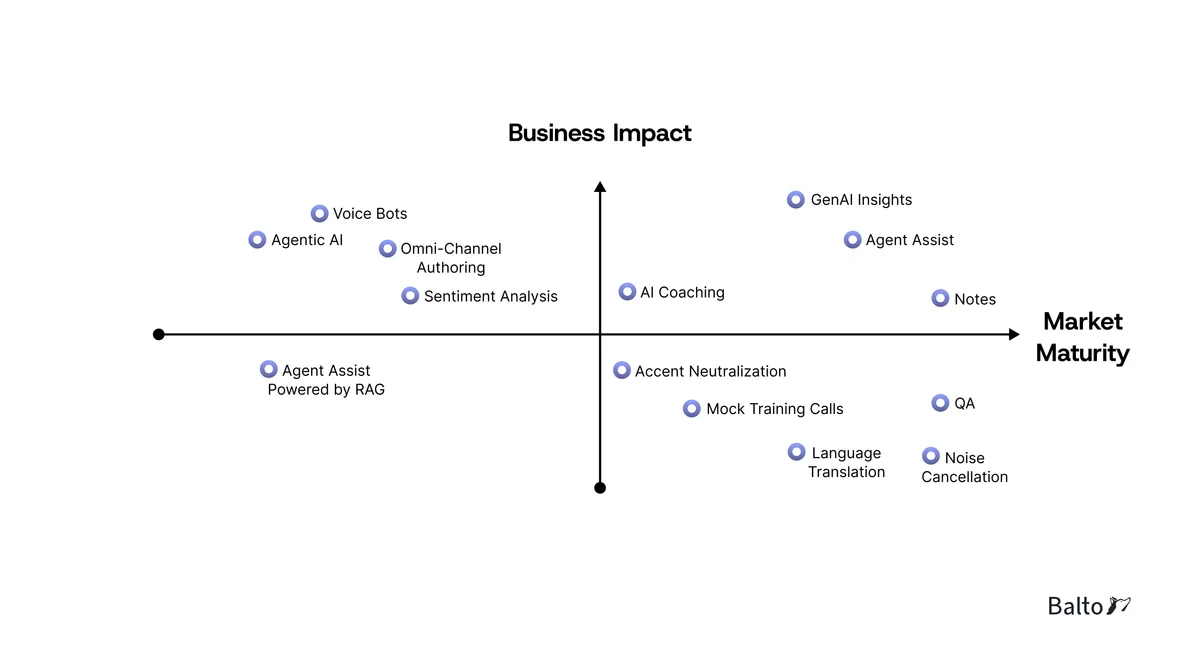
The most successful contact center AI strategies don’t tackle the hardest problems first — they focus on achievable wins. Learn how to invest wisely by focusing on proven use cases that deliver ROI in today’s market. Discover where AI is already transforming customer experience, QA, and operations and where it is still maturing.
A Practical Framework for Contact Center AI
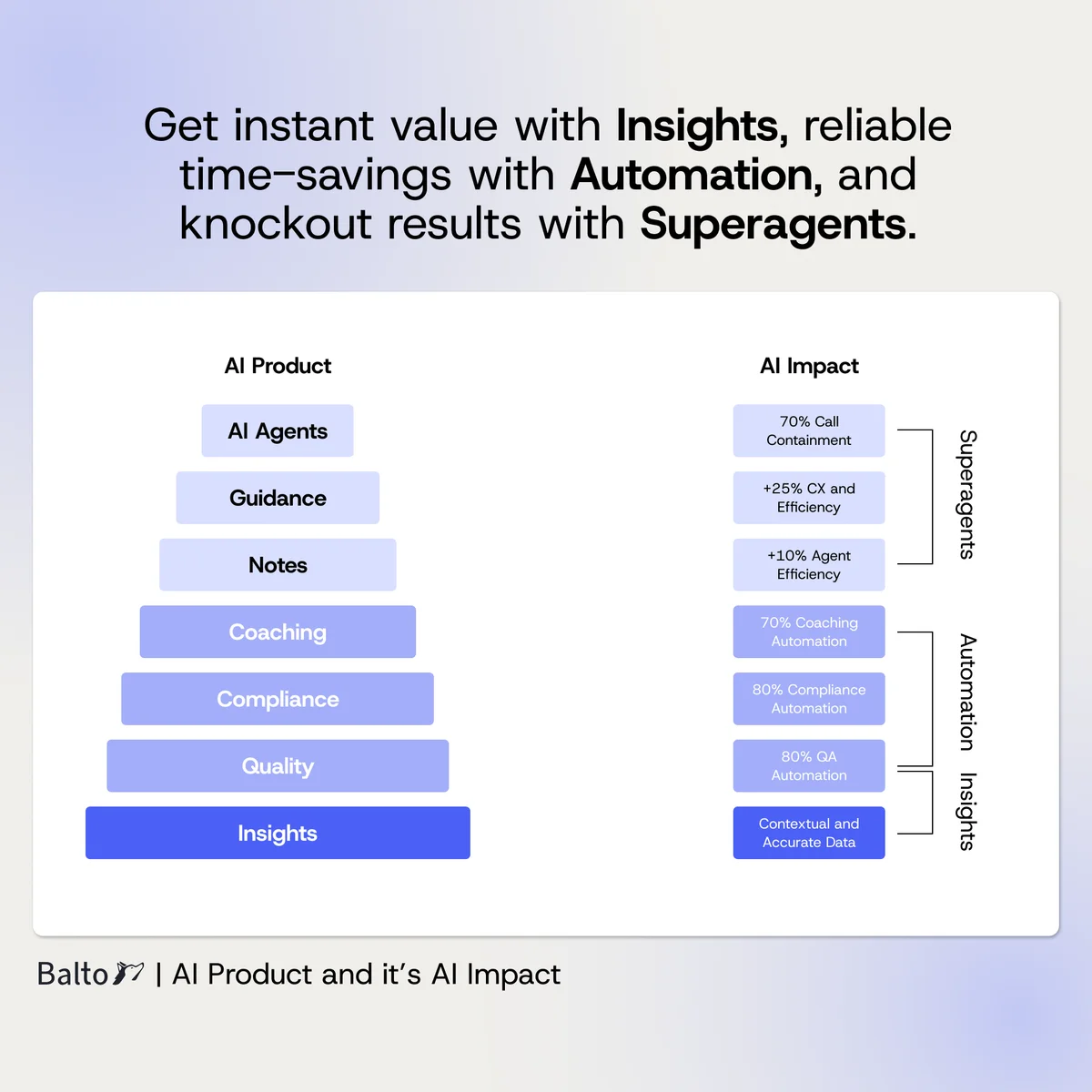
AI in the contact center isn’t one-size-fits-all, and not every use case delivers value at the same time. The most successful teams focus on implementing the right AI capabilities in the right order, starting with proven foundations and building toward more advanced automation and insights.
Agent Assist: Real-Time Guidance That Drives Consistency
Agent Assist is the foundation of modern contact center AI. By listening to live calls and surfacing the right resources at the right moment, agents are more confident, consistent, and compliant from day one.
Instead of long ramp times, knowledge gaps, and inconsistent execution, agents receive dynamic prompts, checklists, and guidance directly within the call. This allows teams to scale best practices across every agent and improve outcomes immediately.
What’s next: Agent Assist will become increasingly adaptive and predictive, anticipating agent needs, personalizing support by skill level, and reducing friction during complex, high-stakes conversations.
AI Notes: Eliminating Low-Value After-Call Work
After-call work is often time-consuming, repetitive, and prone to error. AI-generated summaries and notes automatically capture key details and next steps so agents can stay focused during the call and move on quickly afterward.
With notes generated automatically, agents spend less time documenting and more time helping customers. The result is faster wrap-up, fewer mistakes, improved follow-through, and shorter queues without sacrificing accuracy.
What’s next: Notes will increasingly connect directly into downstream systems and workflows, helping teams automate follow-ups, trigger actions, and ensure nothing falls through the cracks after the call ends.
AI-Powered QA: Visibility, Context, and Coaching at Scale
Traditional manual QA typically covers only a small fraction of interactions, leaving major blind spots in quality, coaching, and compliance. AI-powered QA changes that by evaluating 100% of calls automatically.
Teams gain continuous, real-time visibility into performance and compliance while freeing managers and QA teams to focus on coaching, trend analysis, and improvement—not just review. AI QA builds on existing scorecards and processes, enhancing them without replacing human judgment.
What’s next: QA is evolving from simple scoring to deeper interaction intelligence. Sentiment analysis adds critical context by showing how conversations unfold over time, highlighting emotional shifts, identifying calls at risk, and enabling more proactive coaching and intervention.
Actionable Insights: Turning Conversations into Decisions
When AI analyzes every interaction, teams can finally answer critical questions with confidence: why customers are calling, what’s driving repeat contacts, and where experiences break down.
By querying call data in natural language and drilling down into real examples, leaders gain evidence-based insights that inform coaching strategies, process improvements, and even digital experience updates, putting better decision-making in the hands of the people closest to the customer.
What’s next: Insights will become more prescriptive, not just descriptive, by automatically surfacing opportunities, detecting patterns earlier, and guiding teams toward the actions that will have the greatest operational and customer impact.
AI Voice Agents: Enterprise-Ready Automation That Works
AI voice agents are entering a new era defined by reliability, transparency, and enterprise control. Modern voice agents can handle real conversations, adapt to interruptions and accents, escalate smoothly when needed, and continuously improve over time.
When voice agents are embedded within a broader AI platform, organizations gain unified visibility across both human and automated interactions. This enables consistent analytics, clearer performance insights, and higher-quality customer experiences all from a single source of truth.
What’s next: Voice agents will increasingly handle end-to-end workflows for well-defined use cases, resolving more interactions independently while seamlessly collaborating with human agents when complexity arises.
The Right AI, in the Right Order
The most effective AI strategies start with foundational capabilities like Agent Assist and Notes, expand into QA and insights, and then scale into advanced automation like voice agents. By building in the right sequence, contact centers can unlock faster ROI, better experiences, and a more future-ready operation.