















Robotic Process Automation (RPA) is revolutionizing customer service by automating repetitive, rule-based tasks—allowing human agents to focus on empathy, problem-solving, and complex interactions that build loyalty.
At its core, RPA deploys software bots that mimic human actions in digital systems, connecting tools like CRMs, ticketing systems, and communication platforms. This makes operations faster, more accurate, and consistently on-brand.
Here’s what RPA can do in customer service today:
- 🧾 Automate repetitive tasks like data entry, ticket creation, and customer-profile updates across multiple systems.
- 💬 Enhance self-service experiences by powering chatbots and automated notifications that respond instantly to common inquiries.
- ⚙️ Improve agent efficiency through after-call work automation, data retrieval, and pre-filled forms.
- 📊 Streamline order management and reporting, from processing refunds to generating compliance logs.
- 🤝 Integrate seamlessly with AI to provide real-time guidance, proactive issue resolution, and hyper-personalized support.
Together, these use cases reduce average handle time, improve first-contact resolution, and increase both agent satisfaction and customer trust.
And when RPA works alongside Balto’s real-time AI , automation becomes intelligent. Instead of just processing tasks, it enhances every live customer interaction—making service faster, smarter, and more human.
What Is RPA in Customer Service?
RPA deploys software bots that mimic human actions in digital systems to perform structured, repetitive work—from updating CRM records to processing refunds. Within a contact center, these bots act as silent assistants that make agents faster and more accurate.
To see how automation shapes wider call-center strategy, review call-center automation trends that are redefining efficiency benchmarks.
How RPA Transforms the Customer Experience

RPA eliminates friction across support touchpoints. Instead of customers waiting while agents juggle multiple systems, bots handle background tasks instantly.
Key transformations:
- Speed: Bots execute tasks up to 10× faster than manual input.
- Consistency: They eliminate order-processing and data-entry errors.
- Personalization: Automation surfaces customer context so agents can tailor conversations.
- Availability: 24/7 support for simple inquiries without additional staffing.
A telecom provider that introduced RPA to pre-fetch customer account details saw call times drop 35 percent and first-contact resolution rise 20 percent.
For more on holistic modernization, explore how digital transformation in contact centers enables this shift.
Top RPA Use Cases in Customer Service
Below are ten of the most impactful RPA applications transforming contact-center operations in 2025 and beyond.

1. Automated Data Entry & Profile Updates
Bots extract and validate customer data from emails, chat logs, or forms, then update CRM systems in real time.
This automation reduces manual errors, improves accuracy, and saves agents hours each week—especially when paired with analytics from call-center data analytics use cases .
2. Ticket Categorization & Routing
RPA bots read incoming messages, identify intent, and auto-assign tickets to the right queue—cutting response time by up to 50 percent.
This intelligent routing supports the AI in contact centers trend of blending automation with human empathy.
3. Order & Transaction Processing
From confirming purchases to managing refunds, RPA automates the entire order lifecycle across ERP and CRM platforms.
It eliminates duplicate entries, shortens refund cycles, and ensures complete audit trails for compliance.
4. Customer Identification & Verification
Using optical-character recognition and database lookups, RPA instantly verifies customer identities—critical for regulated sectors like finance or telecom.
A bot can confirm account details in two seconds while maintaining compliance accuracy above 99 percent.
5. Automated Customer Communication
RPA sends post-interaction updates—confirmation emails, payment reminders, shipment notifications—without human intervention.
That consistency strengthens omnichannel engagement and complements insights from omnichannel communication for customer service .
6. Chatbot Enablement & AI Integration
RPA powers chatbots behind the scenes: when a customer requests a password reset or account balance, the bot triggers RPA workflows to complete the action.
This tight coupling of AI + RPA (hyperautomation) creates a truly self-service ecosystem.
7. After-Call Work (ACW) Automation
RPA completes post-call tasks—auto-filling disposition codes, summarizing notes, and triggering follow-ups—saving agents 3-5 minutes per call.
When combined with Balto’s real-time AI guidance, agents capture accurate details during the conversation itself, further reducing ACW time.
8. Compliance & Reporting
Bots maintain audit logs, generate weekly compliance reports, and flag anomalies automatically.
These automations support strong quality programs built on the principles discussed in contact-center quality assurance software 2025 .
9. Agent Assist Automation
While agents speak with customers, RPA retrieves account history and previous tickets in real time, cutting average handle time and boosting satisfaction.
This aligns with guidance from average handle time formula insights on performance optimization.
10. Performance Dashboard Automation
RPA compiles metrics like CSAT, FCR, and AHT into automated dashboards, replacing manual spreadsheets with real-time intelligence.
RPA vs. AI: When Automation Meets Intelligence
While RPA automates rule-based, repetitive processes, AI adds the cognitive ability to learn, interpret, and decide. When combined, they create “intelligent automation”—a dynamic blend that’s reshaping modern contact centers.
Key difference:
- RPA follows pre-set rules (“if this, then that”).
- AI adapts to changing scenarios through data patterns.
In leading call centers, RPA handles routine tasks while AI tools like Balto provide real-time speech guidance—coaching agents live as they talk to customers.
This synergy produces faster resolutions, higher satisfaction, and measurable ROI across metrics like CSAT and FCR.
For more context on how these technologies integrate, check how artificial intelligence is transforming contact centers .

Benefits of RPA for Customer Support Teams
RPA’s value isn’t just operational—it drives measurable business outcomes across speed, quality, and scalability.
1. Faster Service Delivery: Bots process requests 5–10× faster than humans, dramatically improving time-to-resolution.
2. Reduced Human Error: Automation ensures consistent data entry, compliant processes, and standardized documentation.
3. Increased Agent Productivity: By handling repetitive tasks, RPA frees agents to focus on complex customer issues—reducing burnout and improving morale.
4. Enhanced CX Metrics: Organizations using RPA often see measurable gains in First Contact Resolution (FCR) and Net Promoter Score (NPS), aligning with Balto’s mission to help teams deliver frictionless experiences.
5. 24/7 Availability: Unlike human shifts, bots operate continuously—perfect for businesses offering around-the-clock support.
When implemented alongside call-center automation trends , RPA serves as a cornerstone of scalable service excellence.
Challenges and Best Practices for Implementing RPA

Despite its advantages, RPA success depends on thoughtful implementation. Common pitfalls include poor process selection, lack of integration, and low adoption among agents.
Challenges:
- Automating processes that are too unstructured or require human judgment.
- Scaling bots without strong IT governance.
- Change management and agent buy-in.
Best Practices:
- Start small: Automate one high-volume process first.
- Integrate RPA with AI and analytics: Combine structured automation with insight-driven decision-making.
- Involve agents early: Train them to use and trust automation as an assistant, not a threat.
- Measure and iterate: Track efficiency and quality metrics to refine workflows continuously.
For insight on measuring automation ROI, visit measure ROI of customer service for frameworks that quantify the impact of RPA and AI on key KPIs.
How Balto Amplifies RPA’s Impact with Real-Time AI
Balto doesn’t compete with RPA—it completes it.
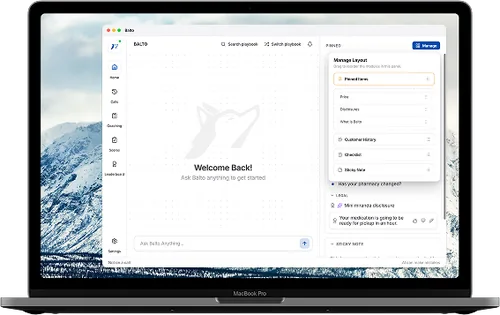
While RPA automates tasks, Balto’s Real-Time Guidance automates decisions in the moment. It listens to calls as they happen, identifies intent, compliance cues, and sentiment, and guides agents live with prompts that improve every customer interaction.
RPA + Balto = Intelligent Automation in Action
- RPA automates after-call updates; Balto ensures agents collect the right details during the call.
- RPA delivers faster workflows; Balto delivers smarter conversations.
- Together, they maximize efficiency and elevate customer experience.
This synergy empowers contact centers to unify process automation with human performance optimization—a combination that’s shaping the next generation of customer engagement.
Future Trends: RPA, AI Agents, and Customer Experience 2030
By 2030, customer service will evolve toward hyperautomation—where RPA, AI, analytics, and voice intelligence work as one ecosystem.
Emerging trends include:
- AI-powered RPA orchestration: Bots coordinating themselves via predictive algorithms.
- Voice-triggered automation: AI listening to customer calls and triggering RPA actions in real time.
- Autonomous service agents: Blending human oversight with self-healing automation.
- Cloud-native scalability: SaaS-based RPA solutions integrating directly into platforms like Balto.
Forward-thinking organizations investing today in combined AI + RPA workflows will lead tomorrow’s service landscape.
For a glimpse of what’s next, read contact-center technology trends 2025 —an in-depth look at where automation and AI are headed.
Building Smarter, Faster, More Human Service with RPA + AI
RPA is no longer optional—it’s the engine powering modern customer experience. Yet its full potential emerges only when paired with AI tools that make automation adaptive and context-aware.
Balto stands at this intersection. By blending real-time agent guidance with RPA-driven workflows, businesses can unlock both operational efficiency and human connection—at scale.
FAQs
RPA uses software bots to automate repetitive tasks such as data entry, form filling, and order updates. It streamlines operations and frees agents for customer engagement.
By eliminating wait times and errors, RPA helps agents focus on empathetic problem-solving, leading to higher satisfaction and loyalty.
Ticket routing, after-call documentation, and compliance reporting are the most common—aligned with processes described in call-center quality monitoring scorecard .
Yes. AI interprets intent, while RPA executes actions—forming hyperautomation. Balto’s AI guidance exemplifies this synergy in real time.
Identify repetitive, structured processes, build pilot automations, and expand gradually. Include IT, operations, and QA in the rollout.
Yes—cloud RPA platforms scale affordably and deliver measurable ROI within months.
Chatbots handle front-end communication; RPA powers back-end execution. Combined, they deliver complete automation loops.
It logs every transaction automatically and ensures data integrity—key for industries like healthcare and finance.
The next decade will see RPA merge seamlessly with AI and voice tech, enabling proactive, predictive service experiences.
Balto’s real-time AI integrates with RPA workflows to guide agents, improve accuracy, and accelerate outcomes—making automation truly intelligent.
Liked what you read? See Balto in action.
Balto helps leading contact centers turn insights into outcomes, in real time. Book a live demo to discover how our AI powers better conversations, coaching, and conversions.