Call Center Quality Monitoring Scorecards: Templates, Examples, and Best Practices


If you want your contact center agents to deliver consistent, high-quality customer experiences, you need a reliable way to measure performance.
How well are your call center quality monitoring scorecards doing the job?
At Balto , we’ve seen how the right scorecard can turn quality assurance (QA) from a subjective exercise into a data-driven framework for coaching, compliance, and customer satisfaction.
What is it?
A call center quality monitoring scorecard is a structured tool that breaks down customer interactions into measurable criteria.
Instead of guessing how well an agent handled a call, managers and QA analysts can evaluate the conversation against clear benchmarks.
Why does it matter?
Scorecards ensure every agent is evaluated fairly, highlight coaching opportunities, and tie daily interactions to business outcomes like first call resolution, CSAT, and compliance.
Without them, it’s almost impossible to know whether customer service is consistently hitting the mark.
What are the key components of a QA scorecard?
Most scorecards track categories like:
- Greeting and introduction: Did the agent open the call professionally and verify customer details?
- Communication skills: Was the tone clear, empathetic, and easy to follow?
- Process and compliance: Were the required scripts and regulations followed?
- Problem-solving and resolution: Was the issue diagnosed and resolved effectively?
- Closing: Did the agent confirm resolution and end on a positive note?
What are the benefits of using a QA scorecard?
- Fairness and consistency: Every agent is measured against the same standards.
- Better coaching: Results highlight exactly where improvement is needed.
- Improved customer satisfaction: Agents build trust through empathy and accuracy.
- Compliance confidence: Reduces risk by ensuring required steps are followed.
- Business impact: Connects QA directly to KPIs like retention and revenue.
Together, these elements make QA scorecards the backbone of effective contact center management.
In this guide, we’ll walk through what QA scorecards are, why they matter, and how to build one. We’ll also share templates and best practices to help you put them into action.
What is a Call Center Quality Monitoring Scorecard?
A call center quality monitoring scorecard is a structured tool that helps contact centers evaluate how well agents handle customer interactions.
Think of it as a checklist or rating system that breaks down a conversation into measurable criteria, so managers and QA analysts can provide fair, consistent, and actionable feedback.

Instead of relying on gut feel, scorecards let teams measure performance across both soft skills (like tone, empathy, and active listening) and hard metrics (like compliance, resolution accuracy, and call flow adherence).
This makes it easier to identify what agents are doing well and where they need coaching.
By standardizing how conversations are assessed, a quality monitoring scorecard ensures that every agent is measured against the same benchmarks.
This consistency not only drives fairness but also connects QA directly to customer satisfaction and business outcomes.
Why Call Center Quality Assurance Scorecards Matter
In a busy contact center, consistency is everything.
A call center quality assurance (QA) scorecard gives managers and QA teams a reliable framework to measure how well agents deliver service, instead of leaving performance open to interpretation.
Here’s why call center quality assurance scorecards matter so much:
Ensure Fairness and Consistency
QA scorecards ensure that every agent is evaluated against the same standards, reducing bias and subjectivity in coaching.
Improve Customer Satisfaction
By tracking soft skills like empathy alongside hard metrics like compliance, scorecards help agents deliver experiences that leave customers feeling heard and supported.
Identify Coaching Opportunities
Scorecards highlight exactly where agents need improvement, whether that’s following the script, reducing handle time, or practicing active listening.
Connect QA to Business Outcomes
Quality monitoring directly impacts KPIs like CSAT , first call resolution, and compliance adherence.
A strong QA program isn’t just about agent performance: it drives customer loyalty and revenue.
Build a Culture of Accountability
When agents know how they’re being measured, expectations become clearer, and performance improves naturally.
In short, a QA scorecard turns call monitoring from a box-checking exercise into a powerful tool for performance improvement and customer experience.
With the right structure and tools like Balto’s AI-powered QA , scorecards become the backbone of a continuous improvement program in your contact center.
Key Components of a QA Scorecard
A QA scorecard works best when it balances objectivity with actionable insights.
While every contact center will customize its scorecard based on goals, industry, and compliance requirements, most share a common set of components:
Greeting & Introduction
- Did the agent open the call warmly and professionally?
- Were customer details verified correctly?
Communication Skills
- Was the agent’s tone clear, confident, and empathetic?
- Did they avoid interrupting and practice active listening?
Process & Compliance
- Were scripts, disclosures, and regulatory requirements followed?
- Did the agent gather all necessary information before proceeding?
Product & Process Knowledge
- Was the information accurate and aligned with company policies?
- Did the agent demonstrate expertise when answering questions?
Problem-Solving & Resolution
- Did the agent correctly diagnose the issue and offer effective solutions?
- Was the problem resolved within the first interaction whenever possible?
Closing the Interaction
- Did the agent confirm the resolution or next steps?
- Did they end the call on a positive, professional note?
Customer Experience Factors
- Did the customer feel heard and valued?
- Was effort minimized for the customer throughout the interaction?
Scoring Approaches
Most contact centers use one of two methods for scoring QA scorecards:
- Checklist (Pass/Fail): Quick, easy to apply, ensures compliance, but doesn’t capture nuance.
- Weighted Scoring (like a 0–5 scale per category): More flexible, allows you to emphasize priority behaviors like empathy or compliance.
Scorecard Examples
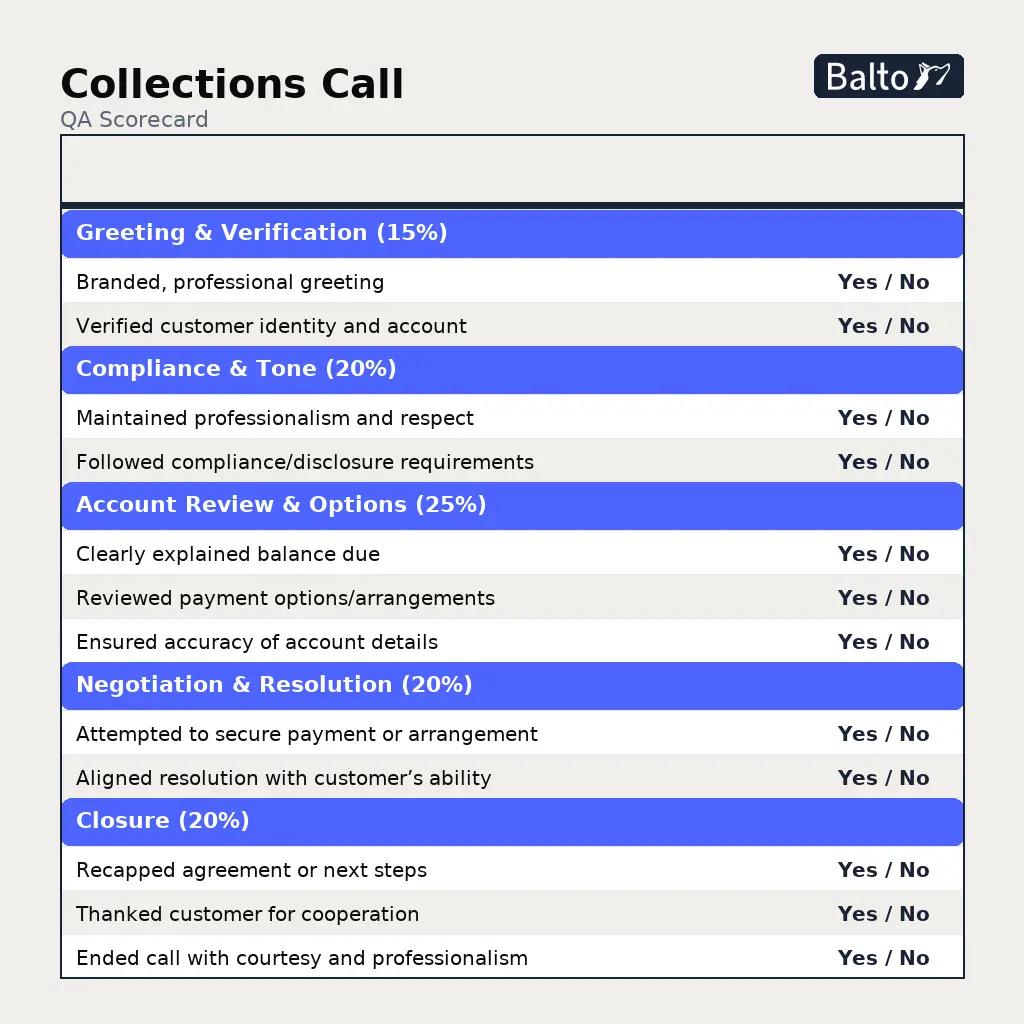
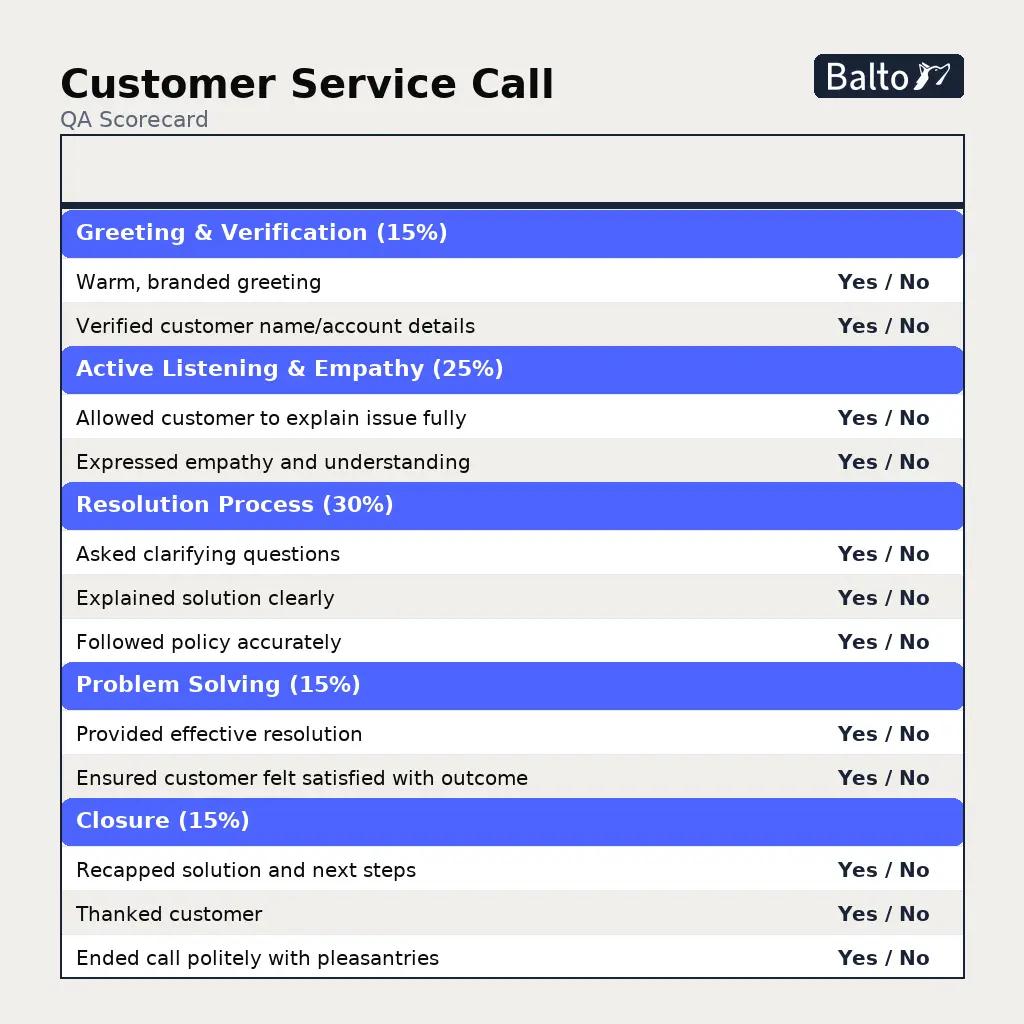
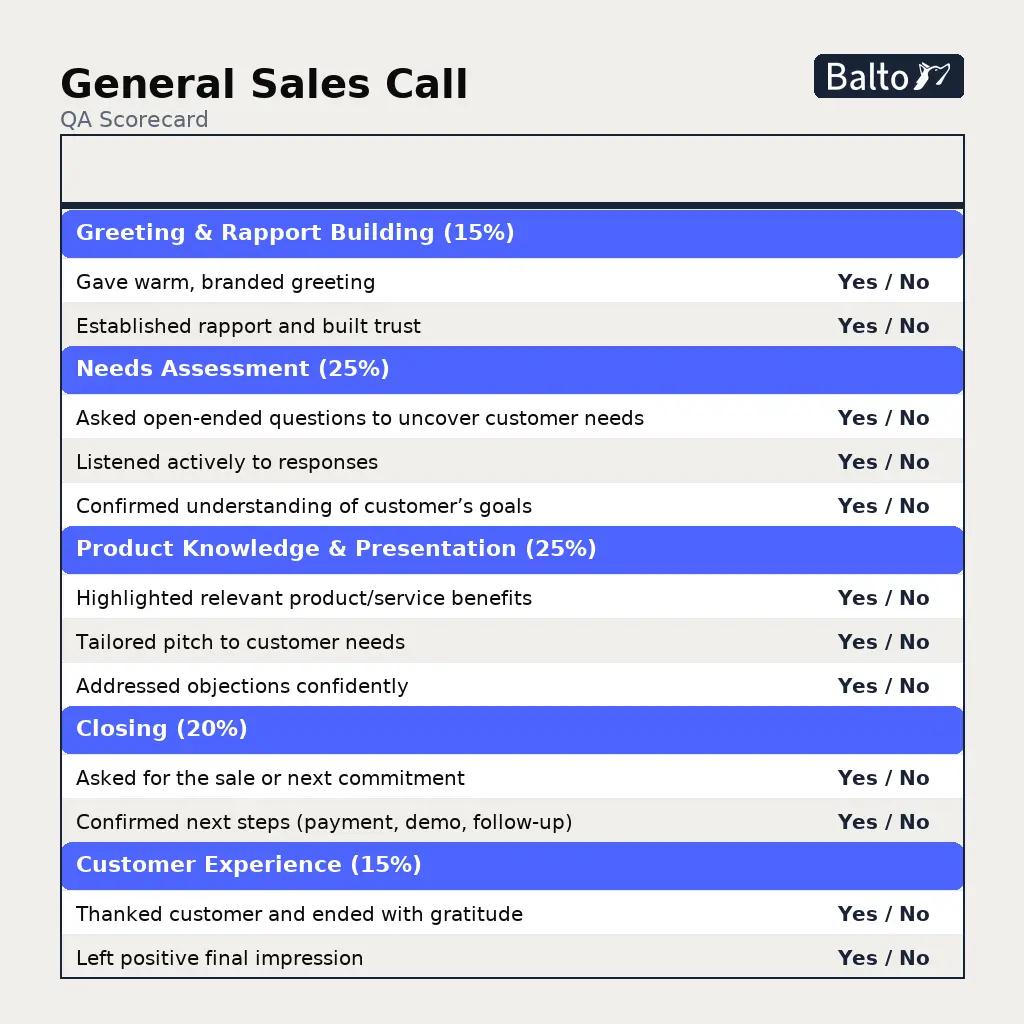
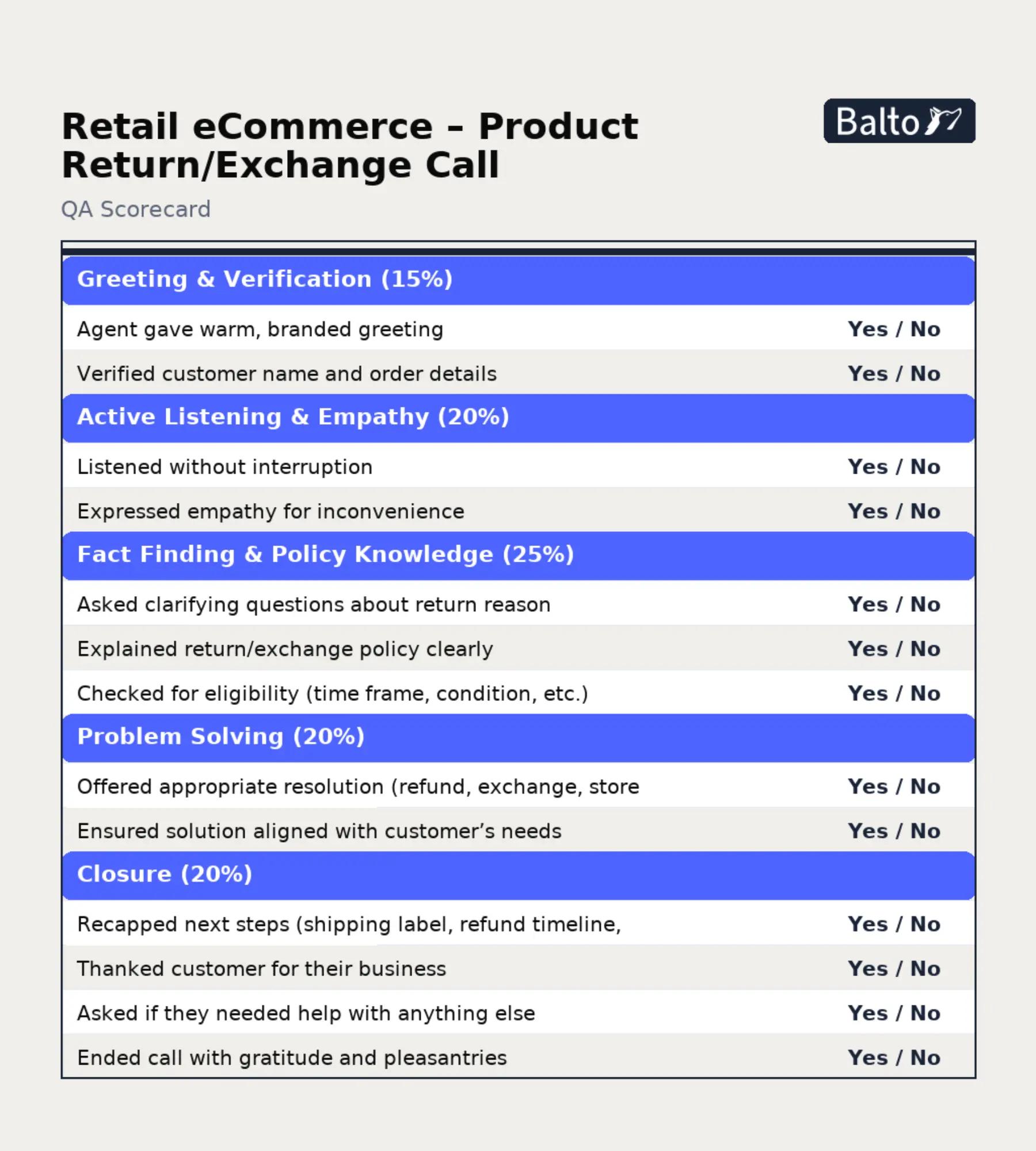
Looking for inspiration? See four scorecard examples below from Balto : Collections, Customer Service, General Sales, and Retail eCommerce
Collections QA Scorecard
Call Center Agent Scorecard vs. QA Scorecard: What’s the Difference?
The terms agent scorecard and QA scorecard are often used interchangeably, but they serve different purposes in a contact center.
Call Center Agent Scorecard
- Focus: Performance outcomes
- Tracks: Metrics tied to productivity and efficiency, such as average handle time (AHT), first call resolution (FCR), sales conversion rates, or customer satisfaction scores.
- Used by: Supervisors and managers to monitor day-to-day performance and set individual goals.
Call Center QA Scorecard
- Focus: Quality of interactions
- Tracks: How an agent handled a given call, including tone, empathy, compliance, accuracy, and adherence to process.
- Used by: QA teams or trainers to guide coaching and ensure consistency across the team.
Think of it this way:
- An agent scorecard tells you what the results were.
- A QA scorecard shows you how those results were achieved.
When used together, these two tools give managers a complete picture: not just whether agents are hitting their numbers, but whether they’re delivering customer experiences that build trust and loyalty.
How to Build a Call Monitoring Scorecard (Step-by-Step)
Creating an effective call monitoring scorecard doesn’t have to be complicated.
The key is to design a framework that balances objectivity, fairness, and alignment with your business goals.
Here’s a step-by-step process you can follow:
1. Define Your Objectives
Decide what you want your scorecard to achieve.
Is the priority compliance, customer satisfaction, sales, or a mix of all three?
Your goals will determine which criteria to include and how to weigh them.
2. Select Key Evaluation Criteria
Choose the categories that matter most to your customer experience. Common ones include:
- Greeting & professionalism
- Active listening and empathy
- Product/process knowledge
- Compliance and disclosures
- Resolution accuracy
- Closing the interaction
3. Decide on a Scoring Method
Pick between:
- Checklist (Yes/No) for compliance or must-do actions.
- Weighted scoring (0–5 scale) for soft skills and customer experience factors.
- Or a hybrid approach, which combines both for more balanced evaluations.
4. Create Clear Scoring Guidelines
Provide definitions and examples so evaluators know exactly what each score means.
This reduces subjectivity and keeps evaluations consistent across different QA analysts.
5. Pilot the Scorecard
Test your draft on a handful of recorded calls.
Gather feedback from QA reviewers, supervisors, and even agents to refine unclear items or adjust weighting.
6. Train QA Analysts and Supervisors
Hold calibration sessions to ensure that everyone scoring calls interprets the criteria the same way.
This is critical for fairness and accuracy.
7. Link Results to Coaching Plans
Don’t let scores sit in a spreadsheet.
Use the insights to shape targeted coaching, celebrate wins, and address gaps.
For example, an agent struggling with empathy can be enrolled in soft skills training, while someone missing compliance items may need process reinforcement.
8. Review and Update Regularly
Customer expectations and processes evolve.
Refresh your scorecard every few months to ensure it reflects new compliance rules, business priorities, or customer feedback.
Following these steps ensures your QA scorecard isn’t just a monitoring tool, it’s an engine for continuous improvement in your contact center.
Call Center Quality Assurance Scorecard Examples
Every contact center’s scorecard will look a little different depending on its goals, industry, and compliance needs.
Still, most call monitoring scorecards fall into a few common formats.
Here are some examples you can adapt:
1. Basic Checklist Scorecard
A basic checklist scorecard is a simple pass/fail system that confirms whether key steps were followed.
| Pass | Fail | |
|---|---|---|
| Agent greeted customer professionally | ☐ | ☐ |
| Customer information verified | ☐ | ☐ |
| Compliance disclosures read | ☐ | ☐ |
| Issue resolved or properly escalated | ☐ | ☐ |
| Call closed on a positive note | ☐ | ☐ |
2. Weighted QA Scorecard
A weighted QA call monitoring scorecard assigns points to each category based on contact center priorities.
| Weight | Score (0–5) | Weighted Total | |
|---|---|---|---|
| Greeting & Introduction | 10% | — | — |
| Communication Skills | 25% | — | — |
| Compliance & Process | 20% | — | — |
| Problem-Solving & Resolution | 25% | — | — |
| Closing | 20% | — | — |
| Final Score | 100% | — | — |
💡Prop tip: A weighted QA scorecard is best for centers balancing both customer experience and regulatory requirements.
3. Customer Experience-Focused Scorecard
A customer experience-focused scorecard is primarily designed for CX-driven teams, highlighting empathy and satisfaction.
It would include questions like:
- Did the agent actively listen and show understanding? (1–5)
- Was the solution explained clearly? (1–5)
- Did the customer feel valued throughout the call? (1–5)
- Would the customer likely recommend the service? (1–5)
These quality assurance scorecard examples give managers a starting point.
You can mix and match formats — for example, using a checklist for compliance items and weighted scoring for customer experience — to find a scorecard that works best for you.
Common Mistakes to Avoid with QA Scorecards
Even the best-intentioned quality assurance scorecards can fall short if they’re not designed or applied correctly.
Here are some of the most common pitfalls contact centers face:
Making Scorecards Too Complex
Overly detailed scorecards slow down evaluations and overwhelm agents.
A tool that’s supposed to simplify performance tracking shouldn’t feel like a burden.
Focusing Only on Compliance
Compliance is essential, but ignoring soft skills like empathy or active listening leaves out the human side of customer service.
Using Vague or Subjective Criteria
Criteria like “agent was friendly” or “customer seemed happy” are too open to interpretation.
Without clear definitions, evaluations can become inconsistent.
Scoring Too Few Calls
Reviewing only a handful of interactions doesn’t give an accurate picture of an agent’s performance.
It also risks bias if those calls aren’t representative.
Failing to Connect Scores to Coaching
A scorecard is only useful if the results translate into actionable coaching.
Without that link, agents see scores as judgment instead of a growth tool.
Not Updating Scorecards Regularly
Business goals, compliance requirements, and customer expectations evolve.
A static scorecard quickly becomes outdated.
These mistakes not only undermine the purpose of a QA program but can also frustrate both agents and managers.
In the next section, we’ll walk through best practices to make sure your scorecards drive real improvement.
Best Practices for Using a Customer Service QA Scorecard
Avoiding pitfalls is only half the battle. The real value comes from using your customer service QA scorecard as a tool for continuous improvement.
Here’s how to do it right:

Keep Scorecards Simple and Focused
Limit your scorecard to the criteria that matter most.
This makes evaluations faster, easier to follow, and more actionable for agents.
Balance Compliance with Soft Skills
Include both process-driven items (like disclosures) and human skills (like empathy and communication).
This ensures agents meet requirements and deliver great customer experiences.
Define Criteria Clearly
Write scoring guidelines with specific examples so reviewers know exactly what each score means.
Clear definitions reduce bias and help agents understand expectations.
Score 100% of Calls
Use AI-driven QA to expand coverage and score 100% of calls so you can eliminate random sampling.
With today’s tools and technologies , you don’t need to miss a thing.
Link Results Directly to Coaching
Pair scores with actionable feedback and targeted coaching plans.
This shifts QA from being a “gotcha” exercise to a growth tool that agents value.
Review and Refresh Scorecards Regularly
Update your scorecard as business goals, compliance rules, or customer expectations evolve.
Regular updates keep it relevant and effective.
When built with these best practices in mind, scorecards have the potential to become more than a monitoring tool.
How AI Improves QA Scorecards in Contact Centers
Traditionally, QA teams could only review a small percentage of calls (usually 1–2%) because manual monitoring was too time-consuming.
That limited scope leaves blind spots, and agents often feel scores don’t reflect their true performance.
AI-powered QA changes that.
Here’s how artificial intelligence improves call center scorecards:

100% Interaction Coverage
Instead of sampling a few calls, AI can automatically score every conversation across voice, chat, and email.
This gives a complete picture of agent performance.
Real-Time Monitoring
AI evaluates calls as they happen, alerting supervisors (and even agents) to missed compliance steps or coaching opportunities on the spot, before a call is over.
Consistency and Objectivity
Automated scoring removes the variability of human reviewers, ensuring agents are measured fairly across the board.
Faster Insights
AI-powered dashboards highlight trends instantly, whether it’s a recurring compliance gap or an uptick in empathy scores.
Scalable Coaching
With more accurate and complete data, managers can design targeted coaching programs that focus on the areas with the highest impact.
With tools like Balto’s AI QA , contact centers can move beyond manual sampling and finally make scorecards a real driver of customer experience and business performance.
Turn QA Scorecards into a Competitive Advantage
A well-designed call center quality monitoring scorecard does more than measure performance; it builds consistency, fairness, and growth into every customer interaction.
When paired with best practices and the power of AI, scorecards can become a strategic asset that improves compliance, boosts customer satisfaction, and empowers agents to do their best work.
Balto makes it simple to take your QA program to the next level with AI-powered scorecards that evaluate every call in real time and surface actionable insights for coaching and improvement.
FAQs
A call center quality monitoring scorecard is a structured tool used to evaluate how agents handle customer interactions.
It breaks conversations into measurable criteria (like greeting, compliance, and resolution) so QA teams can provide consistent, fair feedback.
A strong quality assurance scorecard usually covers: greeting and introduction, communication skills, process and compliance, problem-solving and resolution, and call closing.
Some also include customer experience factors like empathy or effort.
Start by defining your goals (compliance, CX, sales, or a mix).
Select key evaluation criteria, decide on scoring methods (checklist, weighted, or hybrid), create clear scoring guidelines, pilot the scorecard, and refine it based on feedback.
Examples include a basic checklist (yes/no for required steps), a weighted scoring system (assigning points by category), or a customer experience-focused scorecard that emphasizes empathy and satisfaction.
An agent scorecard measures performance outcomes (like handle time, FCR, or sales conversions).
A quality assurance scorecard evaluates how those results were achieved: focusing on call quality, compliance, and customer experience.
Yes. Many providers, including Balto, offer free QA scorecard templates that can be customized to your contact center’s needs.
AI automatically scores 100% of calls in real time, removes reviewer bias, and highlights trends instantly.
With tools like Balto’s AI QA, managers get consistent, objective insights at scale.
Common KPIs include first call resolution (FCR), customer satisfaction (CSAT), compliance adherence, and average handle time (AHT).
The right mix depends on your business goals.
Use a hybrid approach: give compliance items a pass/fail status, while weighting behaviors like empathy or problem-solving on a scale (e.g., 0–5).
This ensures regulatory accuracy while rewarding customer experience.
Most teams use a 1–5 or 1–10 scale, with clear definitions for each point.
Reliable thresholds depend on your goals: for example, 90%+ for compliance-heavy industries, or 80%+ if weighting soft skills more heavily.
Review your scorecards at least quarterly.
Update them whenever compliance rules, product updates, or customer expectations change.
Use QA results to identify patterns and build tailored coaching plans .
For example, an agent missing empathy points may need soft skills training, while one struggling with compliance may need refresher process coaching.
Liked What You Read? See Balto in Action.
Balto helps leading contact centers turn insights into outcomes—in real time. Book a live demo to discover how our AI powers better conversations, coaching, and conversions.