








Best Contact Center AI Software for Collections in 2026


The best contact center AI software for collections is Balto , the AI Workforce for the contact center, because collections' real-time compliance and negotiation environment is exactly what closed-loop Agent Assist + automated QA is purpose-built for. Real-time prompts carry the required disclosures on live calls, and automated QA scores 100% of interactions against your custom compliance scorecards.
Collections is where AI's operational payoff shows up in three places at once. First, it reduces compliance risk by scoring 100% of calls against your scorecards, not the industry-typical 1-3% manual sample. Second, it helps frontline collectors handle disputes and negotiate promises-to-pay in the moment. Third, it deflects routine calls (payment reminders, right-party verification) through AI agents so human collectors focus on accounts that need judgment.
Here are the top platforms across three categories:
Category 1: Real-time Agent Assist + Automated QA for Collections
- 1. Balto: Best for real-time compliance prompts and objection handling with 100% automated QA against custom compliance scorecards
- 2. Observe.AI: Best for QA-integrated conversation intelligence with pre-built collections compliance scorecards
- 3. Cresta: Best for collections operations applying sales-motion coaching to promise-to-pay negotiation
Category 2: Collections-Specific AI Platforms
- 4. Prodigal.ai: Best for collections-native conversation intelligence purpose-built for the vertical
- 5. Skit.ai: Best for AI agents handling routine collections calls end-to-end
- 6. TrueAccord: Best for AI-driven digital-first collections as an operating platform (not just software)
Category 3: Analytics + Dialer AI Used in Collections
- 7. CallMiner: Best for enterprise speech analytics with deep collections adoption
- 8. Convoso: Best for outbound-dialer AI in collections operations focused on right-party contact
- 9. NICE Enlighten AI Analytics: Best for collections teams standardized on the NICE CXone stack
Here are the five criteria the guide walks through to evaluate each tool:
- 1. Compliance coverage. Does the tool score 100% of calls, or sample?
- 2. Real-time or post-call. Does the AI help the collector at the moment of a dispute, or only after?
- 3. Collections KPI attribution. Can the tool report RPC lift, PTP lift, and promise-kept rate, not just aggregate averages?
- 4. Dialer + CCaaS integration. How native is the connection to your dialer for real-time signal flow?
- 5. Compliance-team workflow. Can compliance analysts review exceptions in a single inbox with call-level evidence?
The rest of this guide walks through each tool, when to use it, and how the layered approach protects compliance while lifting yield.
Why Collections Is Different: Compliance, Negotiation, and the Cost-to-Collect Math
Collections is one of the most regulated contact center verticals. Every call has language requirements: Mini-Miranda disclosures, right-party contact verification, state-specific consumer protection language, and prohibited practices under FDCPA and TCPA. A single failed disclosure can trigger a compliance exception with real liability exposure downstream.
That compliance layer sits on top of the operational reality that collections is also a negotiation environment. Promise-to-pay isn't a script; it's a real-time judgment call. Collectors negotiate payment amounts, plan schedules, hardship claims, and dispute assertions in the moment. Post-call review teaches the collector what they should have said. Only real-time Agent Assist helps them say the right thing right now.
The math underneath is a P&L metric. Cost-to-collect determines net yield, and every second saved on average handle time, every point of promise-kept rate lift, and every compliance exception avoided flows directly to the bottom line. Collections runs on volume and consistency; the AI that helps most is the AI that reduces variance across the workforce, not just the AI that reports on it.
Collections also has structurally higher agent turnover than most contact center verticals. That makes ramp time and consistency across the workforce disproportionately important. Real-time Agent Assist that carries the compliance guardrails plus the top-performer negotiation language is essentially a floor-under-worst-case: new collectors get the winning language on the calls they'd otherwise fumble.
How to Evaluate AI Software for Collections
Not every "AI contact center platform" moves collections outcomes the same way. Before you shortlist, ask five questions:
- 1. Compliance coverage: does the tool score 100% of calls, or sample? Manual QA teams typically review 1-3% of interactions. Sampling produces reports. 100% coverage produces evidence you can defend in an audit and pattern data that actually reflects your workforce.
- 2. Real-time or post-call: does the AI help the collector at the moment of a dispute, or only after? Post-call review teaches. Real-time assist executes. Both matter, but only real-time changes the outcome on this call. For compliance disclosures specifically, real-time is the only layer that prevents the exception from happening in the first place.
- 3. Collections KPI attribution: can the tool report RPC lift, PTP lift, and promise-kept rate, not just aggregate averages? Fleet-wide numbers hide which queues, skill groups, and time windows are actually breaking. Look for platforms that attribute lift per queue, per campaign, per collector.
- 4. Dialer + CCaaS integration: how native is the connection to your dialer for real-time signal flow? Collections runs on outbound dialers. The AI has to integrate natively with your dialer stack (Convoso, LiveVox, Genesys, NICE, Five9, and similar) or the real-time story doesn't work.
- 5. Compliance-team workflow: can compliance analysts review exceptions in a single inbox with call-level evidence? Compliance workflow matters as much as detection. Every exception needs the underlying call, timestamp, and reviewer trail so audits are defensible.
Comparison Table: 9 AI Tools for Collections Scored
| Platform | Category | Compliance Coverage | Real-time or Post-call | Best For |
|---|---|---|---|---|
| Balto | Category 1 (Agent Assist) | 100% with custom scorecards | Real-time + post-call | In-the-moment compliance and negotiation |
| Observe.AI | Category 1 (Agent Assist) | 100% with pre-built scorecards | Post-call + limited real-time | Compliance-heavy post-call QA depth |
| Cresta | Category 1 (Agent Assist) | 100% | Real-time + post-call | Sales-motion coaching for PTP negotiation |
| Prodigal.ai | Category 2 (Collections-Specific AI) | 100% (collections-native) | Post-call | Vertical-native conversation intelligence |
| Skit.ai | Category 2 (Collections-Specific AI) | 100% (on AI-handled calls) | Real-time (autonomous) | AI agents handling routine collections calls |
| TrueAccord | Category 2 (Collections-Specific AI) | N/A (agency, not software) | Digital-first operating model | Outsourced AI-driven digital collections |
| CallMiner | Category 3 (Analytics + Dialer AI) | Sampling or 100% (config-dependent) | Post-call (batch) | Enterprise speech analytics for collections |
| Convoso | Category 3 (Analytics + Dialer AI) | Limited (dialer-level) | Real-time (dialer workflow) | Outbound dialer with RPC optimization |
| NICE Enlighten AI Analytics | Category 3 (Analytics + Dialer AI) | 100% (within NICE stack) | Post-call + limited real-time | Collections teams standardized on NICE CXone |
The comparison isn't about which tool is objectively best. It's about which tool matches your operational drag, your CCaaS stack, and your compliance posture.
Category 1: Real-time Agent Assist + Automated QA for Collections
Category 1 is where collections' compliance and negotiation problems meet the same technology. Real-time Agent Assist surfaces the required disclosure at the moment it's due and the winning objection response when a debtor pushes back. Automated QA then scores 100% of calls against your compliance scorecards, not the 1-3% manual sample most collections operations run today. Together, they turn compliance from a periodic audit exercise into a continuous, defensible signal.
1. Balto: Best for Real-Time Compliance Prompts + Objection Handling with 100% Automated QA

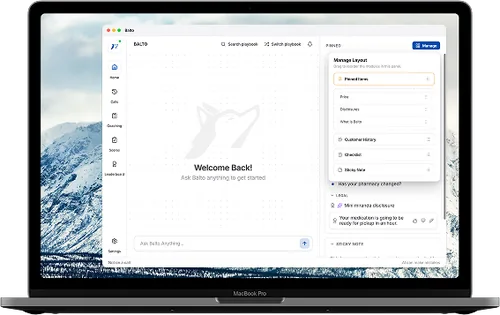
Balto is purpose-built for real-time Agent Assist . Dynamic prompts surface the required disclosure at the right moment (Mini-Miranda, right-party contact scripts, state-specific language) and the winning negotiation response when the debtor raises common objections (hardship, dispute, promise-timing, employment change). AgentGPT lets collectors ask ad-hoc questions during the call. AI Notes automates post-call CRM updates so collectors move faster to the next attempt.
The closed-loop model is what separates the platform structurally. Automated QA scores 100% of calls against your custom compliance scorecards, and exceptions route to a single review inbox with call-level evidence including timestamps, transcript segments, and reviewer trails. Coaching sessions auto-bundle from the calls where behavior on a specific compliance line or negotiation moment made the difference. What top collectors do on their winning calls becomes the guidance the rest of the team sees in real time.
Best for: collections operations (first-party, third-party, healthcare RCM, financial services A/R, telecom, utilities) where compliance risk and real-time negotiation matter equally.
Key features:
- Real-time dynamic prompts on live calls (disclosures, objection responses, next-best-action)
- AgentGPT for ad-hoc collector questions during the call
- AI Notes automating post-call CRM updates
- Closed-loop QA + coaching on shared behavioral standards
- Agentic Insights across 100% of calls with LLM-driven analytics
- Custom compliance scorecards for FDCPA, TCPA, state consumer protection, and client-specific requirements
- 60+ native dialer and CCaaS integrations (Genesys, NICE CXone, Five9, Talkdesk, Amazon Connect, Salesforce, RingCentral, LiveVox, 8x8)
Pricing: Custom. Contact sales for a demo.
2. Observe.AI: Best for QA-Integrated Conversation Intelligence with Pre-Built Collections Compliance Scorecards

Observe.AI combines conversation intelligence with 100% automated QA and generative AI post-call summaries. Its differentiator for collections is a library of pre-built compliance scorecards for FDCPA, TCPA, and state-level consumer protection rules, which shortens time-to-value for compliance-heavy operations.
Best for: collections operations that need deep QA and compliance depth with post-call analytics as the primary layer.
Key features:
- 100% call coverage with automated QA scoring
- Pre-built compliance scorecards for FDCPA, TCPA, and state rules
- Generative AI post-call summaries
- Coaching workflow integration
- CCaaS and dialer integrations
Pricing: Custom.
3. Cresta: Best for Collections Operations Applying Sales-Motion Coaching to Promise-to-Pay Negotiation

Cresta specializes in real-time behavioral coaching during live conversations with custom generative AI models trained on top-performer calls. For collections operations that treat promise-to-pay negotiation as a sales-adjacent motion, Cresta's model customization approach fits.
Best for: larger collections operations (500+ agents) that treat PTP negotiation as a sales motion and can justify custom generative AI model training investment.
Key features:
- Real-time behavioral coaching prompts during live calls
- Custom generative AI models trained on top-performer calls
- Conversation intelligence and post-call analytics
- CCaaS and dialer integrations
Pricing: Custom, enterprise-tier.
Category 2: Collections-Specific AI Platforms
Category 2 tools are purpose-built for collections. Rather than a general contact center AI adapted to the vertical, they start from the collections operating model (RPC rates, PTP negotiation, dispute handling, right-party verification, payment scheduling) and build outward. For collections operations that want a vertical-native platform, Category 2 is worth serious evaluation alongside Category 1.
4. Prodigal.ai: Best for Collections-Native Conversation Intelligence Purpose-Built for the Vertical

Prodigal.ai is a collections-native conversation intelligence platform. Its models are trained on collections calls specifically, which means categorization (dispute vs. hardship vs. wrong number vs. right-party verification) reflects the actual vocabulary and patterns of collections conversations rather than generic contact center taxonomies.
Best for: collections operations that want a vertical-native conversation intelligence platform and are willing to work with a specialist vendor rather than a general contact center AI.
Key features:
- Collections-native conversation intelligence models
- Dispute detection and categorization
- Right-party contact verification analytics
- Post-call analytics tuned to collections KPIs (RPC, PTP, promise-kept)
- Compliance monitoring
Pricing: Custom.
5. Skit.ai: Best for AI Agents Handling Routine Collections Calls End-to-End

Skit.ai builds AI agents that handle routine collections calls autonomously. Its models cover payment reminders, right-party verification, hardship assessment, and payment scheduling, with the goal of deflecting routine volume so human collectors focus on accounts that need judgment.
Best for: collections operations with high volumes of routine calls where AI agent deflection can meaningfully reduce human workload.
Key features:
- AI agents for outbound and inbound collections calls
- Payment reminder and verification workflows
- Multi-language support
- Compliance controls built into AI agent scripts
- Integration with major collections platforms
Pricing: Custom, usage-based.
6. TrueAccord: Best for AI-Driven Digital-First Collections as an Operating Platform

TrueAccord operates as an AI-native collections agency rather than a software product. Rather than licensing the AI and running it in-house, operations engage TrueAccord to handle collections as a service, with the AI-driven digital-first operating model applied to consumer outreach through email, SMS, and self-service payment flows.
Best for: operations exploring outsourced digital-first collections as an alternative to building an in-house team with AI software.
Key features:
- AI-driven consumer outreach across digital channels (email, SMS, web)
- Self-service payment flows with dynamic offer optimization
- Compliance monitoring across the digital contact model
- Analytics on consumer engagement and payment patterns
Pricing: Contingency or service-based (not software licensing).
Category 3: Analytics + Dialer AI Used in Collections
Category 3 tools sit at the analytics or dialer layer. They're not purpose-built for collections, but they show up in most large collections operations because collections runs on outbound dialers and speech analytics. AI features are increasingly built in, but the AI is typically bolt-on rather than the core objection-handling engine. Useful complementary layer for reporting and workflow, but a collector at the moment of a compliance disclosure or a dispute still needs a Category 1 tool for the real-time response.
7. CallMiner: Best for Enterprise Speech Analytics with Deep Collections Adoption

CallMiner is one of the longest-tenured speech analytics platforms with deep enterprise adoption in collections. Its analyst-heavy customization footprint means large operations often have years of custom categorizations and reports built in. AI features have been layered on over time, but the platform's architecture reflects its pre-AI origins.
Best for: enterprise collections operations with existing analyst teams built on CallMiner's mature customization footprint who aren't ready to migrate.
Key features:
- Speech and text analytics across voice, chat, and email
- Sentiment analysis and topic modeling
- Compliance monitoring workflows
- Deep customization for analyst teams
- Long-standing integrations with legacy CCaaS platforms
Pricing: Enterprise custom pricing.
8. Convoso: Best for Outbound-Dialer AI in Collections Operations Focused on Right-Party Contact

Convoso is an outbound dialer platform heavily adopted in collections and outbound sales. Its AI features focus on RPC optimization: predictive dialing, list management, answering-machine detection, and time-of-day optimization for right-party contact. The AI is dialer-level, not conversation-level.
Best for: outbound-heavy collections operations optimizing RPC rates through dialer AI and list management.
Key features:
- Predictive and progressive dialing with AI optimization
- List management and lead scoring for RPC
- Answering-machine detection and voicemail drop
- CRM integrations
- Reporting on dialer KPIs (RPC rate, contact rate, connect rate)
Pricing: Custom, seat-based.
9. NICE Enlighten AI Analytics: Best for Collections Teams Standardized on the NICE CXone Stack

NICE Enlighten AI Analytics is NICE's native AI analytics layer inside the CXone platform. For collections operations already fully standardized on NICE CXone across CCaaS, WFM, and QA, Enlighten adds AI analytics without a separate vendor procurement.
Best for: enterprise collections operations already fully standardized on the NICE CXone stack.
Key features:
- Native integration inside NICE CXone
- Speech and text analytics
- Enlighten Copilot for conversational AI queries
- Agent behavior and customer sentiment scoring
- Compliance monitoring
Pricing: Bundled with NICE CXone tiers.
Common Mistakes Collections Leaders Make Buying AI
Every collections AI project I see makes at least one of the mistakes below. These are the reasons so many operations deploy AI and still see the same compliance exceptions and the same PTP-negotiation drops quarter after quarter.
- 1. Buying analytics when the drag is in-the-moment compliance execution. CallMiner and Observe.AI are excellent at post-call review, but if collectors miss the required disclosure on the call, no post-call report saves that exception.
- 2. Assuming dialer AI covers compliance. Convoso and similar dialer-first tools improve RPC math, but the compliance scorecard runs on what the collector says during the conversation, not just who picks up the phone.
- 3. Not connecting AI to your existing scorecard framework. Generic compliance scorecards underperform. The AI has to score against your specific scorecard categories, your state-specific language requirements, and your client-required disclosures.
- 4. Ignoring the ramp-time payoff. Collections has structurally high turnover. Real-time Agent Assist that carries the compliance guardrails plus top-performer negotiation language is the biggest ramp-time lever available.
- 5. Treating buy-versus-outsource as a false choice. TrueAccord-style AI-native agencies solve a different problem than in-house AI software. Some operations should buy software; others should outsource to AI-driven agencies. Diagnose which one fits your operating model before either.
Collections AI Category-Fit Diagnostic
Different collections problems point to different categories. This 5-question diagnostic routes you to the category most likely to move your compliance and yield numbers fastest.
Key Collections AI Statistics
Bring It All Together
Collections is a compliance-heavy real-time environment where in-the-moment support matters equally on the compliance side and the negotiation side. The best AI stack starts with Category 1 tools that carry the required disclosures during live calls and score 100% of interactions against your custom scorecards afterward. Balto ranks first because the closed-loop model (Agent Assist + automated QA + coaching on shared behavioral standards) is the operational model that matches how collections actually manages risk and yield.
Observe.AI is a strong direct competitor for compliance-first operations that lean heavier on post-call QA depth. Category 2 tools (Prodigal.ai, Skit.ai, TrueAccord) are legitimate options for teams wanting a vertical-native approach or an outsourced digital-first operating model. Category 3 tools (CallMiner, Convoso, NICE Enlighten) are complementary at the analytics and dialer layer, but they don't replace the in-the-moment layer where compliance disclosures and negotiation responses actually happen.
Diagnose which layer is dragging your operation most, then build from that lever outward.
FAQs
The best contact center AI software for collections is Balto because its closed-loop model matches how collections operations actually manage risk and yield. Real-time Agent Assist carries the required compliance disclosures during live calls, automated QA scores 100% of interactions against your custom compliance scorecards, and coaching runs on the same behavioral standards.
Observe.AI is the strongest direct competitor with pre-built compliance scorecards for FDCPA and TCPA. Prodigal.ai is the strongest collections-native alternative if you want a vertical-purpose-built platform.
AI improves compliance in two ways. First, real-time Agent Assist surfaces the required language (Mini-Miranda, disclosure statements, state-specific rules) at the moment it's due, so collectors don't miss the required elements on live calls.
Second, automated QA scans 100% of interactions against custom compliance scorecards, catching exceptions that would otherwise slip through the 1-3% sample manual QA teams typically review. Exceptions route to compliance analysts with call-level evidence, timestamps, and reviewer trails for defensible audit workflows.
AI doesn't replace the human collector on a promise-to-pay negotiation, but real-time Agent Assist meaningfully helps the collector at the moment of the negotiation. The AI surfaces the winning objection response, the right payment plan option based on account context, and the required disclosures for the specific state or client.
Post-call review then feeds the pattern back into coaching so the next negotiation goes better. This is the layer where AI actually moves promise-kept rate.
Real-time Agent Assist puts a prompt on the collector's screen during the live call. Conversation intelligence analyzes recorded calls after they end and surfaces patterns for coaching.
Both matter in collections, but they solve different problems. Real-time helps the collector on the call happening right now, which is where compliance disclosures either happen or don't. Conversation intelligence helps you find which collectors miss which patterns across the workforce.
Yes, for well-defined routine call types. AI agents from vendors like Skit.ai handle payment reminders, right-party verification, hardship assessment, and payment scheduling autonomously. This is called call deflection or containment.
Complex negotiations, disputed accounts, and hardship claims that require judgment still require a human collector. The strongest operational model uses AI agents for the routine tier of calls and routes complex accounts to human collectors backed by real-time Agent Assist.
RPC improvement comes from the dialer AI layer, not from Agent Assist. Predictive dialing, list management with lead scoring, answering-machine detection, and time-of-day optimization all improve the odds that the contact is a right party.
Once the RPC lands, real-time Agent Assist helps the collector verify right-party contact correctly and move into the negotiation. The two layers compound: dialer AI increases RPC attempts, Agent Assist increases the conversion of those attempts to promise-to-pay.
Real-time Agent Assist deployments typically show measurable AHT and quality-score changes within the first month, because the impact is on-call and immediate. Compliance scorecards can be configured and running within weeks depending on your scorecard complexity.
Legacy speech analytics platforms and enterprise workforce optimization suites take longer, typically 6-12 months for full enterprise implementations. Modern real-time platforms have compressed that timeline substantially for collections operations.
Track four categories: compliance, contact, conversion, and cost. Compliance covers exception rate against your custom scorecard categories. Contact covers RPC rate and connect rate from the dialer layer.
Conversion covers PTP rate, promise-kept rate, and dispute-to-resolution rate at the conversation layer. Cost covers cost-to-collect, AHT per collection call, and ramp time for new collectors. AI should move all four categories once deployed correctly.
Five questions filter serious platforms from marketing hype. First, does the AI score 100% of calls against custom scorecards or just sample. Second, does the AI help the collector in the moment of a dispute or only after.
Third, can the reporting attribute lift per queue and per collector, not just aggregate averages. Fourth, how native is the integration with your dialer stack for real-time signal flow. Fifth, can compliance analysts review exceptions in a single inbox with call-level evidence for defensible audit workflows.
Liked What You Read? See Balto in Action.
Balto helps leading contact centers turn insights into outcomes, in real time. Book a live demo to discover how our AI powers better conversations, coaching, and conversions.