















Coaching call center agents means giving agents specific, data-backed feedback tied to actual call behavior, not generic advice about being more empathetic or handling calls faster. Most contact centers are inconsistent at it: without automated QA tools, supervisors typically review fewer than 3% of calls, leaving 97% of agent interactions without any structured feedback loop.
The five call center agent coaching techniques are:
1. Real-Time Coaching: Whispered live guidance during active calls, best for new agents and high-stakes call types
2. Post-Call Review: Reviewing QA-flagged call moments with specific timestamps, sessions kept under 20 minutes
3. One-on-One Structured Sessions: Scheduled 30-minute sessions with data first, agent self-assessment second
4. Peer Coaching: Pairing mid-performers with top agents using a structured observation form
5. AI-Assisted Coaching: Real-time prompts that catch mistakes as calls happen, so managers coach patterns rather than individual errors
This guide covers everything you need to implement all five, including tools like Balto , the AI Workforce for the contact center, which automates the parts of coaching most centers cannot scale manually:
- A 6-step session template you can run next week
- How to build a written coaching plan that covers every agent, not just the ones on your radar
- How AI closes the coaching loop so feedback reaches every call, not just the ones you happen to monitor
- The KPIs that tell you whether your coaching is working
What Is Call Center Agent Coaching?
Call center agent coaching is a structured process where supervisors use real call data to give agents targeted feedback on specific behaviors, with the goal of changing how they handle future interactions.
It is different from training. Training transfers knowledge: product information, compliance rules, call scripts, system navigation. Coaching changes behavior on actual calls, built around what an agent is doing right now and how to do it better next time.
There are three main formats: real-time coaching (whispered guidance during a live call), post-call review (reviewing specific call moments after the fact), and structured one-on-one sessions (scheduled, data-driven conversations). For a broader foundation, see our guide on call center coaching best practices .
5 Call Center Agent Coaching Techniques That Actually Work
The most effective contact centers do not rely on a single coaching approach. Different situations call for different techniques. A new agent on a live call needs something different than a tenured agent working through a pattern of FCR misses.

1. Real-Time Coaching (Whisper Coaching)
The supervisor listens to a live call and delivers short cues to the agent via a headset channel the customer cannot hear. A 10-word prompt (“slow down, confirm the policy number first”) lands better than silence followed by a 30-minute debrief.
This technique works best for new agents in their first 90 days or for high-stakes call types where a misstep has immediate consequences: compliance risks, escalations, sales moments. Keep cues to one sentence. More than that and you split the agent’s attention at the worst possible moment.
2. Post-Call Review Sessions
Pull one or two calls flagged by QA: a compliance miss, a dropped resolution, a CSAT risk. Review specific moments with timestamps, not general impressions. “At minute 3:42, you confirmed the address but did not verify the policy number before quoting the rate” is actionable. “You need to follow the script more carefully” is not.
Keep post-call reviews under 20 minutes. The goal is one or two concrete behavior changes, not a full performance audit.
3. One-on-One Structured Sessions
A scheduled 30-minute session, weekly for new agents and bi-weekly for tenured ones. Data comes first: pull QA scores and KPI trends before you meet. Agent perspective comes second: ask how they think the past two weeks went before you share your read.
This is the format where the step-by-step session template below applies directly. See also: how to coach agents effectively the first time to get first-session structure right.
4. Peer Coaching and Call Shadowing
Pair a mid-performing agent with a consistently high performer. Give both a structured observation form: the shadowing agent listens for three specific things (how the top performer handles objections, how they open and close, how they manage hold time). Without structure, shadowing becomes passive listening with no behavior transfer.
Peer coaching works best as a supplement to manager-led sessions, not a replacement. It is particularly effective for soft skills, including tone, rapport, and empathy, which are harder to coach in a debrief setting.
5. AI-Assisted Coaching
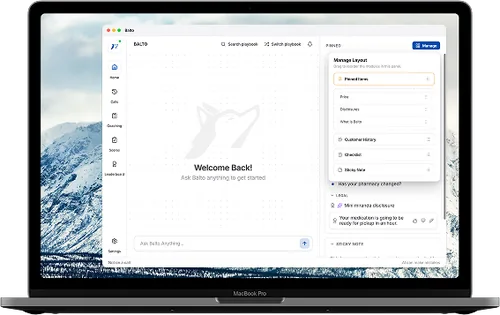
Balto changes the coaching equation by surfacing the right behavior during a call, not after it. Rather than waiting for a supervisor to flag an issue in a post-call review, the AI delivers real-time prompts to agents as conversations unfold, covering objection handling, compliance disclosures, and required next steps.
This means managers can focus their coaching time on patterns and development, not correcting individual mistakes the AI already caught in the moment. For the performance angle on the same topic, see our guide on how to improve call center agent performance .
How to Run a Call Center Coaching Session: A Step-by-Step Template
Most coaching sessions underperform because they are unstructured. The manager walks in with a general sense of how the agent is doing, the agent feels ambushed or unclear on what is expected, and nothing specific changes afterward.
This 6-step framework gives every session a clear shape, from prep to follow-up.

Step 1: Pull the Data Before You Meet
Before the session, pull the agent’s QA scores, AHT, FCR rate, and any flagged calls from the past two weeks. Know the one or two specific behaviors you want to address before you walk in. Reviewing data in the session itself wastes time and signals that you have not prepared.
Step 2: Set a Clear Agenda (Share It in Advance)
Send the agent a one-paragraph note before the session: “We will spend 30 minutes reviewing your last two weeks. I want to talk through two calls specifically and set a goal for the next two weeks.” Advance notice removes the feeling of being called into the principal’s office, and it gives the agent time to self-reflect before the conversation starts.
Step 3: Let the Agent Speak First
Start the session by asking the agent how they think the past two weeks went. Their self-assessment tells you where their awareness is. If they identify the same issue you flagged, your job is easier. If they do not, you learn something about where the disconnect is. Coaching that is a dialogue lands better than coaching that is a monologue. See also: soft skills for contact center coaching that help managers run more effective sessions.
Step 4: Focus on One or Two Behaviors – Not Everything at Once
Pick the one or two behaviors with the highest leverage on performance and stay there. Covering six issues in 30 minutes means nothing changes. Covering one issue well, with a specific call example, a clear explanation of the impact, and an agreed-upon change, has a real chance of sticking.
Step 5: Set a SMART Action Item, Not a Vague Goal
Do not end the session with “keep working on your AHT.” End it with: “For the next two weeks, try confirming the account number before pulling up the policy. That should cut your average handle time by about 30 seconds. We will check the numbers at our next session.”
SMART means: Specific (the account number step), Measurable (30 seconds off AHT), Achievable (one behavior change), Relevant (tied to a tracked KPI), and Time-bound (two weeks). Vague goals produce vague results.
Step 6: Follow Up Before the Next Formal Session
A check-in between sessions does more for behavior change than a formal debrief two weeks later. After the session, send a one-line recap of the action item. Check in informally three or four days later: “How is the account number flow going?” It signals you are paying attention, and that the coaching session was not just a box to check.
How to Build a Call Center Coaching Plan
A coaching plan is not a single session. It is a documented structure covering who gets coached, on what cadence, on which behaviors, and how progress is tracked over time.
Most contact centers only coach reactively: a supervisor notices an underperformer, schedules a session, and hopes something changes. The problem is coverage. Without automated QA tools, supervisors review only 1-3% of calls, which means 97-99% of agent interactions happen without any feedback loop at all. A written coaching plan changes that.
Who gets coached: Every agent, not just underperformers. High performers benefit from coaching focused on stretch goals and development. Mid-performers benefit from targeted skill-building. Underperformers need structured improvement plans with clear milestones and an escalation path.
Cadence:
- New agents (0-90 days): weekly 1-on-1 sessions
- Tenured agents: bi-weekly 1-on-1 sessions plus periodic post-call reviews
- Agents on a performance improvement plan: weekly with documented notes each session
What to coach on: Tie coaching topics directly to QA scores and KPI trends. If an agent’s FCR drops three weeks in a row, that is a coaching signal. If their AHT is high but CSAT is strong, the conversation is very different from the one where both metrics are off.
How to track progress: Document the baseline KPI at the start of each coaching cycle. Review it at the 30-day mark. If the behavior has not shifted, adjust the approach, not just repeat the same session. For practical tools on avoiding the re-coaching trap, see how to stop re-coaching the same agents and our call center quality assurance guide for the QA-to-coaching connection.
The coaching plan must be written down. A plan that lives only in a supervisor’s memory is not a plan.

Coaching Readiness Checklist
Is your coaching program actually working? Check off what you’re doing consistently.
0 of 15 complete
Pre-Session Preparation
- I pull QA scores and KPI data before every coaching session
- I identify 1-2 specific call moments to review, not general impressions
- I share the agenda with the agent at least 24 hours in advance
- I review the agent’s previous action items before the meeting
- I block uninterrupted time — no multitasking during coaching sessions
Session Execution
- I let the agent self-assess before giving my feedback
- I focus on specific behaviors, not personality or attitude
- I use call recordings or data to anchor feedback, not memory alone
- I set SMART action items: specific, measurable, and time-bound
- I confirm the agent understands and agrees with the action plan before closing
Post-Session Follow-Up
- I document session notes and action items in writing
- I check in informally before the next formal session
- I track KPI movement from the pre-coaching baseline
- I acknowledge improvement when I see it, not just flag problems
- I adjust the coaching plan if the same issues keep resurfacing
See Balto Coaching →
How AI Is Changing Call Center Agent Coaching
Traditional coaching has two structural problems: coverage and timing.
On coverage: without AI-powered QA, supervisors review 1-3% of calls. Coaching is built on an unrepresentative sample, often the calls the supervisor happened to be monitoring rather than the calls with the most performance signal.
On timing: post-call feedback arrives hours or days after the interaction. For most agents, the behavioral context has faded. The conversation is over, the customer moved on, and the feedback lands without the moment to anchor it.
Balto addresses both problems directly.

Real-time guidance surfaces the right behavior during calls: compliance disclosures, objection handling, de-escalation prompts, delivered as the conversation unfolds. Mistakes that would have become coaching moments are caught before they happen. Agents using real-time AI guidance report 20-30% reductions in average handle time and reach full proficiency twice as fast as those trained through traditional methods alone.
On the QA side, the system scores 100% of calls automatically, not the 1-3% a supervisor can manually review. When an agent’s score drops below a defined threshold, a coaching session is automatically triggered. The supervisor does not have to catch the issue; the system flags it.
The loop closes when coaching outcomes feed back into what gets surfaced in real time. If agents consistently struggle with a specific objection, that pattern informs the guidance standards for the next call. Better automated agent performance tracking makes it easier to see where coaching is working and where the guidance itself needs updating. For the QA scoring layer of this picture, see our guide on measuring and improving QA scores .
How to Measure Whether Your Coaching Is Working
Coaching without measurement is guesswork. These six KPIs tell you whether your program is actually changing agent behavior.
1. QA score trend: Compare the agent’s QA score from the week before coaching started to the score four weeks after. A 3-5 point improvement is a meaningful signal. No movement is a signal too.
2. First Call Resolution (FCR): FCR is the clearest outcome metric for coaching quality. An agent who resolves more issues on the first call has internalized better call-handling behavior, not just followed a script differently. Organizations with consistent coaching programs see up to 14% improvement in FCR rates.
3. Average Handle Time (AHT): AHT movement tells you about efficiency. Watch directionality: lower AHT is good when CSAT stays flat or improves. Lower AHT with declining CSAT means agents are rushing, not improving.
4. CSAT: A lag metric. Changes in coaching behavior take 2-4 weeks to show up in CSAT scores. Use it as a confirmation signal, not an early indicator.
5. Agent attrition rate: Agents who receive consistent, structured coaching report higher job satisfaction and lower intent to leave. Replacing an agent costs an average of $5,000-$7,500 when you factor in recruitment, training, and ramp time. Attrition reduction is one of the clearest ROI signals for a strong coaching program.
6. Re-coaching rate: If you are addressing the same behavior in three consecutive sessions without progress, the coaching approach needs to change, not just the intensity. Track how often the same issue resurfaces across your team.
Track these against a pre-coaching baseline, not an external benchmark. What matters is whether your agents are moving.
For a full breakdown of how each metric connects to call behavior, see our guide on call center metrics and KPIs .
Coaching call center agents is one of the highest-leverage investments a contact center can make. But it only works when it is consistent, data-driven, and tied to specific call behavior, not built around whichever agents a supervisor happened to observe that week.
The techniques, session template, and coaching plan framework in this guide give you the structure to make coaching systematic. Balto closes the loop by automating QA coverage, triggering coaching from real performance data, and surfacing the right behavior in real time so managers spend their coaching hours on development rather than damage control.
FAQs
Coaching for call center agents is a structured feedback process where supervisors use actual call data to help agents improve specific behaviors. Unlike training, which covers knowledge and procedures, coaching focuses on real call performance: what the agent is doing right now and how to do it better.
It is ongoing and personalized to each agent’s current gaps, not a one-time event.
The 70/30 rule means the agent should do 70% of the talking during a coaching session, and the supervisor 30%. Self-reflection drives behavior change more effectively than top-down feedback. When agents identify their own gaps, they are more likely to act on them.
In practice: ask before you tell. Let the agent assess the call first.
In contact centers, the 80/20 rule typically refers to service level: answering 80% of calls within 20 seconds. In a coaching context, it often means 80% of performance problems come from 20% of agent behaviors.
Focus coaching on the highest-impact behaviors first. Trying to fix everything at once usually changes nothing.
Clarity: Be specific about what behavior needs to change and why.
Context: Anchor feedback in real call data, not general impressions.
Consistency: Coach every agent on a regular cadence, not just when something goes wrong.
Collaboration: Make coaching a two-way conversation, not a performance review.
Commitment: End every session with a documented, agreed-upon action item.
- New agents (first 90 days): weekly structured sessions
- Tenured agents: bi-weekly 1-on-1 sessions, supplemented by post-call reviews
- Agents on a performance improvement plan: weekly, with documented notes
The minimum for any active agent is once a month. Less than that and coaching has no continuity.
Training delivers knowledge: product information, compliance rules, system navigation, call scripts. Coaching changes behavior on real calls using actual performance data.
Training happens at defined points (onboarding, product updates). Coaching is ongoing and personalized to each agent’s current gaps. Both are necessary; they serve different purposes.
Start with data, not assumptions. Pull QA scores and identify the 1-2 behaviors with the biggest gap between what the agent is doing and what the QA standard requires. Run each session using a structured template: share the data, let the agent speak first, focus on one behavior, and set a SMART action item before the session ends.
Key principles for coaching underperformers:
- Use specific call examples with timestamps, not general impressions
- Set one clear SMART action item per session, not a list of everything that needs to change
- Check in informally 3-4 days after the session instead of waiting for the next formal review
- If the same behavior issue persists across three consecutive sessions, escalate to a formal performance improvement plan with documented milestones and a clear timeline
Avoid repeating the same coaching approach when it is not working. If three sessions have not moved the metric, change the method: different call examples, a different framing, or pairing the agent with a peer for structured shadowing.
A coaching plan should be a written document covering who gets coached, on what cadence, on which behaviors, and how progress is tracked. At minimum it should include:
- Coaching cadence per agent tier (new agents weekly, tenured agents bi-weekly, underperformers weekly)
- Target behaviors tied to QA scorecard criteria
- Baseline KPI metrics at the start of each coaching cycle
- SMART action items per session with a clear owner and due date
- 30-day progress review checkpoint
- Escalation path if performance does not improve after three sessions
AI shifts coaching from reactive to proactive in two ways. First, real-time guidance delivers in-call prompts so agents handle situations correctly as they happen, not hours later in a debrief. Second, automated QA scores every call, not just the 1-3% a supervisor can manually review, so coaching is triggered by actual performance data across all agents.
The result is a coaching loop that covers every agent, every call, not just the ones a supervisor happened to monitor.
Effective coaching is specific, consistent, and data-driven:
- The supervisor reviews QA scores and call data before every session
- Each session covers one or two behaviors with real call examples
- Action items are SMART and agreed upon before the session ends
- Progress is tracked against a pre-coaching baseline
- The same issues do not resurface in three consecutive sessions without a change in approach
If coaching is happening but nothing is changing, the problem is usually vague feedback, no follow-up between sessions, or repeating the same approach without adjusting when it is not working.
Liked what you read? See Balto in action.
Balto helps leading contact centers turn insights into outcomes, in real time. Book a live demo to discover how our AI powers better conversations, coaching, and conversions.