





Best Call Center Software for BPO Companies (2026)


The best call center software for BPO companies isn’t one platform — it’s a three-layer stack: a CCaaS platform for routing, recording, and multi-client compliance; an AI Brain layer for real-time agent guidance and automated QA; and a WFM and CRM layer for workforce scheduling and customer data management.
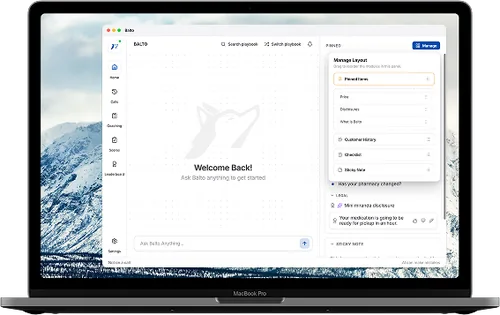
Balto , the AI Workforce for the contact center, anchors the AI Brain layer in this guide. It is the only tool in the stack that closes the loop between real-time guidance, QA scoring, coaching, and analytics on a single shared system.
This guide covers:
- The three-layer BPO contact center stack and why each layer matters
- The 4 best CCaaS platforms for multi-client BPO operations
- The 4 best AI Brain tools for real-time guidance and automated QA
- The 2 best WFM and CRM platforms for BPO workforce optimization
- How to build your BPO stack without ripping out existing infrastructure
Quick Summary
Layer 1: CCaaS — Phone System and Routing
- NICE CXone — Enterprise BPO platform with built-in WFM, multi-tenant routing, and native AI across voice and digital channels. Best for large, complex BPO operations running 500+ agent seats.
- Genesys Cloud CX — Open architecture CCaaS with AI-powered routing, omnichannel WEM, and an app marketplace for client-specific integrations. Best for omnichannel BPOs managing diverse client portfolios.
- Five9 — Cloud contact center platform built for outbound-heavy BPO campaigns with predictive dialing, compliance tools, and strong CRM integrations. Best for mid-market BPOs running high-volume outbound.
- Talkdesk — Modern CCaaS with rapid deployment, strong AI features, and flexible pricing. Best for high-growth BPOs that need to onboard new clients fast without long implementation cycles.
Layer 2: AI Brain — Real-Time Guidance and QA
- Balto — Closed-loop AI guidance, automated QA, coaching, and insights that run on shared standards and get smarter with every call. Works on any CCaaS platform. Best for BPOs needing complete agent performance automation.
- Observe.AI — Conversation intelligence with 100% automated QA scoring and agent coaching workflows. Best for BPOs prioritizing call coverage and omnichannel QA at scale.
- Cresta — Real-time AI coaching focused on sales and service skill development. Best for BPOs running sales-driven programs where every rep needs to perform like a top earner.
- Level AI — AI QA and agent performance analytics with conversation intelligence. Best for BPOs building data-driven coaching programs tied directly to QA outcomes.
Layer 3: WFM and CRM
- Verint — Enterprise workforce management with forecasting, scheduling, adherence tracking, and speech analytics built for large BPO environments. Best for BPOs managing labor costs across multiple client accounts.
- Salesforce — CRM platform that gives BPO agents complete customer context and multi-client case management. Best for BPOs where client SLAs require full account history on every call.
How the Tools Compare
How the Tools Compare
| Tool | Layer | Best For | Key Features | Pricing |
|---|---|---|---|---|
| NICE CXone | CCaaS | Enterprise BPO operations | Multi-tenant routing, built-in WFM, native AI | $100–$240+/agent/mo |
| Genesys Cloud CX | CCaaS | Omnichannel BPO at scale | AI routing, WEM, open app marketplace | $75–$155+/agent/mo |
| Five9 | CCaaS | Mid-market outbound campaigns | Predictive dialing, TCPA compliance, CRM sync | $149–$229+/agent/mo |
| Talkdesk | CCaaS | High-growth BPO onboarding | Rapid deployment, AI assist, flexible pricing | $85–$145+/agent/mo |
| Balto | AI Brain | Closed-loop agent performance | Real-time guidance, auto QA, coaching, insights | Custom pricing |
| Observe.AI | AI Brain | 100% call coverage QA | Conversation intelligence, auto QA, coaching | Custom pricing |
| Cresta | AI Brain | AI-driven sales coaching | Real-time coaching, agent assist, GenAI | Custom pricing |
| Level AI | AI Brain | QA-driven performance analytics | AI QA, conversation intelligence, analytics | Custom pricing |
| Verint | WFM | BPO workforce optimization | Forecasting, scheduling, adherence, speech analytics | Custom pricing |
| Salesforce | CRM | CRM-driven BPO case management | 360 customer view, multi-client cases, Service Cloud | $25–$500+/user/mo |
Layer 1: CCaaS — Phone System and Routing
CCaaS is the foundation every BPO contact center runs on. It handles inbound and outbound call routing, multi-tenant client separation, compliance recording, and the infrastructure that connects agents to customers. Without a purpose-built CCaaS, BPOs can’t enforce per-client configurations or scale outbound dialing across dozens of campaigns simultaneously.
NICE CXone: Best for Enterprise BPO Operations

NICE CXone is the most complete enterprise CCaaS platform in the market. Built specifically for high-volume, multi-client contact center environments, CXone combines omnichannel routing, built-in workforce management, and a native AI layer under one platform. BPOs running 500+ agents across multiple client accounts use CXone to enforce per-client routing rules, compliance recording standards, and service-level agreements at scale.
The platform’s open API architecture allows deep integration with client CRMs and third-party AI tools, so BPOs don’t have to rebuild their agent desktop every time a new client comes on. CXone’s WFM module handles forecasting, scheduling, and adherence tracking natively, which is significant for BPOs managing complex shift structures across multiple campaigns. Approximately 60% of major CCaaS platforms now have native AI capabilities, and CXone’s Enlighten AI suite is among the most developed — covering QA scoring, customer sentiment, and agent performance.
The tradeoff is cost and implementation complexity. CXone is priced for enterprise contracts and requires meaningful IT resources to configure and maintain. Smaller BPOs or those with simpler client portfolios may find the overhead exceeds the value.
Best for: Enterprise BPO operations requiring built-in WFM, multi-tenant routing, and native AI across voice and digital channels under a single contract.
Key features:
- Multi-tenant routing with per-client configuration
- Built-in WFM with forecasting, scheduling, and adherence
- Enlighten AI for QA scoring, sentiment, and agent performance
- Omnichannel support: voice, chat, email, social, messaging
- Open API for CRM and third-party integrations
Pricing: $100–$240+/agent/month depending on modules; enterprise contracts typical.
✅ Pros
Most complete enterprise CCaaS with native WFM
Enlighten AI covers QA, sentiment, and forecasting
Strong multi-tenant and per-client routing controls
❌ Cons
High cost and complex implementation
Native AI QA is not a full closed-loop system
Genesys Cloud CX: Best for Large-Scale Omnichannel BPO

Genesys Cloud CX is the CCaaS platform most often chosen by BPOs running large, omnichannel operations that span voice, digital, and back-office functions. Its open architecture and extensive app marketplace make it genuinely flexible: BPOs can bolt on client-specific tools, third-party AI systems, and custom integrations without overhauling the core platform. Workforce Engagement Management (WEM) is built into the platform at higher tiers, covering forecasting, scheduling, and QA workflows.
Genesys’s AI-powered routing is among the strongest in the CCaaS market, routing conversations based on agent skills, customer history, and real-time queue conditions. For BPOs managing 10, 20, or 50+ client accounts simultaneously, that routing precision directly affects SLA performance and client satisfaction scores. The platform supports the full omnichannel stack: voice, email, chat, SMS, messaging apps, and social.
The cost structure can be complex — Genesys tiers are based on feature bundles, not just seat counts, and some WEM and AI features require higher-tier licenses. Implementation timelines for large BPOs can be significant. For organizations already running Genesys, the path to adding AI Brain and WFM layers is straightforward.
Best for: Large-scale omnichannel BPOs with diverse client portfolios, strong integration requirements, and an established CCaaS architecture.
Key features:
- AI-powered skills-based routing with real-time queue management
- Built-in WEM: forecasting, scheduling, QA workflows
- Open app marketplace for third-party integrations
- Omnichannel: voice, chat, email, SMS, social, messaging
- Open APIs for deep client-specific customization
Pricing: $75–$155+/agent/month; WEM and AI features require higher tiers.
✅ Pros
Open architecture with extensive integration marketplace
AI routing precision reduces misroutes and SLA misses
Full WEM included at higher tiers
❌ Cons
Complex tiered pricing; AI features add cost fast
Long implementation timelines for large deployments
Five9: Best for Mid-Market BPO Outbound Campaigns

Five9 is the CCaaS platform of choice for mid-market BPOs running high-volume outbound campaigns. Its predictive dialing engine, combined with TCPA compliance tools and auto-disposition workflows, makes it purpose-built for outbound-heavy programs: debt collection, sales prospecting, appointment setting, and customer win-back campaigns. Five9 connects natively with Salesforce, Microsoft Dynamics, ServiceNow, and Zendesk, giving agents CRM context without switching between systems.
The platform’s IVA (Intelligent Virtual Agent) handles inbound deflection and self-service for routine inquiries, reducing agent load on campaigns where a significant portion of incoming contacts don’t need a live rep. Five9’s analytics and reporting are robust for mid-market needs, covering agent performance, campaign metrics, and compliance adherence across client accounts.
Five9 is less suited to BPOs requiring deep multi-tenant enterprise customization or built-in WFM. Workforce management requires a third-party integration, and the platform’s omnichannel capabilities are solid but narrower than Genesys or NICE CXone. For BPOs where outbound performance and CRM integration are the priority, Five9 delivers strong value at a lower price point than enterprise-tier alternatives.
Best for: Mid-market BPOs running high-volume outbound dialing campaigns with strong CRM integration requirements.
Key features:
- Predictive dialing with TCPA compliance guardrails
- Native CRM integrations: Salesforce, Microsoft Dynamics, ServiceNow
- IVA for inbound deflection and self-service
- Auto-disposition and campaign management tools
- Performance analytics and compliance reporting
Pricing: $149–$229+/agent/month; outbound-specific modules add to base cost.
✅ Pros
Industry-leading predictive dialing for outbound BPO
Strong CRM-native integrations reduce agent context-switching
Lower price point than enterprise CCaaS alternatives
❌ Cons
No built-in WFM — requires third-party integration
Less suited to complex multi-tenant enterprise BPOs
Talkdesk: Best for High-Growth BPO Operations

Talkdesk is the CCaaS platform built for BPOs that need to move fast. Its cloud-native architecture enables rapid deployment, with new client campaigns typically going live in days rather than months. For high-growth BPOs adding new client accounts regularly, Talkdesk’s flexible licensing and modular configuration mean new programs don’t require full IT project cycles.
Talkdesk Copilot provides in-call AI assistance for agents, surfacing suggested responses, relevant knowledge base articles, and compliance alerts in real time. The platform’s AI Studio allows non-technical administrators to build custom AI workflows and routing logic without engineering resources, which matters for BPOs where speed of configuration is tied to contract wins. Call recording, quality management, and reporting are included at standard tiers.
The tradeoffs are enterprise depth and WFM maturity. Talkdesk’s WFM product exists but is less mature than Verint or the built-in WFM in NICE CXone. Multi-tenant configurations for very large BPO environments require more manual setup than platforms designed explicitly for enterprise outsourcing. For growth-stage BPOs in the 50–500 agent range, Talkdesk is a strong fit.
Best for: High-growth BPOs in the 50–500 agent range that need rapid client onboarding without long implementation cycles.
Key features:
- Cloud-native architecture with fast deployment timelines
- Talkdesk Copilot for real-time AI agent assistance
- AI Studio for no-code workflow and routing configuration
- Flexible licensing that scales with seat changes
- Built-in call recording, QM, and performance reporting
Pricing: $85–$145+/agent/month; AI Copilot and advanced modules add to base cost.
✅ Pros
Fastest deployment timeline in the CCaaS category
AI Studio enables non-technical workflow customization
Flexible licensing matches BPO growth patterns
❌ Cons
WFM product less mature than enterprise alternatives
Multi-tenant depth limited for very large BPO environments
Layer 2: The AI Brain — Real-Time Guidance and QA
The AI Brain layer is where BPOs win or lose on margin. CCaaS platforms handle the call infrastructure, but they don’t coach agents during live calls, score every conversation for compliance, or automatically trigger coaching when a rep underperforms. Approximately 60% of major CCaaS platforms now have native AI capabilities, but none deliver the closed-loop system BPOs need: guidance that runs during the call, QA that scores 100% of recordings, and coaching that fires automatically based on what QA finds.
High agent turnover means new reps need real-time support from their first call. Multi-client compliance means every call must be scored, not just a spot sample. Margin pressure means the entire agent population must perform, not just top earners.

Balto: Best for Real-Time Agent Guidance and Closed-Loop QA

Balto is the AI Brain built for BPO contact centers that can’t afford inconsistent agent performance. Its closed-loop architecture connects four functions that most BPOs run as separate point solutions: real-time agent guidance, automated QA scoring, coaching triggered by QA results, and analytics that feed back into what the guidance system surfaces. When these functions run on shared standards — the same rubric powering QA also drives the real-time checklist, which also informs coaching assignments — every layer gets smarter with every call.
For BPO operations specifically, Balto solves two problems that pure CCaaS AI can’t: it works across any telephony infrastructure without requiring a CCaaS replacement, and it enforces per-client compliance standards in real time, not retroactively. A rep handling a healthcare client account and a financial services client account in the same shift gets different compliance guardrails on each call, automatically. Balto’s 4.8-star G2 rating (559 reviews) reflects the impact in high-volume contact centers where the consistency gap between top and bottom performers costs real revenue.
The closed-loop story matters for BPOs because turnover is high. When a new rep joins, they have Balto’s real-time checklists guiding every call from day one. When QA identifies a compliance miss, coaching is triggered automatically — not two weeks later when a supervisor finds time to review recordings. When coaching patterns show the same gap recurring across a client account, BaltoGPT Insights surfaces that trend so managers can address the root cause, not just the symptom.
Best for: BPO contact centers needing real-time agent guidance, 100% automated QA, and coaching automation in a single closed-loop system that works on any CCaaS platform.
Key features:
- Real-time AI guidance with per-client compliance checklists
- Automated QA scoring on 100% of calls — no sampling
- Coaching triggered automatically from QA results
- BaltoGPT for call-level and account-level insights
- Works on any CCaaS platform — no telephony replacement required
Pricing: Custom pricing based on seat count and modules.
✅ Pros
Only tool with closed-loop guidance + QA + coaching + insights
Works on any CCaaS — no rip-and-replace required
Per-client compliance enforcement in real time
❌ Cons
Custom pricing requires a demo to get a quote
Digital channel coverage expanding — primarily voice-first today
Observe.AI: Best for Conversation Intelligence and Auto QA

Observe.AI is a conversation intelligence platform built around the premise that QA should cover 100% of calls, not the 1–3% that manual review can realistically reach. Its AI scoring engine transcribes and evaluates every recorded conversation against configurable rubrics, identifying compliance misses, script deviations, and agent performance patterns across the entire call population. For BPOs managing multiple client accounts with distinct QA standards, Observe.AI’s multi-rubric configuration is a significant operational advantage.
The platform’s agent coaching workflows connect QA findings to structured coaching assignments, so managers aren’t manually triaging hundreds of flagged calls. Automated coaching sequences are triggered by QA score thresholds, and supervisors can review AI-flagged calls with full transcript and sentiment data before delivering feedback. Observe.AI also supports omnichannel QA — scoring voice, chat, and email interactions against unified or channel-specific rubrics.
The gap between Observe.AI and a full closed-loop system is real-time guidance. Observe.AI is primarily a post-call intelligence tool — it evaluates what happened on a call, not what’s happening during it. BPOs that need agents guided in the moment during live calls require a complementary real-time tool alongside Observe.AI’s post-call QA.
Best for: BPOs prioritizing 100% call coverage, omnichannel QA, and automated coaching workflows triggered by QA score thresholds.
Key features:
- 100% call scoring with AI-powered auto QA
- Multi-rubric QA configuration per client account
- Automated coaching workflows triggered by QA thresholds
- Omnichannel QA: voice, chat, email
- Sentiment analysis and compliance monitoring at scale
Pricing: Custom pricing based on seat count and modules.
✅ Pros
100% call coverage closes the QA sampling gap
Multi-rubric QA supports distinct per-client standards
Omnichannel QA across voice, chat, and email
❌ Cons
Primarily post-call — no real-time guidance during live calls
Coaching automation less tightly closed-loop than dedicated guidance platforms
Cresta: Best for AI-Powered Sales and Service Coaching
Cresta builds AI coaching tools centered on a specific thesis: identify what top-performing agents do differently, then teach every other agent to do the same thing in real time. Its “Expertise Mapping” capability analyzes conversation patterns across the agent population, identifies winning behaviors, and surfaces those behaviors as coaching prompts during live calls. For BPOs running sales-driven programs — outbound prospecting, upsell campaigns, renewal conversations — this approach directly targets the performance spread between top and bottom earners.
Cresta’s real-time assist surface presents coaching nudges, suggested responses, and objection-handling guidance during calls. Its post-call analytics identify conversation patterns at scale, giving managers data on which coaching interventions correlate with outcome improvements. Cresta also includes a QA module, though it is less the primary value driver than the real-time coaching system.
Cresta is most valuable in environments where the performance gap between top and average agents is significant and where sales or service outcomes (conversion rates, renewal rates, NPS scores) are the primary contract metrics. For BPOs running compliance-heavy operations where real-time script adherence matters as much as sales technique, a tool with stronger compliance guardrails may be a better fit.
Best for: BPOs running sales and service programs where real-time coaching based on top-performer behavior directly improves conversion and retention outcomes.
Key features:
- Expertise Mapping — identifies top-performer behaviors at scale
- Real-time agent assist with coaching nudges during live calls
- Post-call conversation analytics and performance insights
- QA scoring module integrated with coaching workflows
- GenAI-powered response suggestions and summarization
Pricing: Custom pricing based on deployment size.
✅ Pros
Expertise Mapping gives coaching a measurable behavioral basis
Strong real-time coaching for sales-focused BPO programs
GenAI-powered suggestions reduce cognitive load on agents
❌ Cons
Less suited to compliance-heavy BPO programs
QA module is secondary to the coaching system
Level AI: Best for AI QA and Agent Performance Analytics
Level AI is a conversation intelligence and QA platform designed for contact centers that want to build data-driven coaching programs grounded in QA outcomes. Its AI scoring engine evaluates calls against configurable rubrics, identifies performance patterns, and generates coaching recommendations tied directly to specific QA failures. The connection between what QA finds and what coaching delivers is tighter in Level AI than in most standalone QA tools.
The platform’s semantic intelligence engine understands conversation context beyond keyword matching — it evaluates tone, intent, and outcome, not just whether a required phrase was spoken. For BPOs with complex compliance requirements or nuanced service standards, this matters: a rep can say the right words in the wrong context and still fail the interaction. Level AI’s analytics layer gives managers a view of coaching effectiveness over time, tracking whether specific interventions are moving QA scores in the expected direction.
Level AI is primarily a post-call intelligence tool. Like Observe.AI, it evaluates conversations after they happen rather than guiding agents in the moment. BPOs with real-time compliance requirements will need to pair it with a real-time guidance tool to cover both use cases.
Best for: BPOs building data-driven coaching programs directly connected to QA outcomes, with a focus on conversation intelligence that goes beyond keyword detection.
Key features:
- AI QA scoring with semantic understanding (not just keyword matching)
- Coaching recommendations tied to specific QA failures
- Analytics tracking coaching effectiveness over time
- Configurable rubrics per client account or program
- Trend detection across agent populations and client portfolios
Pricing: Custom pricing based on seat count.
✅ Pros
Semantic QA catches context failures keyword tools miss
Coaching directly tied to specific QA finding categories
Analytics track whether coaching is actually moving scores
❌ Cons
Post-call only — no real-time guidance capability
Smaller market footprint than Observe.AI in enterprise BPO
Layer 3: WFM and CRM
The third layer in a BPO contact center stack handles two functions that directly control cost and client satisfaction: workforce management and customer data. WFM covers forecasting, scheduling, and adherence tracking — the operational machinery that determines whether the right number of agents are logged in for each client campaign at the right time. CRM gives agents the customer context they need the moment a call connects, without manual data lookup or screen-toggling between systems.
For BPOs managing multiple client accounts simultaneously, WFM and CRM are where margin efficiency is either protected or lost. Overstaffing a campaign by 10% across a 300-seat operation adds hundreds of thousands of dollars in annual labor cost. Agents working without CRM context produce longer handle times, lower first-call resolution, and weaker client satisfaction scores.
Verint: Best for Workforce Management in BPO Environments

Verint is the enterprise WFM platform most commonly deployed in large BPO environments. Its workforce management suite covers demand forecasting, agent scheduling, intraday adherence monitoring, and performance analytics across the full contact center operation. For BPOs running 200+ agents across multiple client campaigns with different volume patterns, SLA requirements, and shift structures, Verint’s multi-campaign scheduling engine is the operational backbone.
Verint’s forecasting models ingest historical call volume, seasonal patterns, client contract requirements, and real-time queue data to produce staffing recommendations. Managers can adjust parameters by client account, campaign type, and channel, then publish schedules and monitor adherence in real time. Agents exceeding adherence thresholds are flagged automatically, and supervisors receive alerts without having to pull manual reports.
Beyond WFM, Verint’s speech analytics layer provides post-call conversation intelligence — transcription, keyword spotting, sentiment tracking, and compliance flagging. For BPOs that want WFM and speech analytics from a single platform, Verint’s combined offering reduces integration complexity. The platform does require meaningful implementation resources, and smaller BPOs may find the cost-benefit calculation challenging.
Best for: Large BPO environments managing complex multi-client scheduling, adherence monitoring, and labor cost optimization across 200+ agent seats.
Key features:
- Multi-campaign WFM: forecasting, scheduling, and adherence
- Real-time adherence monitoring with automated alerts
- Speech analytics for post-call compliance and sentiment tracking
- Intraday management tools for real-time volume fluctuations
- Performance analytics by agent, team, client, and campaign
Pricing: Custom pricing; enterprise contracts standard for large deployments.
✅ Pros
Best-in-class multi-campaign WFM for large BPO environments
Real-time adherence monitoring reduces overstaffing cost
Speech analytics included without a separate platform
❌ Cons
High implementation complexity and cost
Overkill for smaller BPOs under 150 agents
Salesforce: Best for CRM-Driven BPO Operations
Salesforce Service Cloud is the CRM standard for BPOs whose client contracts include SLA requirements tied to case resolution, customer history tracking, or multi-channel service consistency. When an agent picks up a call, Service Cloud surfaces the full customer record: prior interactions, open cases, product history, and any client-specific data fields that the BPO’s contract requires. That context eliminates the “let me look up your account” dead time that inflates average handle time on high-volume accounts.
For BPOs managing multiple client accounts within a single Salesforce org, the multi-tenant data model allows complete client data separation — each client’s customer records are isolated, with role-based access controls preventing cross-client data exposure. Service Cloud’s case management and routing tools also handle complex escalation workflows: cases that need supervisor review, specialist queues, or client-specific SLA timers are all managed within the platform.
Salesforce’s cost structure is significant. At higher tiers, Service Cloud licenses run $165–$500+/user/month, and BPOs typically add implementation partners, custom development, and ongoing admin costs. For BPOs where the client contract mandates Salesforce (which is common in financial services, healthcare, and large enterprise accounts), the platform is often the only viable choice. For smaller BPOs or those with simpler CRM needs, HubSpot or a CCaaS-native CRM may offer better cost efficiency.
Best for: BPOs managing enterprise client accounts with complex CRM requirements, multi-channel case management, and client-mandated data architecture.
Key features:
- 360 customer view with full interaction and case history on call connect
- Multi-tenant data model with per-client data isolation
- Case management with SLA timers and escalation workflows
- Native integration with major CCaaS platforms
- Einstein AI for case classification, routing, and agent assistance
Pricing: $25–$500+/user/month depending on tier; enterprise BPO deployments typically use Service Cloud Enterprise or Unlimited.
✅ Pros
Industry-standard CRM for enterprise client contracts
Per-client data isolation with role-based access controls
Native CCaaS integrations with NICE, Genesys, Five9, and Talkdesk
❌ Cons
High licensing and implementation cost for smaller BPOs
Significant admin overhead to maintain multi-client org
How to Build Your BPO Contact Center Stack
Building a BPO contact center stack doesn’t require replacing everything at once. Most BPOs already have a CCaaS platform in place — the work is adding the AI Brain and WFM layers on top of existing infrastructure, not starting from scratch.

Step 1: Audit your current CCaaS for multi-tenancy and compliance
Before adding any new layer, confirm that your existing CCaaS platform can enforce per-client routing rules, maintain compliant call recording for each client’s requirements, and handle the outbound dialing volume your campaigns demand. If your CCaaS is missing any of these, address that first — the AI Brain and WFM layers won’t compensate for a leaky foundation.
Step 2: Add the AI Brain layer without replacing your phone system
The AI Brain layer installs on top of your existing CCaaS, not in place of it. Balto, for example, integrates with NICE CXone, Genesys, Five9, Talkdesk, and most other major platforms through native connectors. Implementation typically takes days to weeks, not months — and because the AI Brain layer handles guidance, QA, and coaching independently, it doesn’t require IT changes to the CCaaS configuration.
Step 3: Connect WFM for accurate scheduling, forecasting, and adherence
Once the AI Brain layer is in place, WFM integration connects labor management to call performance data. Verint integrates with all four CCaaS platforms in this guide and pulls real-time queue data for intraday staffing adjustments. The output: schedules based on actual demand patterns per client campaign, not flat estimates.
Step 4: Align QA rubrics so coaching and real-time guidance run on shared standards
The most common mistake BPOs make when adding an AI Brain layer is configuring QA and real-time guidance separately. If the checklist an agent sees in real time doesn’t match the rubric QA scores against, agents get contradictory signals. Set up shared rubrics from the start — what QA scores is what guidance reinforces, and what coaching targets is what rubrics flag. This is the core of the closed-loop system.
Step 5: Measure by per-agent revenue and client retention, not call volume
Call volume is an input metric. Per-agent revenue and client retention rate are outcome metrics. Once all three layers are in place, shift your primary KPIs to outcomes. Balto’s automated agent performance tracking makes this transition straightforward — every agent’s QA score, coaching completion rate, and call outcome are visible in a single dashboard.
Which layer should you prioritize first?
If your current CCaaS isn’t working for multi-client operations, start there. If your CCaaS is stable but your QA coverage is below 100% and your coaching is reactive rather than automatic, the AI Brain layer delivers the fastest ROI. If labor costs are your primary pressure and your per-agent performance is already solid, WFM optimization is the highest-leverage move.
The BPO call center software market is projected to grow from $91.1 billion in 2024 to $120.5 billion by 2035 — a 15.29% CAGR driven primarily by cloud migration and AI adoption. BPOs that build a three-layer stack now are positioning for the margin and client retention advantage that underpins that growth.
The right stack isn't the most expensive one. It's the one that covers all three layers with tools that work together — CCaaS for the infrastructure, an AI Brain for agent and QA performance, and WFM and CRM for workforce and customer data. That combination is what separates BPOs winning on margin from those competing purely on price.
Want to see how Balto's closed-loop system works for BPO operations? Book a demo →
Building on existing infrastructure starts with getting the AI Brain layer right. Balto's closed-loop system connects real-time guidance, automated QA, coaching, and insights on shared standards — and it works on whatever CCaaS platform you're already running. The result is a consistent agent population, not just a team of top performers surrounded by underperformers pulling down your client satisfaction scores and contract renewals.
FAQs
The best call center software for BPO companies is a three-layer stack rather than a single platform. Layer 1 is a CCaaS platform like NICE CXone or Genesys Cloud CX for routing, recording, and multi-client compliance. Layer 2 is an AI Brain tool like Balto for real-time agent guidance, automated QA, and coaching. Layer 3 is WFM and CRM tools like Verint and Salesforce for workforce scheduling and customer data management.
Generic all-in-one platforms built for in-house contact centers don't address BPO operational complexity: multi-client compliance requirements, high agent turnover, and the margin pressure that comes from running multiple campaigns simultaneously. A purpose-built three-layer stack addresses each of these directly, with each layer purpose-fit for its function.
The right combination depends on your operation size, client mix, and whether your primary pressure is on outbound volume, compliance coverage, or labor cost efficiency.
BPO companies typically run three categories of software simultaneously. CCaaS platforms — NICE CXone, Genesys Cloud CX, Five9, and Talkdesk are the most common — handle the core call infrastructure: inbound routing, outbound dialing, omnichannel management, and compliance recording. These are the phone systems and routing engines that every BPO runs.
AI Brain tools are the second category. Balto, Observe.AI, Cresta, and Level AI handle agent performance in ways CCaaS platforms don't: real-time guidance during live calls, automated QA scoring on 100% of recordings, and coaching that fires automatically based on QA results. This category has grown significantly as BPOs face margin pressure that requires consistent performance across the entire agent population, not just top earners.
Workforce management and CRM tools round out the stack. Verint is the WFM standard for large BPO environments. Salesforce Service Cloud is common in enterprise BPO contracts where clients mandate specific CRM architecture.
Call center software cost for BPO operations varies significantly by layer and platform. CCaaS platforms typically run $15–$50/agent/month for entry-level tiers and $100–$240+/agent/month for enterprise configurations with WFM and advanced AI included. NICE CXone enterprise contracts typically start around $100/agent/month, while Genesys Cloud CX ranges from $75–$155+/agent/month depending on the feature bundle.
AI Brain tools like Balto, Observe.AI, Cresta, and Level AI are all custom-priced based on seat count and modules selected. These are typically add-on costs on top of the CCaaS platform rather than replacements. WFM tools like Verint are also enterprise-priced with custom contracts for large deployments. Salesforce Service Cloud ranges from $25/user/month at the Starter tier to $500+/user/month at Unlimited.
The important framing for BPOs is that the AI Brain layer cost is typically offset by measurable efficiency gains: lower average handle time, higher first-call resolution, reduced QA labor, and improved agent retention from faster onboarding. Cloud and AI infrastructure savings for BPOs have been estimated at 15–40% relative to legacy on-premise infrastructure.
BPO call center software needs to address four specific operational requirements that differ from in-house contact centers. First, multi-tenant routing and compliance recording — the ability to enforce distinct configuration, recording rules, and SLA standards per client account, simultaneously. Second, real-time agent guidance tied to per-client compliance requirements, so agents handling multiple client accounts in a single shift apply the right standards on every call.
Third, 100% automated QA rather than spot sampling. A BPO managing 10 client accounts can't manually review enough calls to reliably catch compliance failures or coaching opportunities across the full population. Automated QA scoring that covers every recorded call is the only practical solution at scale. Fourth, workforce management built for multi-campaign environments — forecasting, scheduling, and adherence tracking that accounts for the distinct volume patterns, SLA requirements, and shift structures of each client account.
Features like CRM integration, outbound dialing compliance (TCPA), and omnichannel support matter but are table stakes at this point. The four requirements above are the ones that differentiate BPO-appropriate platforms from generic contact center tools.
CCaaS stands for Contact Center as a Service — a cloud-delivered platform that handles all call infrastructure: inbound routing, outbound dialing, IVR, call recording, and agent management. Unlike traditional on-premise PBX systems, CCaaS platforms are subscribed to per seat, scale up and down on demand, and require no hardware maintenance. For BPOs, this means adding a new client campaign doesn't require purchasing new infrastructure — it's a configuration change and a license expansion.
BPOs need CCaaS specifically because they manage multiple client accounts simultaneously, each with distinct routing logic, compliance recording requirements, and performance SLAs. CCaaS platforms like NICE CXone and Genesys Cloud CX are built with multi-tenant architecture — meaning client configurations are isolated from each other at the platform level, not just at the reporting level.
The shift to cloud CCaaS has also accelerated AI adoption in the BPO market. Cloud infrastructure makes it significantly easier to layer AI Brain tools on top of CCaaS without hardware integration projects. Cloud and AI combined have been estimated to reduce BPO infrastructure costs by 15–40% relative to legacy on-premise systems.
BPO contact centers use AI tools across three distinct phases of the contact center workflow. Real-time AI tools — Balto is the primary example — operate during live calls, surfacing guidance, compliance checklists, and suggested responses as conversations happen. This is the Augmentation phase: AI working alongside agents in the moment, before the call ends.
Post-call AI tools — Observe.AI, Cresta, and Level AI — analyze recorded conversations after they complete, scoring against QA rubrics, identifying coaching opportunities, and generating performance analytics. These tools cover the Intelligence phase: AI learning from every conversation and feeding that learning back into coaching and performance management.
Approximately 60% of major CCaaS platforms now have native AI features as well — primarily for routing optimization, IVR automation, and basic QA. The gap between native CCaaS AI and dedicated AI Brain tools is in depth: CCaaS AI covers the surface, while dedicated AI Brain platforms like Balto deliver a closed-loop system where guidance, QA, coaching, and insights run on shared standards.
BPOs should evaluate contact center software starting from their primary operational pressure, not from a feature checklist. If the primary pressure is multi-client compliance and routing at scale, the CCaaS selection is the most critical decision. If agents are performing inconsistently or QA coverage is limited to spot sampling, the AI Brain layer delivers the highest near-term ROI. If labor costs are the primary problem and scheduling is inefficient, WFM is the priority.
The second evaluation criterion is integration compatibility. Adding an AI Brain layer should not require replacing a working CCaaS platform. Balto and the major AI Brain tools in this guide all integrate with NICE CXone, Genesys Cloud CX, Five9, and Talkdesk through native connectors — the AI Brain layer installs on top of the existing CCaaS, not in place of it.
The third criterion is implementation speed relative to contract timelines. High-growth BPOs adding new clients regularly need software that can be configured for a new client campaign in days, not months. Platforms with faster deployment cycles — Talkdesk for CCaaS, Balto for AI Brain — give BPOs the flexibility to respond to contract wins without infrastructure delays.
Cloud is the right choice for the overwhelming majority of BPO operations today. Cloud CCaaS platforms scale up and down on demand — adding 50 seats for a new client campaign is a configuration change, not a hardware procurement cycle. Cloud licensing also aligns cost with revenue: BPOs pay for active seats rather than fixed infrastructure capacity that may sit underutilized between campaigns.
On-premise contact center software still exists in large enterprise BPOs that built infrastructure investments over decades and face significant switching costs. But even these organizations are typically migrating their AI and analytics capabilities to cloud-first tools, even when the core telephony remains on-premise. Hybrid architectures — on-premise CCaaS with cloud-delivered AI Brain tools — are common in the transitional period.
The operational case for cloud is reinforced by cost data: cloud and AI infrastructure savings for BPOs have been estimated at 15–40% relative to legacy on-premise systems. The total cost advantage includes not just license vs. hardware cost but also IT overhead reduction, faster deployment cycles, and the ability to access new features without hardware upgrade cycles.
Real-time agent guidance improves BPO performance by eliminating the gap between what agents know they should do and what they actually do during live calls under pressure. New reps in particular tend to forget steps, miss compliance requirements, or struggle with objections in the moment — even after training covers these topics. Real-time guidance provides a live checklist and suggested responses during the call, not after it ends.
For BPO operations specifically, real-time guidance solves the multi-client compliance problem. A rep who handles calls for three different client accounts in a single shift needs different compliance behaviors on each call — different required disclosures, different escalation triggers, different prohibited language. Real-time guidance systems like Balto enforce per-client standards automatically, so agents don't have to hold multiple compliance scripts in their head simultaneously.
The business impact shows up in two ways. First, compliance miss rates drop because the system catches the miss in real time and prompts correction, rather than flagging it post-call. Second, onboarding time decreases because new reps have real-time support from day one — the guidance system functions as a continuous coach until the rep builds the muscle memory independently. Both effects directly improve the per-agent revenue and client retention metrics that drive BPO contract renewals.
Traditional call center software was on-premise hardware: physical PBX systems, dedicated servers, and proprietary telephony equipment that BPOs owned, maintained, and upgraded on their own infrastructure. Scaling up required hardware procurement. Adding a new client campaign required IT project cycles. Compliance recording was stored on local servers with limited retention and retrieval capability.
CCaaS is cloud-delivered contact center infrastructure. BPOs subscribe per seat, scale instantly, and access new features through software updates rather than hardware upgrades. The vendor manages infrastructure reliability, security, and compliance certifications — the BPO manages configuration and usage. For a BPO adding 200 new seats for a major contract win, CCaaS means the expansion is live in days rather than weeks.
The more significant difference for BPOs is what becomes possible with cloud architecture. AI Brain tools, WFM platforms, and CRM systems all connect to CCaaS through APIs — integrations that were difficult or impossible with on-premise telephony. The three-layer BPO stack described in this guide is a cloud-native architecture. It relies on CCaaS as the foundation precisely because cloud APIs make layering an AI Brain and WFM system on top of the phone infrastructure operationally straightforward.
Liked what you read? See Balto in action.
Balto helps leading contact centers turn insights into outcomes, in real time. Book a live demo to discover how our AI powers better conversations, coaching, and conversions.