














What is Contact Center Experience? Metrics, Tools, & Best Practices to Serve Your Customers


If your contact center is the heart of your customer support, then customer experience is its pulse. And when that pulse is slow, scattered, or inconsistent, people notice.
At Balto , we help contact centers deliver exceptional customer experiences in real time, guiding agents through live conversations to boost satisfaction, reduce handle time, and improve resolution rates.
But what is contact center experience, and why does it matter?
Contact center experience refers to how customers feel about their interactions with your support team across every touchpoint — from phone calls and live chats to emails, texts, and social media.
It’s not just whether you solve their problem — it’s how quickly, how personally, and how smoothly you do it.
A great contact center experience includes:
- Well-trained, empowered agents
- Short wait times and minimal friction
- Fast, effective call resolution
- Personalized service based on customer history
- Seamless omnichannel support
To measure how well you’re doing, track key metrics like:
- Customer Satisfaction Score (CSAT)
- Net Promoter Score (NPS)
- Customer Effort Score (CES)
- First Contact Resolution (FCR)
- Average Handle Time (AHT)
And to improve the contact center experience? Focus on the agent experience, reduce channel friction, personalize every touchpoint, and embrace AI tools that guide agents in the moment, not after the fact.
What is contact center experience?
Contact center customer experience, or “CX,” refers to the overall impression a customer forms when interacting with your contact center across all channels, agents, and touchpoints.
It’s not just about whether their issue was resolved, but how smoothly, quickly, and helpfully that resolution happened.
From phone calls and emails to live chat, SMS, and social media, today’s contact centers operate across multiple channels. A good experience means customers feel understood, supported, and satisfied — no matter how they reach out.
On the other hand, long wait times, repetitive explanations, or a lack of follow-through can leave customers frustrated or gone for good.
A great contact center experience is consistent, personalized, and efficient. It meets customer needs in real time, supports agents with the right tools, and reinforces trust in your brand.
Contact center vs. call center customer experience

While the terms “contact center” and “call center” are often used interchangeably, the customer experience they offer can be quite different.
Call center customer experience typically centers on voice support. Customers call in, speak with an agent, and (ideally) get their issue resolved.
The experience hinges on factors like wait times, call transfers, and how well agents handle the conversation in real time.
Contact center customer experience, on the other hand, includes voice plus a range of other channels, like email, live chat, SMS, and even social media.
This omnichannel setup means customers expect consistency across platforms. A conversation might start in a chatbot, escalate to an email thread, and end with a phone call. It all needs to feel seamless.
The key differences come down to:
- Channels: Call centers = phone. Contact centers = phone + other digital channels.
- Complexity: Contact center customer experience requires integration across systems and agents.
- Expectations: Customers want faster, more personalized, and consistent service across every channel.
If your team is still operating as a call center, improving customer experience might mean reducing wait times or increasing first-call resolution.
In a contact center, it also means designing a smooth, connected journey, no matter where the conversation begins.
Why does contact center customer experience matter?
The contact center experience you provide to customers is often the only direct interaction a customer has with your brand.
Whether someone’s calling with a question, chatting to resolve a billing issue, or emailing for help with a product, their experience with your contact center shapes how they view your business as a whole.
A smooth, helpful interaction builds trust. A frustrating one can send them straight to a competitor.
Here’s why customer experience in the contact center is so critical:
- Loyalty: 83% of customers say a good experience makes them more likely to stick with a brand, and one bad interaction can undo years of goodwill.
- Revenue: Contact centers aren’t just cost centers anymore: they’re growth engines. Happy customers are more than 3x more likely to buy from you compared to new customers.
- Brand perception: Inconsistent, slow, or impersonal service reflects poorly on the entire company, not just support.
- Agent experience: When customer experiences are smoother, agents feel less overwhelmed, leading to better performance and less turnover.
- ROI: Call center customer experience is tied directly to key metrics like CSAT, NPS, FCR, and AHT, making it easier to track progress and prove ROI.
A strong call center customer experience isn’t a “nice to have” — it’s a business advantage.
What are the key components of contact center customer experience?
A positive contact center experience doesn’t happen by accident; it’s built on a foundation of people, process, and technology.
Here are five key components that shape the meaning of the call center experience for your customers:
Agent training
Your agents are your front line.
Their ability to understand customer needs, navigate systems quickly, and communicate with clarity and empathy has a direct impact on satisfaction.
Consistent, real-time training ensures agents are confident, accurate, and up-to-date — not just during onboarding, but every day on the job.
Wait time
Nobody likes to wait.
Long queues, unhelpful IVR menus, or slow response times can frustrate even the most patient customers.
Reducing hold times and improving first-response speeds across all channels is one of the fastest ways to improve contact or call center customer experience .
Call resolution
Customers want solutions, not runarounds.
High first contact resolution (FCR) rates signal that your agents are equipped to solve problems quickly and effectively — more on that later.
On the flip side, repeat contacts and unresolved issues chip away at trust.
Personalization
What is call center experience? A great call center experience feels human, not transactional.
When agents can see a customer’s history, preferences, and prior interactions, they can personalize conversations and avoid making customers repeat themselves.
This builds rapport and shows the customer that they matter.
Omnichannel support
Customers expect to reach you on their terms, whether that’s through phone, chat, email, SMS, or social. And they expect a consistent, connected experience no matter where they start.
Omnichannel support means integrating all those touchpoints so the conversation flows seamlessly from one to another in order to improve the general contact center experience for your customers.
Together, these five components form the backbone of a modern, customer-centric contact center.
Which metrics can you use to measure contact center customer experience?

You can’t improve what you don’t measure. Tracking the right customer experience metrics helps you understand how well your contact center is performing and where there’s room to grow.
Here are five core metrics every contact center should monitor:
Customer Satisfaction Score (CSAT)
CSAT measures how satisfied customers feel after a given interaction.
Typically collected via a quick post-call or post-chat survey (“How satisfied were you with your experience today?”), CSAT is a direct pulse-check on individual touchpoints that gives you an immediate sense of the call center customer experience.
Net Promoter Score (NPS)
NPS asks customers how likely they are to recommend your company to others, usually on a scale from 0 to 10.
It’s a broader indicator of customer loyalty and overall brand sentiment, often influenced by cumulative experiences with your contact center.
Customer Effort Score (CES)
CES measures how easy or difficult it was for a customer to get their issue resolved. The lower the effort, the better the experience.
This metric is especially useful for identifying friction in your support process or channel handoffs that could be getting in the way of a strong contact center experience for your customers.
First Contact Resolution (FCR)
FCR tracks the percentage of customer issues resolved on the first interaction, no follow-up needed.
It’s a key sign of agent effectiveness and operational efficiency. Higher FCR usually correlates with higher CSAT and lower churn.
Average Handle Time (AHT)
AHT measures how long it takes, on average, to handle a customer interaction from start to finish, including after-call work .
While faster isn’t always better, an efficient AHT combined with high satisfaction often signals a strong experience for both customers and agents.
Monitoring these five KPIs together gives you a holistic view of call center customer experience — from how customers feel, to how efficiently you’re serving them.
Not happy where you landed? Don’t fret. Read on to learn key strategies to improve the meaning of call center experience for your customers.
How can you improve customer experience in a call center or contact center?
Improving contact or call center customer experience doesn’t just mean putting out fires faster — it’s about preventing them in the first place.
It’s about building a system that makes every customer interaction feel smooth, helpful, and human.
Whether you’re working in a traditional call center or managing a multi-channel contact center, here are five proven strategies to boost the contact center experience for your customers:

1. Improve the agent experience
Happy agents = happy customers.
When your agents feel supported, well-trained, and empowered, they deliver better service.
Invest in intuitive tools, clear workflows, and real-time guidance to reduce stress and boost confidence.
When agents have what they need at their fingertips, customers feel the difference.
2. Eliminate friction across channels
Customers don’t think in channels – they just want help.
Whether someone starts a conversation in live chat and moves to email or calls after trying self-service, the experience should feel connected and consistent.
Integrate your systems and create omnichannel processes that let customers switch channels without starting over.
3. Optimize key metrics
Use data points like FCR, CSAT, CES, and AHT not just to monitor performance, but to find improvement opportunities.
For example, low FCR might mean agents need better training or access to information.
High AHT? Maybe your call flows need refining.
Regularly audit your performance metrics and act on the insights to improve the meaning of the call center experience for your customers.
4. Personalize every interaction
Customers notice when they’re treated like ticket numbers, and when they’re treated like people.
Equip your agents with access to customer history, preferences, and past interactions so they can personalize support and skip repetitive questions.
Even small touches (“Thanks for calling back, Jason”) can build trust fast.
5. Proactively solve problems
Don’t wait for customers to complain. Use your data and insights to anticipate common issues and solve them before they escalate.
Proactive outreach (like alerts, reminders, or check-ins) can reduce inbound volume and show customers you’re thinking ahead.
Together, these improvements create a contact center that’s not just reactive, but responsive — designed to meet customer needs before, during, and after every interaction.
What is the role of AI and other tools in enhancing contact center customer experience?
Modern contact centers are increasingly turning to AI-powered tools to elevate customer experience, and with good reason.
When used strategically, AI doesn’t replace agents – it empowers them to work faster, smarter, and with more empathy.
Here’s how AI and other technologies improve contact center customer experience:

Real-time agent assistance
AI can listen to live calls and surface helpful prompts, answers, or next steps as the conversation unfolds.
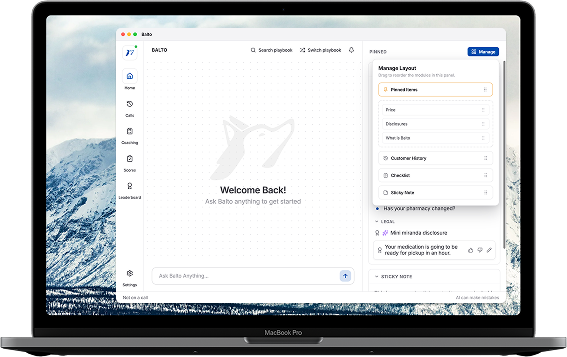
Tools like Balto coach agents in real time, reducing errors, improving compliance, and increasing confidence on the floor.
Intelligent routing and triage
AI can analyze incoming requests and route them to the right agent or department based on sentiment, intent, or complexity.
This means customers spend less time waiting and repeating themselves, and more time getting help from someone who can actually solve their problem.
Sentiment analysis and quality monitoring
AI tools can detect tone, keywords, and emotional cues to flag high-risk interactions or unhappy customers in real time.
This gives supervisors a chance to step in early and provides a richer picture of customer experience than surveys alone.
Personalized automation
AI-powered chatbots and virtual assistants can handle simple questions instantly and escalate more complex issues to human agents with full context.
Done right, this creates a faster, more seamless experience that still feels human.
Smarter training and coaching
AI can identify patterns in agent performance, like which phrases lead to higher CSAT or where call drop-offs happen, and use that data to drive targeted coaching.
That means better outcomes for agents and better service for customers.
Technology isn’t a silver bullet, but when it’s paired with great agents and smart processes, it’s a powerful lever for transforming customer experience.
Delivering a Better Contact Center Customer Experience Starts Now
The contact center experience you deliver to customers has a direct impact on their satisfaction, loyalty, and revenue.
Basically, your contact center is your company’s front line.
By investing in the right tools, training your agents, measuring what matters, and removing friction across channels, you can turn every interaction into an opportunity to build trust and meaningful growth.
And you don’t have to do it alone.
FAQs
Call center customer experience refers to how customers feel about the service they receive during phone-based support interactions.
It includes factors like wait time, agent professionalism, issue resolution, and overall satisfaction during a call.
Contact center customer experience is typically measured using key performance metrics such as CSAT (Customer Satisfaction Score), NPS (Net Promoter Score), CES (Customer Effort Score), FCR (First Contact Resolution), and AHT (Average Handle Time).
Together, these metrics provide a data-backed view of how customers perceive their interactions.
The contact center is often the main point of contact between a business and its customers.
A positive experience increases satisfaction, retention, and loyalty, while a negative one can lead to churn, poor reviews, and lost revenue.
You can improve call center customer experience by training agents effectively, reducing wait times, increasing first-call resolution, and equipping agents with tools that support personalization and real-time guidance.
Investing in agent well-being also directly impacts performance and customer satisfaction.
Call center experience focuses primarily on voice-based service, while contact center experience spans multiple digital and voice channels, including chat, email, and social media.
Contact center customer experience requires seamless integration and consistency across platforms, while call center customer experience centers around phone call quality and resolution.
When customers feel heard, helped, and respected during their interactions, they’re more likely to return and recommend your brand.
A great contact center experience builds trust and strengthens long-term relationships, making loyalty more likely and churn less frequent.
Contact center customer experience spans voice calls, live chat, email, SMS, social media platforms, and sometimes self-service portals or chatbots.
All of these touchpoints contribute to how customers perceive your support.
Agents who feel supported, trained, and empowered are more engaged and more effective.
A positive work environment leads to lower stress, better performance, and higher-quality customer interactions, all of which contribute to a better contact center experience for your customers.
AI tools can assist agents in real time, automate repetitive tasks, analyze sentiment, and streamline routing — all of which lead to faster, more accurate, and more personalized service.
Automation reduces friction, while AI elevates the human touch with smart insights.
Liked What You Read? See Balto in Action.
Balto helps leading contact centers turn insights into outcomes, in real time. Book a live demo to discover how our AI powers better conversations, coaching, and conversions.